← Open CollectionsPublic-domain source library
Velvet Courts: Ottoman, Persian and Italian Silk
Velvet is woven pile, and pile is expensive, so from the fourteenth century it became the fabric of courts. Italian weavers built lattices and pomegranates and put a family’s arms into the cloth; Ottoman workshops at Bursa worked chintamani spots and carnations for the divan; Safavid Kashan and Yazd wove narrative figures and the most colourful velvets ever made. Two heights of pile, uncut loops, voided ground and metal thread are the vocabulary, and the pattern is sculpted rather than printed.
Original means the unmodified digital file supplied by the linked archive, not an upscaled or reconstructed image. Sign in for free downloads. Studio uses a working preview up to 2048 px.
CC0 · Public domain · late 1500s
Brocaded velvet with medallions in ogival lattice
Silk velvet brocaded with gilt and silver thread, of the quality worn at the Topkapi Palace on ceremonial occasions. The ogival lattice organises medallions into an unbroken field.
× px · Unmodified source file
Small archival scan: best for reference and screen use, not large prints.
Open in StudioSource & licensing
- Creator / date
- Turkey, Istanbul or Bursa, maker unknown · late 1500s
- Source credit
- The Cleveland Museum of Art, 2001.3. Open Access.
- Usage notes
- Released by the Cleveland Museum of Art under CC0 1.0. Credit to the museum is encouraged; CC0 does not imply endorsement.
- Original file
- × px · JPG · 0.0 MB
- Source checked
- 2026-11-04 · editorial approval separate
CC0 · Public domain · late 1500s
Brocaded velvet cushion cover with carnations
An Ottoman cushion cover for a royal divan, identified by the lappets at top and bottom. Carnations and tulips in metal thread, on a ground of cut silk pile.
× px · Unmodified source file
Small archival scan: best for reference and screen use, not large prints.
Open in StudioSource & licensing
- Creator / date
- Turkey, Bursa, maker unknown · late 1500s
- Source credit
- The Cleveland Museum of Art, 1984.27. Open Access.
- Usage notes
- Released by the Cleveland Museum of Art under CC0 1.0. Credit to the museum is encouraged; CC0 does not imply endorsement.
- Original file
- × px · JPG · 0.0 MB
- Source checked
- 2026-11-04 · editorial approval separate
CC0 · Public domain · 1525–75
Brocaded velvet cushion cover with crescents
One of the earliest and finest Ottoman cushion covers to survive, its crescents inscribed with smaller crescents. The design is graphic before it is decorative.
× px · Unmodified source file
Small archival scan: best for reference and screen use, not large prints.
Open in StudioSource & licensing
- Creator / date
- Turkey, Istanbul or Bursa, maker unknown · 1525–75
- Source credit
- The Cleveland Museum of Art, 2009.282. Open Access.
- Usage notes
- Released by the Cleveland Museum of Art under CC0 1.0. Credit to the museum is encouraged; CC0 does not imply endorsement.
- Original file
- × px · JPG · 0.0 MB
- Source checked
- 2026-11-04 · editorial approval separate
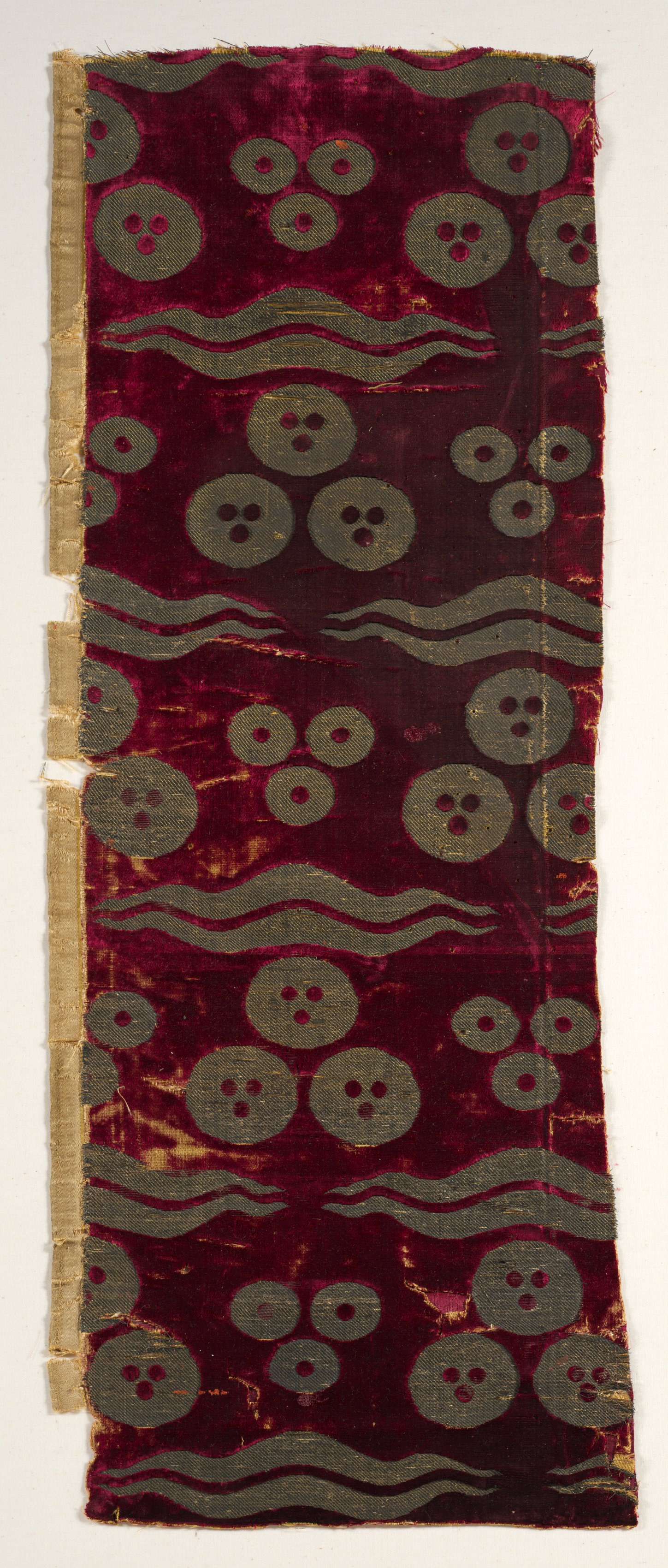
CC0 · Public domain · late 1400s
Brocaded velvet with chintamani design
An early Ottoman velvet from the imperial workshops at Bursa, then the silk capital of the empire. The chintamani motif, three spots and two wavy lines, was a dynastic emblem.
× px · Unmodified source file
Small archival scan: best for reference and screen use, not large prints.
Open in StudioSource & licensing
- Creator / date
- Turkey, Bursa, maker unknown · late 1400s
- Source credit
- The Cleveland Museum of Art, 1943.313. Open Access.
- Usage notes
- Released by the Cleveland Museum of Art under CC0 1.0. Credit to the museum is encouraged; CC0 does not imply endorsement.
- Original file
- × px · JPG · 0.0 MB
- Source checked
- 2026-11-04 · editorial approval separate
CC0 · Public domain · 1575–1625
Brocaded Velvet Panel with Italianate Pattern
Four fabric widths preserved together, unusual for any culture. The gilt pattern mixes Turkish ogival lattices with Italian motifs, evidence of a shared luxury market.
× px · Unmodified source file
Small archival scan: best for reference and screen use, not large prints.
Open in StudioSource & licensing
- Creator / date
- Turkey, Istanbul or Bursa, maker unknown · 1575–1625
- Source credit
- The Cleveland Museum of Art, 2003.3. Open Access.
- Usage notes
- Released by the Cleveland Museum of Art under CC0 1.0. Credit to the museum is encouraged; CC0 does not imply endorsement.
- Original file
- × px · JPG · 0.0 MB
- Source checked
- 2026-11-04 · editorial approval separate
CC0 · Public domain · 1550–99
Tent panel of a dragon slayer
A Safavid velvet from the reign of Shah Tahmasp, one of the most colourful ever woven. Dragons, figures and flowers are built from pile-warp substitution, colour by colour.
× px · Unmodified source file
Small archival scan: best for reference and screen use, not large prints.
Open in StudioSource & licensing
- Creator / date
- Iran, Yazd (?), Safavid period, maker unknown · 1550–99
- Source credit
- The Cleveland Museum of Art, 1948.205. Open Access.
- Usage notes
- Released by the Cleveland Museum of Art under CC0 1.0. Credit to the museum is encouraged; CC0 does not imply endorsement.
- Original file
- × px · JPG · 0.0 MB
- Source checked
- 2026-11-04 · editorial approval separate
CC0 · Public domain · 1550–99
Velvet Fragment, Khusrau Sees Shirin Bathing
An episode from Nizami’s Khamsa, in which the lovers Khusrau and Shirin first set eyes on each other. Persian velvets are almost unique in depicting narrative figures at this scale.
× px · Unmodified source file
Small archival scan: best for reference and screen use, not large prints.
Open in StudioSource & licensing
- Creator / date
- Iran, Kashan, Safavid period, maker unknown · 1550–99
- Source credit
- The Cleveland Museum of Art, 1944.499.a. Open Access.
- Usage notes
- Released by the Cleveland Museum of Art under CC0 1.0. Credit to the museum is encouraged; CC0 does not imply endorsement.
- Original file
- × px · JPG · 0.0 MB
- Source checked
- 2026-11-04 · editorial approval separate
CC0 · Public domain · 1550–99
Khusrau Surprising Shirin While Bathing
The companion fragment to the same scene, separated in the museum’s cataloguing from its pair. Together they show how a single design was divided when a textile was cut up.
× px · Unmodified source file
Small archival scan: best for reference and screen use, not large prints.
Open in StudioSource & licensing
- Creator / date
- Iran, Kashan, Safavid period, maker unknown · 1550–99
- Source credit
- The Cleveland Museum of Art, 1944.499. Open Access.
- Usage notes
- Released by the Cleveland Museum of Art under CC0 1.0. Credit to the museum is encouraged; CC0 does not imply endorsement.
- Original file
- × px · JPG · 0.0 MB
- Source checked
- 2026-11-04 · editorial approval separate
CC0 · Public domain · mid-1500s
Fragment with falconer and attendant in animated lattice
A falconry scene in velvet, celebrated for its draftsmanship: the drawing survives the translation into pile. A lattice of vines carries the figures and keeps them in rhythm.
× px · Unmodified source file
Small archival scan: best for reference and screen use, not large prints.
Open in StudioSource & licensing
- Creator / date
- Iran, Kashan, Safavid period, maker unknown · mid-1500s
- Source credit
- The Cleveland Museum of Art, 1944.239. Open Access.
- Usage notes
- Released by the Cleveland Museum of Art under CC0 1.0. Credit to the museum is encouraged; CC0 does not imply endorsement.
- Original file
- × px · JPG · 0.0 MB
- Source checked
- 2026-11-04 · editorial approval separate
CC0 · Public domain · 1625–50
Velvet panel with four youths smelling flowers
Four single figures with little modelling, a style pioneered by the painter Riza Abbasi and taken up by textile designers. European influence is visible in the pose and the flowers.
× px · Unmodified source file
Small archival scan: best for reference and screen use, not large prints.
Open in StudioSource & licensing
- Creator / date
- Iran, Isfahan or Yazd, Safavid period, maker unknown · 1625–50
- Source credit
- The Cleveland Museum of Art, 1932.42. Open Access.
- Usage notes
- Released by the Cleveland Museum of Art under CC0 1.0. Credit to the museum is encouraged; CC0 does not imply endorsement.
- Original file
- × px · JPG · 0.0 MB
- Source checked
- 2026-11-04 · editorial approval separate
CC0 · Public domain · late 1200s or earlier
Velvet with gold discs
One of the earliest known velvets, brocaded with gilt-metal thread. Before the technology spread west, silk velvet was essentially an Iranian achievement.
× px · Unmodified source file
Small archival scan: best for reference and screen use, not large prints.
Open in StudioSource & licensing
- Creator / date
- Iran, probably Tabriz, Ilkhanid period, maker unknown · late 1200s or earlier
- Source credit
- The Cleveland Museum of Art, 1918.225. Open Access.
- Usage notes
- Released by the Cleveland Museum of Art under CC0 1.0. Credit to the museum is encouraged; CC0 does not imply endorsement.
- Original file
- × px · JPG · 0.0 MB
- Source checked
- 2026-11-04 · editorial approval separate
CC0 · Public domain · 1450–1500
Four-color Velvet with Medici Armorial in Rosettes
A Florentine polychrome velvet carrying the Medici arms, crimson balls on a yellow ground. Luxury cloth was also a coat of arms: a family could be read across a room.
× px · Unmodified source file
Small archival scan: best for reference and screen use, not large prints.
Open in StudioSource & licensing
- Creator / date
- Italy, Florence, maker unknown · 1450–1500
- Source credit
- The Cleveland Museum of Art, 1943.67. Open Access.
- Usage notes
- Released by the Cleveland Museum of Art under CC0 1.0. Credit to the museum is encouraged; CC0 does not imply endorsement.
- Original file
- × px · JPG · 0.0 MB
- Source checked
- 2026-11-04 · editorial approval separate
CC0 · Public domain · 1450–1500
Velvet with Pomegranate Pattern
Three heights of cut crimson pile with gold-thread loops, around the pomegranate motif that dominated European luxury textiles for a century. The pattern is sculpted as much as woven.
× px · Unmodified source file
Small archival scan: best for reference and screen use, not large prints.
Open in StudioSource & licensing
- Creator / date
- Italy, Florence, maker unknown · 1450–1500
- Source credit
- The Cleveland Museum of Art, 1973.20. Open Access.
- Usage notes
- Released by the Cleveland Museum of Art under CC0 1.0. Credit to the museum is encouraged; CC0 does not imply endorsement.
- Original file
- × px · JPG · 0.0 MB
- Source checked
- 2026-11-04 · editorial approval separate
CC0 · Public domain · 1450–1500
Silk Velvet with Gold in Pomegranate Pattern
A velvet in two heights of cut pile with uncut loops, and gold thread worked through it. Varying pile heights creates a relief that catches the light like carving.
× px · Unmodified source file
Small archival scan: best for reference and screen use, not large prints.
Open in StudioSource & licensing
- Creator / date
- Italy, possibly Florence, maker unknown · 1450–1500
- Source credit
- The Cleveland Museum of Art, 1940.596. Open Access.
- Usage notes
- Released by the Cleveland Museum of Art under CC0 1.0. Credit to the museum is encouraged; CC0 does not imply endorsement.
- Original file
- × px · JPG · 0.0 MB
- Source checked
- 2026-11-04 · editorial approval separate
CC0 · Public domain · 1450–1500
Two-color Velvet with Gold in a Double Curved Lattice
Polychrome patterned velvet, a technique not achieved in Italy before the late fourteenth century. The double curved lattice is the structure the pattern hangs on.
× px · Unmodified source file
Small archival scan: best for reference and screen use, not large prints.
Open in StudioSource & licensing
- Creator / date
- Italy, possibly Florence, maker unknown · 1450–1500
- Source credit
- The Cleveland Museum of Art, 1929.82. Open Access.
- Usage notes
- Released by the Cleveland Museum of Art under CC0 1.0. Credit to the museum is encouraged; CC0 does not imply endorsement.
- Original file
- × px · JPG · 0.0 MB
- Source checked
- 2026-11-04 · editorial approval separate
CC0 · Public domain · c. 1575–1600
Procurator’s Velvet Stole
A Venetian stole in alto e basso velvet, the two-height weave that gives the pattern its modelling. Venetian law required senators to wear colour, which made the fabric itself a statement of office.
× px · Unmodified source file
Small archival scan: best for reference and screen use, not large prints.
Open in StudioSource & licensing
- Creator / date
- Italy, Venice, maker unknown · c. 1575–1600
- Source credit
- The Cleveland Museum of Art, 1942.829. Open Access.
- Usage notes
- Released by the Cleveland Museum of Art under CC0 1.0. Credit to the museum is encouraged; CC0 does not imply endorsement.
- Original file
- × px · JPG · 0.0 MB
- Source checked
- 2026-11-04 · editorial approval separate
CC0 · Public domain · early 1400s
Polychrome Velvet
An early Italian polychrome velvet in cut and voided weave. The voided areas are left as flat ground, so the pile draws the design up out of the cloth.
× px · Unmodified source file
Small archival scan: best for reference and screen use, not large prints.
Open in StudioSource & licensing
- Creator / date
- Italy, early 15th century, maker unknown · early 1400s
- Source credit
- The Cleveland Museum of Art, 1940.370. Open Access.
- Usage notes
- Released by the Cleveland Museum of Art under CC0 1.0. Credit to the museum is encouraged; CC0 does not imply endorsement.
- Original file
- × px · JPG · 0.0 MB
- Source checked
- 2026-11-04 · editorial approval separate
CC0 · Public domain · 1400–1450
Velvet Fragment
Cut, uncut, voided and brocaded velvet in one fragment: a sample sheet of everything the weaving could do. These distinctions are what determined price and status.
× px · Unmodified source file
Small archival scan: best for reference and screen use, not large prints.
Open in StudioSource & licensing
- Creator / date
- Italy, Padua and Venice, maker unknown · 1400–1450
- Source credit
- The Cleveland Museum of Art, 1918.310. Open Access.
- Usage notes
- Released by the Cleveland Museum of Art under CC0 1.0. Credit to the museum is encouraged; CC0 does not imply endorsement.
- Original file
- × px · JPG · 0.0 MB
- Source checked
- 2026-11-04 · editorial approval separate
Public-domain status is reported by the linked source and may vary by jurisdiction. Check the source record for your intended use. No exclusive rights or Visual Bounty marketplace license are offered for these images.