← Open CollectionsPublic-domain source library
Floating World: Japanese Woodblock Prints
The print workshops of Edo and Osaka produced images for a market that wanted the city: actors caught at the instant of a role, courtesans between engagements, and famous places seen in rain, snow or moonlight. These fifteen sheets, made between the 1760s and 1850s, trace the woodblock print from hand-coloured line to the full-colour registration that made landscape printing possible. Hokusai’s Fuji, Hiroshige’s Tōkaidō and Sharaku’s actors all depend on the same craft: a block for the keyline, a block for each colour, and paper pressed by hand.
Original means the unmodified digital file supplied by the linked archive, not an upscaled or reconstructed image. Sign in for free downloads. Studio uses a working preview up to 2048 px.
CC0 · Public domain · early 1830s
South Wind, Clear Sky, from Thirty-Six Views of Mount Fuji
The south wind of late summer clears the sky and leaves Fuji bare of snow for a few weeks, the mountain turning the reddish brown that gave this design its nickname, Red Fuji. Hokusai made it for Thirty-Six Views of Mount Fuji, begun in 1829, in which the mountain is seen from every distance and season.
3400 × 2329 px · Unmodified source file
Open in StudioSource & licensing
- Creator / date
- Katsushika Hokusai (Japanese, 1760–1849) · early 1830s
- Source credit
- The Cleveland Museum of Art, 1930.189. Open Access.
- Usage notes
- Released by the Cleveland Museum of Art under CC0 1.0. Credit to the museum is encouraged; CC0 does not imply endorsement.
- Original file
- 3400 × 2329 px · JPG · 0.0 MB
- Source checked
- 2026-11-04 · editorial approval separate
CC0 · Public domain · 1835–36
Poem by Minamoto no Muneyuki from the series One Hundred Poems by One Hundred Poets Explained by the Nurse
Hokusai’s series imagines a confused nurse trying to illustrate the classical poems of the Hyakunin Isshu, so that each poem becomes a domestic scene. The verse here mourns a mountain village in winter, where the grass and the people who cut it have both gone.
3400 × 2363 px · Unmodified source file
Open in StudioSource & licensing
- Creator / date
- Katsushika Hokusai (Japanese, 1760–1849) · 1835–36
- Source credit
- The Cleveland Museum of Art, 1985.327. Open Access.
- Usage notes
- Released by the Cleveland Museum of Art under CC0 1.0. Credit to the museum is encouraged; CC0 does not imply endorsement.
- Original file
- 3400 × 2363 px · JPG · 0.0 MB
- Source checked
- 2026-11-04 · editorial approval separate
CC0 · Public domain · 1857
Sudden Shower over Shin-Ōhashi Bridge and Atake, from One Hundred Famous Views of Edo
A summer squall crosses the Sumida River and walkers fold under umbrellas and straw mats. Published two years after the earthquake and fire of 1855, the print shows the rebuilt Great Bridge, and its slanting grey bands became one of the most copied designs in Japanese printmaking.
2285 × 3400 px · Unmodified source file
Open in StudioSource & licensing
- Creator / date
- Utagawa Hiroshige (Japanese, 1797–1858) · 1857
- Source credit
- The Cleveland Museum of Art, 1921.318. Open Access.
- Usage notes
- Released by the Cleveland Museum of Art under CC0 1.0. Credit to the museum is encouraged; CC0 does not imply endorsement.
- Original file
- 2285 × 3400 px · JPG · 0.0 MB
- Source checked
- 2026-11-04 · editorial approval separate
CC0 · Public domain · 1857
The Moon-Viewing Promontory, from One Hundred Views of Famous Places in Edo
The viewer stands among pines at the end of a moon-viewing party, looking through a doorway at a figure whose silhouette shows through the paper of a sliding screen, only a hem trailing into view.
2317 × 3400 px · Unmodified source file
Open in StudioSource & licensing
- Creator / date
- Utagawa Hiroshige (Japanese, 1797–1858) · 1857
- Source credit
- The Cleveland Museum of Art, 1985.320. Open Access.
- Usage notes
- Released by the Cleveland Museum of Art under CC0 1.0. Credit to the museum is encouraged; CC0 does not imply endorsement.
- Original file
- 2317 × 3400 px · JPG · 0.0 MB
- Source checked
- 2026-11-04 · editorial approval separate
CC0 · Public domain · 1833
Driving Rain at Shōno, from Fifty-Three Stations of the Tokaidō
Three printing blocks produced the three greys that set the bamboo thickets back into the distance, while rain falls in hard diagonals across travellers running for cover. The sheet belongs to the Fifty-Three Stations of the Tōkaidō.
3400 × 2270 px · Unmodified source file
Open in StudioSource & licensing
- Creator / date
- Utagawa Hiroshige (Japanese, 1797–1858) · 1833
- Source credit
- The Cleveland Museum of Art, 1948.306. Open Access.
- Usage notes
- Released by the Cleveland Museum of Art under CC0 1.0. Credit to the museum is encouraged; CC0 does not imply endorsement.
- Original file
- 3400 × 2270 px · JPG · 0.0 MB
- Source checked
- 2026-11-04 · editorial approval separate
CC0 · Public domain · c. 1835
Night Rain at Karasaki, from Eight Views of Ōmi
The sacred Karasaki pine on Lake Biwa had its branches propped on bamboo poles to shelter the shrine beneath. Hiroshige renders the rain as fine vertical lines against the dark water.
3400 × 2288 px · Unmodified source file
Open in StudioSource & licensing
- Creator / date
- Utagawa Hiroshige (Japanese, 1797–1858) · c. 1835
- Source credit
- The Cleveland Museum of Art, 1985.312. Open Access.
- Usage notes
- Released by the Cleveland Museum of Art under CC0 1.0. Credit to the museum is encouraged; CC0 does not imply endorsement.
- Original file
- 3400 × 2288 px · JPG · 0.0 MB
- Source checked
- 2026-11-04 · editorial approval separate
CC0 · Public domain · c. 1848–50
Nissaka: The Night-Weeping Stone at Sayo no Nakayama, from the series The Fifty-Three Stations of the Tōkaidō
A steep pass on the Tōkaidō road, named for a stone said to weep at night, with travellers hauling a palanquin up the slope toward it.
3400 × 2202 px · Unmodified source file
Open in StudioSource & licensing
- Creator / date
- Utagawa Hiroshige (Japanese, 1797–1858) · c. 1848–50
- Source credit
- The Cleveland Museum of Art, 1985.323. Open Access.
- Usage notes
- Released by the Cleveland Museum of Art under CC0 1.0. Credit to the museum is encouraged; CC0 does not imply endorsement.
- Original file
- 3400 × 2202 px · JPG · 0.0 MB
- Source checked
- 2026-11-04 · editorial approval separate
CC0 · Public domain · 1794
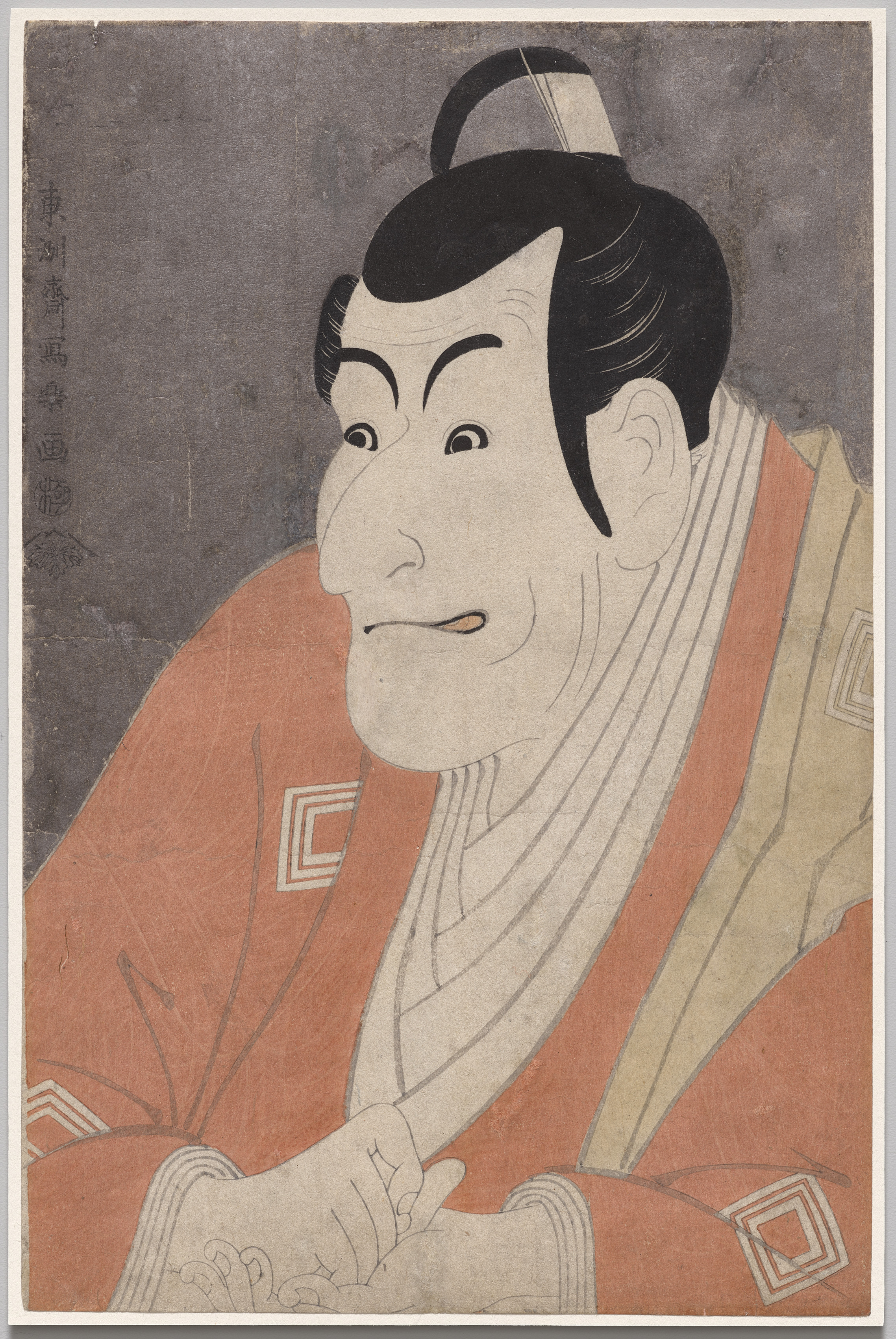
Ichikawa Ebizō IV (Danjurō) as Takemura Sadanoshin in The Loving Wife's Parti-Colored Reins
An actor image, yakusha-e, from Sharaku’s brief two-year career: the face is pushed forward and the expression held at the instant it is most legible. The actor plays a father permitted to perform opposite his daughter one last time before she is banished for a forbidden love affair.
2276 × 3400 px · Unmodified source file
Open in StudioSource & licensing
- Creator / date
- Tōshūsai Sharaku (Japanese, active 1794–95) · 1794
- Source credit
- The Cleveland Museum of Art, 1930.205. Open Access.
- Usage notes
- Released by the Cleveland Museum of Art under CC0 1.0. Credit to the museum is encouraged; CC0 does not imply endorsement.
- Original file
- 2276 × 3400 px · JPG · 0.0 MB
- Source checked
- 2026-11-04 · editorial approval separate
CC0 · Public domain · 1794
Otani Tokuji I as the Retainer Sodesuke in "Flowering Irises: A Soga Vendetta of the Bunroku Era"
Sharaku set his actor portraits against a dark ground flecked with mica so that the figure seems to step out of the paper. Ōtani Tokuji I appears in a vendetta play about two brothers pursuing the man who murdered their father.
2401 × 3400 px · Unmodified source file
Open in StudioSource & licensing
- Creator / date
- Tōshūsai Sharaku (Japanese, active 1794–95) · 1794
- Source credit
- The Cleveland Museum of Art, 1930.206. Open Access.
- Usage notes
- Released by the Cleveland Museum of Art under CC0 1.0. Credit to the museum is encouraged; CC0 does not imply endorsement.
- Original file
- 2401 × 3400 px · JPG · 0.0 MB
- Source checked
- 2026-11-04 · editorial approval separate
CC0 · Public domain · 1832
Arashi Rikan II as Danshichi Kurōbei in "Mirror of Naniwa: The Summer Festival"
A Kabuki print from Osaka, where actor images recorded performances in the city’s theatres. Arashi Rikan II plays an otokodate, a street tough who defends those without power, in a play still staged today.
2357 × 3400 px · Unmodified source file
Open in StudioSource & licensing
- Creator / date
- Shunbaisai Hokuei (Japanese, d. 1837) · 1832
- Source credit
- The Cleveland Museum of Art, 1980.84. Open Access.
- Usage notes
- Released by the Cleveland Museum of Art under CC0 1.0. Credit to the museum is encouraged; CC0 does not imply endorsement.
- Original file
- 2357 × 3400 px · JPG · 0.0 MB
- Source checked
- 2026-11-04 · editorial approval separate
CC0 · Public domain · c. 1793
The Flirtatious Type, from Ten Types in the Physiognomy of Women
Utamaro’s bijinga, pictures of beautiful people, worked as a kind of taxonomy: this sheet belongs to a series that sorts women into ten temperaments and invites the viewer to compare them.
2274 × 3400 px · Unmodified source file
Open in StudioSource & licensing
- Creator / date
- Kitagawa Utamaro (Japanese, c. 1754–1806) · c. 1793
- Source credit
- The Cleveland Museum of Art, 1930.218. Open Access.
- Usage notes
- Released by the Cleveland Museum of Art under CC0 1.0. Credit to the museum is encouraged; CC0 does not imply endorsement.
- Original file
- 2274 × 3400 px · JPG · 0.0 MB
- Source checked
- 2026-11-04 · editorial approval separate
CC0 · Public domain · c. 1798
Takigawa of the Ōgiya from the series A Selection of Eastern Beauties
The courtesan Takigawa of the Ōgiya, the House of Fans, smokes tobacco, a fashion of eighteenth-century Edo. Prints of celebrated beauties sold the way fashion plates did, and buyers followed the hairstyles and gestures they showed.
2345 × 3400 px · Unmodified source file
Open in StudioSource & licensing
- Creator / date
- Kitagawa Utamaro (Japanese, c. 1754–1806) · c. 1798
- Source credit
- The Cleveland Museum of Art, 1930.219. Open Access.
- Usage notes
- Released by the Cleveland Museum of Art under CC0 1.0. Credit to the museum is encouraged; CC0 does not imply endorsement.
- Original file
- 2345 × 3400 px · JPG · 0.0 MB
- Source checked
- 2026-11-04 · editorial approval separate
CC0 · Public domain · 1767
Righteousness, from The Five Virtues
Two young male courtesans read by candlelight, one holding the illustrated drawing manual published by Tachibana Morikuni in 1720, with a poem set above. Harunobu’s full-colour prints, nishiki-e, established the palette later Edo printmaking built on.
2619 × 3400 px · Unmodified source file
Open in StudioSource & licensing
- Creator / date
- Suzuki Harunobu (Japanese, 1724–1770) · 1767
- Source credit
- The Cleveland Museum of Art, 1985.307. Open Access.
- Usage notes
- Released by the Cleveland Museum of Art under CC0 1.0. Credit to the museum is encouraged; CC0 does not imply endorsement.
- Original file
- 2619 × 3400 px · JPG · 0.0 MB
- Source checked
- 2026-11-04 · editorial approval separate
CC0 · Public domain · c. 1770
Courtesan Dreaming of her Childhood
A pillar print, hashira-e, made to hang on the wooden post of a room. The tall narrow format follows a courtesan’s dream of being led away from her family as a girl, her hand in a man’s.
659 × 3400 px · Unmodified source file
Open in StudioSource & licensing
- Creator / date
- Suzuki Harunobu (Japanese, 1724–1770) · c. 1770
- Source credit
- The Cleveland Museum of Art, 1920.516. Open Access.
- Usage notes
- Released by the Cleveland Museum of Art under CC0 1.0. Credit to the museum is encouraged; CC0 does not imply endorsement.
- Original file
- 659 × 3400 px · JPG · 0.0 MB
- Source checked
- 2026-11-04 · editorial approval separate
CC0 · Public domain · c. 1796–97
Women Beside a Stream Chasing Fireflies
Women and children chase fireflies along a stream at dusk, sleeves lifting in the breeze; the movement is carried almost entirely by the fall of fabric.
2216 × 3400 px · Unmodified source file
Open in StudioSource & licensing
- Creator / date
- Chōbunsai Eishi (Japanese, 1756–1829) · c. 1796–97
- Source credit
- The Cleveland Museum of Art, 1920.523. Open Access.
- Usage notes
- Released by the Cleveland Museum of Art under CC0 1.0. Credit to the museum is encouraged; CC0 does not imply endorsement.
- Original file
- 2216 × 3400 px · JPG · 0.0 MB
- Source checked
- 2026-11-04 · editorial approval separate
Public-domain status is reported by the linked source and may vary by jurisdiction. Check the source record for your intended use. No exclusive rights or Visual Bounty marketplace license are offered for these images.