← Open CollectionsPublic-domain source library
Cast: South Asian Bronze Deities
In South Asia a bronze image was not a representation but a body the deity could enter. Cast by the lost-wax method, a figure was destroyed in the making, so each is unique; it was then consecrated, dressed, fed and carried in procession. The Chola workshops of Tamil Nadu in the ninth to twelfth centuries produced the most refined of these images, and the same technology travelled to Kashmir, Nepal and Angkor. These twelve bronzes are shown as sculpture and as what they were built to be: objects of worship with a job to do.
Original means the unmodified digital file supplied by the linked archive, not an upscaled or reconstructed image. Sign in for free downloads. Studio uses a working preview up to 2048 px.
CC0 · Public domain · 1000s
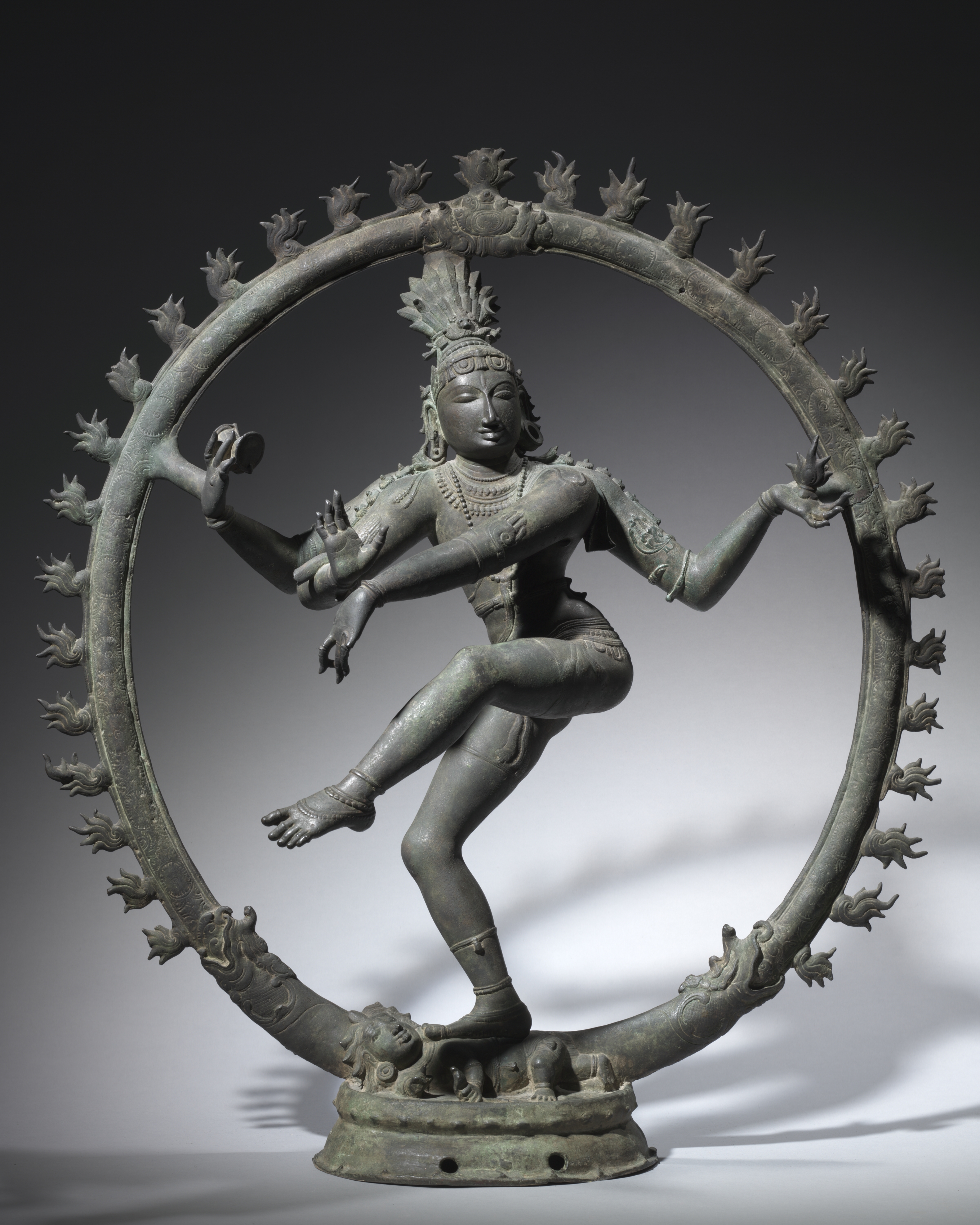
Nataraja, Shiva as the Lord of Dance
One of the most celebrated sculptural forms in Indian art: Shiva as Nataraja, Lord of the Dance, balancing on one foot inside a ring of flame. The pose condenses Hindu metaphysics, and Chola founders cast it in bronze by the lost-wax method.
3039 × 3400 px · Unmodified source file
Open in StudioSource & licensing
- Creator / date
- South India, Tamil Nadu, Chola period (900–1200s), maker unknown · 1000s
- Source credit
- The Cleveland Museum of Art, 1930.331. Open Access.
- Usage notes
- Released by the Cleveland Museum of Art under CC0 1.0. Credit to the museum is encouraged; CC0 does not imply endorsement.
- Original file
- 3039 × 3400 px · JPG · 0.0 MB
- Source checked
- 2026-11-04 · editorial approval separate
CC0 · Public domain · 800s
Shiva and Parvati
A Pala-period bronze of Shiva with Parvati from Bengal, made when the region’s monasteries were the centre of Buddhist and Hindu metalwork in eastern India.
3400 × 3166 px · Unmodified source file
Open in StudioSource & licensing
- Creator / date
- East India, Bengal, Pala period, 9th Century, maker unknown · 800s
- Source credit
- The Cleveland Museum of Art, 1964.50. Open Access.
- Usage notes
- Released by the Cleveland Museum of Art under CC0 1.0. Credit to the museum is encouraged; CC0 does not imply endorsement.
- Original file
- 3400 × 3166 px · JPG · 0.0 MB
- Source checked
- 2026-11-04 · editorial approval separate
CC0 · Public domain · c. 1020–40
Shiva and Parvati
Chola bronzes of the ninth to twelfth centuries are among the most celebrated works of the Indian tradition, and this Shiva with Parvati shows why: the modelling is soft enough that the metal reads as flesh.
3079 × 3400 px · Unmodified source file
Open in StudioSource & licensing
- Creator / date
- South India, Tamil Nadu, Viracholapuram, maker unknown · c. 1020–40
- Source credit
- The Cleveland Museum of Art, 1961.94. Open Access.
- Usage notes
- Released by the Cleveland Museum of Art under CC0 1.0. Credit to the museum is encouraged; CC0 does not imply endorsement.
- Original file
- 3079 × 3400 px · JPG · 0.0 MB
- Source checked
- 2026-11-04 · editorial approval separate
CC0 · Public domain · c. 1000
Shiva as Lord of Music
After creating the world, Shiva manifested in many forms, each emphasising a different aspect of his character. As Lord of Music he holds the instrument and the beat that orders time.
2375 × 3400 px · Unmodified source file
Open in StudioSource & licensing
- Creator / date
- South India, Tamil Nadu, Chola period (900-13th century), maker unknown · c. 1000
- Source credit
- The Cleveland Museum of Art, 1971.117. Open Access.
- Usage notes
- Released by the Cleveland Museum of Art under CC0 1.0. Credit to the museum is encouraged; CC0 does not imply endorsement.
- Original file
- 2375 × 3400 px · JPG · 0.0 MB
- Source checked
- 2026-11-04 · editorial approval separate
CC0 · Public domain · c. 1050
Trident with Shiva as Half-Woman (Ardhanarishvara)
The trident, Shiva’s weapon, encircles his own form, split into male right and female left. Ardhanarishvara states that the god contains both principles, and the bronze turns the idea into a single silhouette.
2907 × 3400 px · Unmodified source file
Open in StudioSource & licensing
- Creator / date
- South India, Tamil Nadu, Chola period (900-13th Century), maker unknown · c. 1050
- Source credit
- The Cleveland Museum of Art, 1969.117. Open Access.
- Usage notes
- Released by the Cleveland Museum of Art under CC0 1.0. Credit to the museum is encouraged; CC0 does not imply endorsement.
- Original file
- 2907 × 3400 px · JPG · 0.0 MB
- Source checked
- 2026-11-04 · editorial approval separate
CC0 · Public domain · 900s–1000s
Kali
Parvati, Shiva’s female aspect, has her own cycle of myths and emanates into fiercer forms. As Kali she is the goddess who destroys what must be destroyed.
2350 × 3400 px · Unmodified source file
Open in StudioSource & licensing
- Creator / date
- South India, Tamil Nadu, Chola period (900-13th century), maker unknown · 900s–1000s
- Source credit
- The Cleveland Museum of Art, 1956.7. Open Access.
- Usage notes
- Released by the Cleveland Museum of Art under CC0 1.0. Credit to the museum is encouraged; CC0 does not imply endorsement.
- Original file
- 2350 × 3400 px · JPG · 0.0 MB
- Source checked
- 2026-11-04 · editorial approval separate
CC0 · Public domain · c. 1070
Ganesha
Ganesha, the god of wealth and abundance, removes obstacles and protects his worshippers. The elephant head and generous body are theological arguments rather than caricature.
2058 × 3400 px · Unmodified source file
Open in StudioSource & licensing
- Creator / date
- South India, Medieval period, Chola dynasty(10th-13th century), maker unknown · c. 1070
- Source credit
- The Cleveland Museum of Art, 1970.62. Open Access.
- Usage notes
- Released by the Cleveland Museum of Art under CC0 1.0. Credit to the museum is encouraged; CC0 does not imply endorsement.
- Original file
- 2058 × 3400 px · JPG · 0.0 MB
- Source checked
- 2026-11-04 · editorial approval separate
CC0 · Public domain · c. 950
Goddess Holding a Lotus
Sculptors worked to an ideal rather than from a model: a figure worthy of holding the sacred presence of a goddess, built on a system of proportions and attributes. Chola, about 950.
2366 × 3400 px · Unmodified source file
Open in StudioSource & licensing
- Creator / date
- South India, Tamil Nadu, Chola period (800s–1200s), maker unknown · c. 950
- Source credit
- The Cleveland Museum of Art, 1984.2. Open Access.
- Usage notes
- Released by the Cleveland Museum of Art under CC0 1.0. Credit to the museum is encouraged; CC0 does not imply endorsement.
- Original file
- 2366 × 3400 px · JPG · 0.0 MB
- Source checked
- 2026-11-04 · editorial approval separate
CC0 · Public domain · 1100s–1200s
Shiva Saint: Manikkavachakar
Between the seventh and ninth centuries a movement of South Indian saints experienced direct mystical encounters with Shiva, and their poems are still sung. This is a portrait bronze of one of them.
2505 × 3400 px · Unmodified source file
Open in StudioSource & licensing
- Creator / date
- South India, Tamil Nadu, 12th-13th century, maker unknown · 1100s–1200s
- Source credit
- The Cleveland Museum of Art, 1967.148. Open Access.
- Usage notes
- Released by the Cleveland Museum of Art under CC0 1.0. Credit to the museum is encouraged; CC0 does not imply endorsement.
- Original file
- 2505 × 3400 px · JPG · 0.0 MB
- Source checked
- 2026-11-04 · editorial approval separate
CC0 · Public domain · 1000s
Goddess Siddhalakshmi
The five-headed, ten-armed goddess described in Kashmiri ritual handbooks is white and rests on a lotus and on Shiva. Few such images survive, because Kashmir’s temples were destroyed.
2483 × 3400 px · Unmodified source file
Open in StudioSource & licensing
- Creator / date
- India, Kashmir, maker unknown · 1000s
- Source credit
- The Cleveland Museum of Art, 1982.47. Open Access.
- Usage notes
- Released by the Cleveland Museum of Art under CC0 1.0. Credit to the museum is encouraged; CC0 does not imply endorsement.
- Original file
- 2483 × 3400 px · JPG · 0.0 MB
- Source checked
- 2026-11-04 · editorial approval separate
CC0 · Public domain · 1000s
Goddess Uma
Uma, a mother goddess, turns toward her consort Shiva. This image belongs to a companion pair, and the gilt bronze with stone inlay is characteristic of Nepalese workshops.
2733 × 3400 px · Unmodified source file
Open in StudioSource & licensing
- Creator / date
- Nepal, maker unknown · 1000s
- Source credit
- The Cleveland Museum of Art, 1982.49. Open Access.
- Usage notes
- Released by the Cleveland Museum of Art under CC0 1.0. Credit to the museum is encouraged; CC0 does not imply endorsement.
- Original file
- 2733 × 3400 px · JPG · 0.0 MB
- Source checked
- 2026-11-04 · editorial approval separate
CC0 · Public domain · 1300s
Kubjika–Navatman
The tantric goddess Kubjika sits on the bent knee of her consort Navatman, a form of Shiva, in gilt bronze set with semiprecious stones.
3400 × 3225 px · Unmodified source file
Open in StudioSource & licensing
- Creator / date
- Nepal, maker unknown · 1300s
- Source credit
- The Cleveland Museum of Art, 1984.3. Open Access.
- Usage notes
- Released by the Cleveland Museum of Art under CC0 1.0. Credit to the museum is encouraged; CC0 does not imply endorsement.
- Original file
- 3400 × 3225 px · JPG · 0.0 MB
- Source checked
- 2026-11-04 · editorial approval separate
CC0 · Public domain · 1010–80
Kneeling Male Figure
A kneeling figure with hands raised in adoration, the third eye marking his identification with Shiva. Made at Angkor under the Baphuon, when Khmer bronze casting matched anything in India.
2264 × 3400 px · Unmodified source file
Open in StudioSource & licensing
- Creator / date
- Cambodia, Angkor, Baphuon, Baphuon period, 1000s, maker unknown · 1010–80
- Source credit
- The Cleveland Museum of Art, 1978.8. Open Access.
- Usage notes
- Released by the Cleveland Museum of Art under CC0 1.0. Credit to the museum is encouraged; CC0 does not imply endorsement.
- Original file
- 2264 × 3400 px · JPG · 0.0 MB
- Source checked
- 2026-11-04 · editorial approval separate
Public-domain status is reported by the linked source and may vary by jurisdiction. Check the source record for your intended use. No exclusive rights or Visual Bounty marketplace license are offered for these images.