← Open CollectionsPublic-domain source library
Drypoint and Shadow: Rembrandt’s Etchings
Rembrandt made roughly 290 etchings and pulled them himself, which is why they feel less like reproductions than like drawings that happened to be printed. He worked on copper with a needle through wax, then bit the plate in acid, and increasingly finished the image in drypoint — a burin dragged through the metal that holds ink in a soft ridge and wears flat after a few dozen impressions. These twelve sheets come from every part of his activity: the great landscape prints, the portraits of friends and sitters, the passion scenes he returned to and reworked, and three self-portraits that track the changing distance between the man and the image.
Original means the unmodified digital file supplied by the linked archive, not an upscaled or reconstructed image. Sign in for free downloads. Studio uses a working preview up to 2048 px.
CC0 · Public domain · c. 1649
The Hundred Guilder Print
Christ teaching, and around him everything the teaching is for: the sick carried in on stretchers, mothers with children, beggars, and the rich young man turning away. Rembrandt built the scene out of separate passages of etching and drypoint and never quite dissolved them into one space, which is part of why it holds the eye.
3400 × 2466 px · Unmodified source file
Open in StudioSource & licensing
- Creator / date
- Rembrandt van Rijn (Dutch, 1606–1669) · c. 1649
- Source credit
- The Cleveland Museum of Art, 1942.757. Open Access.
- Usage notes
- Released by the Cleveland Museum of Art under CC0 1.0. Credit to the museum is encouraged; CC0 does not imply endorsement.
- Original file
- 3400 × 2466 px · JPG · 0.0 MB
- Source checked
- 2026-11-05 · editorial approval separate
CC0 · Public domain · 1641
The Windmill
A post mill on a rampart above the water, sails just catching the light while a heavy sky builds behind it. Almost everything in the print is contrast: sunlit masonry against deep shadow, the mill’s wooden body against the flat sky.
3400 × 2444 px · Unmodified source file
Open in StudioSource & licensing
- Creator / date
- Rembrandt van Rijn (Dutch, 1606–1669) · 1641
- Source credit
- The Cleveland Museum of Art, 1941.657. Open Access.
- Usage notes
- Released by the Cleveland Museum of Art under CC0 1.0. Credit to the museum is encouraged; CC0 does not imply endorsement.
- Original file
- 3400 × 2444 px · JPG · 0.0 MB
- Source checked
- 2026-11-05 · editorial approval separate
CC0 · Public domain · 1643
The Three Trees
Three trees on a low rise, a rain-swept sky, the towers of Amsterdam small on the horizon and lightning in the distance. It is Rembrandt’s largest landscape etching, and the one where weather carries most of the drama.
3400 × 2583 px · Unmodified source file
Open in StudioSource & licensing
- Creator / date
- Rembrandt van Rijn (Dutch, 1606–1669) · 1643
- Source credit
- The Cleveland Museum of Art, 1966.334. Open Access.
- Usage notes
- Released by the Cleveland Museum of Art under CC0 1.0. Credit to the museum is encouraged; CC0 does not imply endorsement.
- Original file
- 3400 × 2583 px · JPG · 0.0 MB
- Source checked
- 2026-11-05 · editorial approval separate
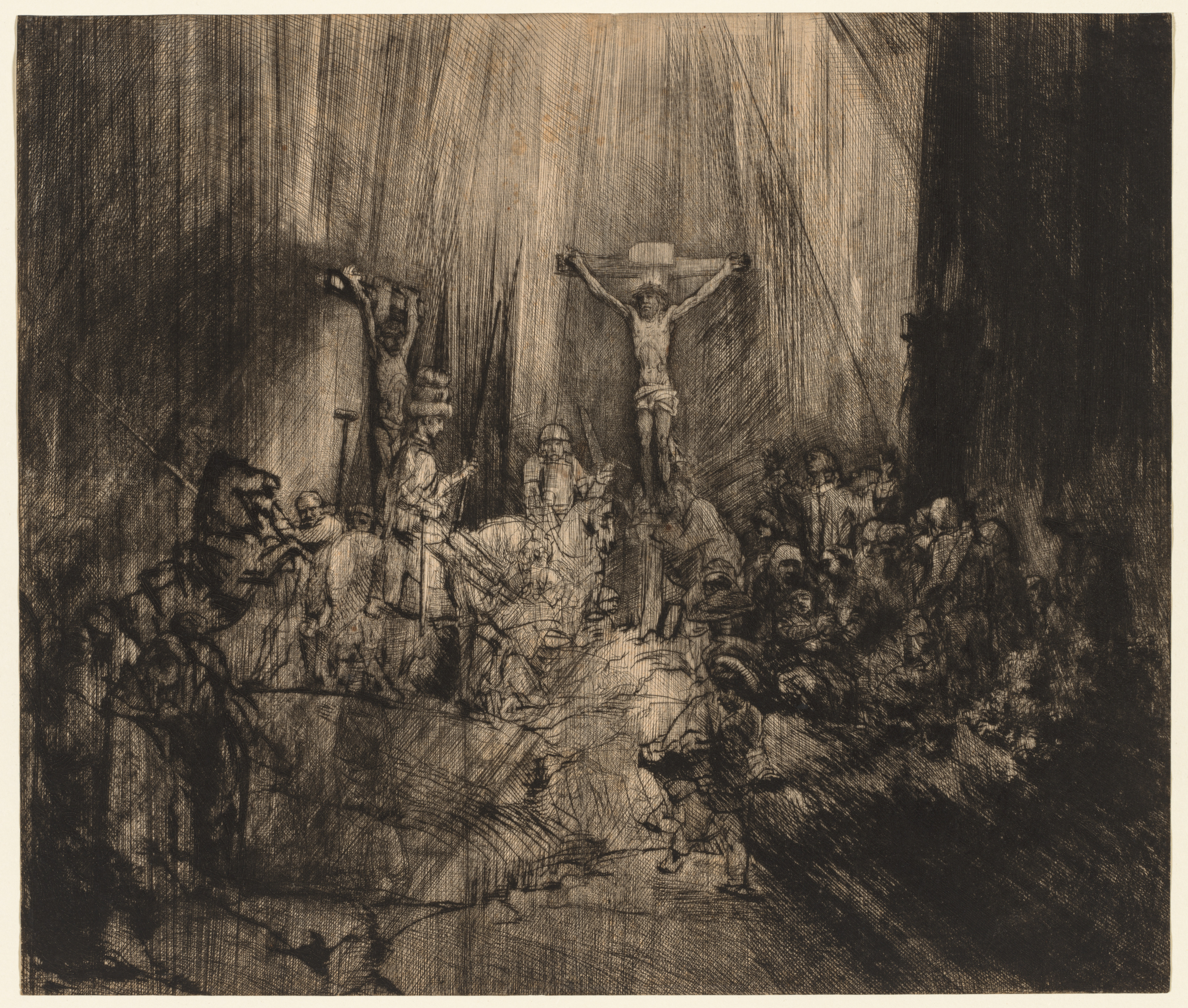
CC0 · Public domain · 1653-c.1660
The Three Crosses
Christ between the two thieves as the light fails, with soldiers, mourners and onlookers pressing in from both sides. Rembrandt reworked the drypoint plate over years, scraping figures away and deepening the darkness until the open scene of the early impressions closed into near night.
3400 × 2886 px · Unmodified source file
Open in StudioSource & licensing
- Creator / date
- Rembrandt van Rijn (Dutch, 1606–1669) · 1653-c.1660
- Source credit
- The Cleveland Museum of Art, 1959.241. Open Access.
- Usage notes
- Released by the Cleveland Museum of Art under CC0 1.0. Credit to the museum is encouraged; CC0 does not imply endorsement.
- Original file
- 3400 × 2886 px · JPG · 0.0 MB
- Source checked
- 2026-11-05 · editorial approval separate
CC0 · Public domain · 1655
Ecce Homo: Christ Presented to the People
Pilate presents Christ to the crowd from a high step in a vast pillared hall. Drawn almost entirely in drypoint, the plate wore down quickly under printing, so each surviving impression records a slightly different state of a very fragile surface.
3400 × 2711 px · Unmodified source file
Open in StudioSource & licensing
- Creator / date
- Rembrandt van Rijn (Dutch, 1606–1669) · 1655
- Source credit
- The Cleveland Museum of Art, 2006.155. Open Access.
- Usage notes
- Released by the Cleveland Museum of Art under CC0 1.0. Credit to the museum is encouraged; CC0 does not imply endorsement.
- Original file
- 3400 × 2711 px · JPG · 0.0 MB
- Source checked
- 2026-11-05 · editorial approval separate
CC0 · Public domain · 1648
Self-Portrait Drawing at a Window
Rembrandt shows himself at work, etching needle in hand, looking out from the window where the plate was being worked. The window supplies the light; the hand and the drawing board are left deliberately loose.
2893 × 3400 px · Unmodified source file
Open in StudioSource & licensing
- Creator / date
- Rembrandt van Rijn (Dutch, 1606–1669) · 1648
- Source credit
- The Cleveland Museum of Art, 1934.350. Open Access.
- Usage notes
- Released by the Cleveland Museum of Art under CC0 1.0. Credit to the museum is encouraged; CC0 does not imply endorsement.
- Original file
- 2893 × 3400 px · JPG · 0.0 MB
- Source checked
- 2026-11-05 · editorial approval separate
CC0 · Public domain · 1639
Self-Portrait Leaning on a Stone Sill
Rembrandt in velvet, soft cap and curled hair, leaning on a stone ledge as though he were a gentleman of an earlier century. The pose quotes the self-portraits of Raphael and Titian, which he knew chiefly through prints.
2711 × 3400 px · Unmodified source file
Open in StudioSource & licensing
- Creator / date
- Rembrandt van Rijn (Dutch, 1606–1669) · 1639
- Source credit
- The Cleveland Museum of Art, 1940.879. Open Access.
- Usage notes
- Released by the Cleveland Museum of Art under CC0 1.0. Credit to the museum is encouraged; CC0 does not imply endorsement.
- Original file
- 2711 × 3400 px · JPG · 0.0 MB
- Source checked
- 2026-11-05 · editorial approval separate
CC0 · Public domain · 1647
Jan Six
The Amsterdam patrician and poet Jan Six stands at an open window with a book, looking away from the viewer rather than at them. Light comes in from the left and picks out the hand, the page and the edge of the cloak; everything else is allowed to go dark.
2733 × 3400 px · Unmodified source file
Open in StudioSource & licensing
- Creator / date
- Rembrandt van Rijn (Dutch, 1606–1669) · 1647
- Source credit
- The Cleveland Museum of Art, 1961.80. Open Access.
- Usage notes
- Released by the Cleveland Museum of Art under CC0 1.0. Credit to the museum is encouraged; CC0 does not imply endorsement.
- Original file
- 2733 × 3400 px · JPG · 0.0 MB
- Source checked
- 2026-11-05 · editorial approval separate
CC0 · Public domain · 1658
Woman Bathing Her Feet in a Brook
A woman steps into shallow water and lifts her skirt, looking down at the surface rather than out at us. Long read as Hendrickje Stoffels, Rembrandt’s companion, the figure is drawn as much with the needle as bitten with acid, so the line stays soft.
1773 × 3400 px · Unmodified source file
Open in StudioSource & licensing
- Creator / date
- Rembrandt van Rijn (Dutch, 1606–1669) · 1658
- Source credit
- The Cleveland Museum of Art, 1997.4. Open Access.
- Usage notes
- Released by the Cleveland Museum of Art under CC0 1.0. Credit to the museum is encouraged; CC0 does not imply endorsement.
- Original file
- 1773 × 3400 px · JPG · 0.0 MB
- Source checked
- 2026-11-05 · editorial approval separate
CC0 · Public domain · 1656
Jan Lutma, Goldsmith
The elderly Amsterdam silversmith Jan Lutma sits in a carved chair with a piece of his own silverwork in one hand and his tools on the table. The sitter is sunk in shadow while the metal and the hammer handles do the reflecting.
2643 × 3400 px · Unmodified source file
Open in StudioSource & licensing
- Creator / date
- Rembrandt van Rijn (Dutch, 1606–1669) · 1656
- Source credit
- The Cleveland Museum of Art, 1963.85. Open Access.
- Usage notes
- Released by the Cleveland Museum of Art under CC0 1.0. Credit to the museum is encouraged; CC0 does not imply endorsement.
- Original file
- 2643 × 3400 px · JPG · 0.0 MB
- Source checked
- 2026-11-05 · editorial approval separate
CC0 · Public domain · 1639
Death of the Virgin
Mary lies dying in a dim, heavily curtained room while the apostles crowd the bed, one supporting her, others praying or covering their faces. The composition looks back to Dürer’s woodcut of the same subject, but the room here is Dutch: cloth, timber, and a single pooled light.
2697 × 3400 px · Unmodified source file
Open in StudioSource & licensing
- Creator / date
- Rembrandt van Rijn (Dutch, 1606–1669) · 1639
- Source credit
- The Cleveland Museum of Art, 1926.467. Open Access.
- Usage notes
- Released by the Cleveland Museum of Art under CC0 1.0. Credit to the museum is encouraged; CC0 does not imply endorsement.
- Original file
- 2697 × 3400 px · JPG · 0.0 MB
- Source checked
- 2026-11-05 · editorial approval separate
CC0 · Public domain · 1634
The Angel Appearing to the Shepherds
The annunciation to the shepherds at night: the sky breaks open above a field of sleeping men and cattle. Rembrandt staged a single sudden light against heavy biting and left most of the ground in darkness.
2891 × 3400 px · Unmodified source file
Open in StudioSource & licensing
- Creator / date
- Rembrandt van Rijn (Dutch, 1606–1669) · 1634
- Source credit
- The Cleveland Museum of Art, 1949.115. Open Access.
- Usage notes
- Released by the Cleveland Museum of Art under CC0 1.0. Credit to the museum is encouraged; CC0 does not imply endorsement.
- Original file
- 2891 × 3400 px · JPG · 0.0 MB
- Source checked
- 2026-11-05 · editorial approval separate
Public-domain status is reported by the linked source and may vary by jurisdiction. Check the source record for your intended use. No exclusive rights or Visual Bounty marketplace license are offered for these images.