← Open Collections

Public-domain source library

Natural Structures

In nineteenth-century Britain, photography opened new ways to study plants as both specimens and compositions. William Henry Fox Talbot laid ferns on sensitised paper in 1839, Anna Atkins printed algae in Prussian blue, and Frank Meadow Sutcliffe photographed ferns within their woodland surroundings. Together, these works contrast the clarity of a plant silhouette with the layered textures of a living landscape.

Explore the works and their histories through the original collections and institutions that preserve them. Source images are available to download, with creative exploration in Studio.

Works
26
Sources
5
Makers
15
Dates
late 1870s · 1852–54 · 1843–53
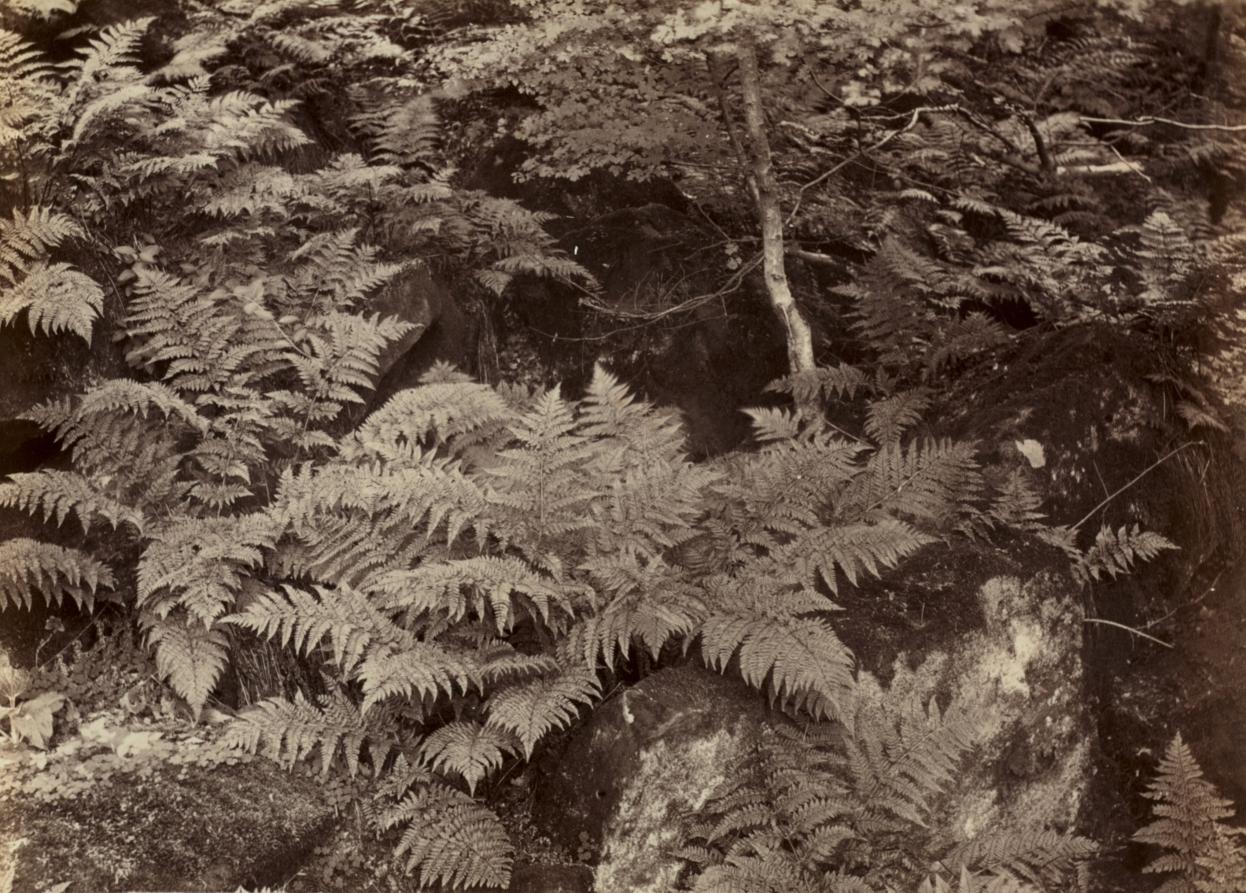
Fern fronds overlap among rocks and woodland undergrowth in Frank Meadow Sutcliffe’s late-1870s albumen print. Rather than isolating a single specimen, the photograph records plants in their surroundings, bringing the fine divisions of their leaves into conversation with rough stone and deep shadow.

late 1870s

Untitled (Fern Study)

Fern fronds overlap among rocks and woodland undergrowth in Frank Meadow Sutcliffe’s late-1870s albumen print. Rather than isolating a single specimen, the photograph records plants in their surroundings, bringing the fine divisions of their leaves into conversation with rough stone and deep shadow.

3400 × 2437 px

Open in Studio
Source & credits
Creator / date
Frank Meadow Sutcliffe (British, 1853–1941) · late 1870s
Source credit
Untitled (Fern Study), late 1870s. Frank Meadow Sutcliffe (British, 1853–1941). Albumen print; image: 14.2 x 19.8 cm (5 9/16 x 7 13/16 in.); matted: 30.6 x 35.6 cm (12 1/16 x 14 in.). The Cleveland Museum of Art, John L. Severance Fund, 1988.238
Original file
3400 × 2437 px · JPG · 4.8 MB
Additional museum file
Full-resolution TIFF master ↗ (large file)
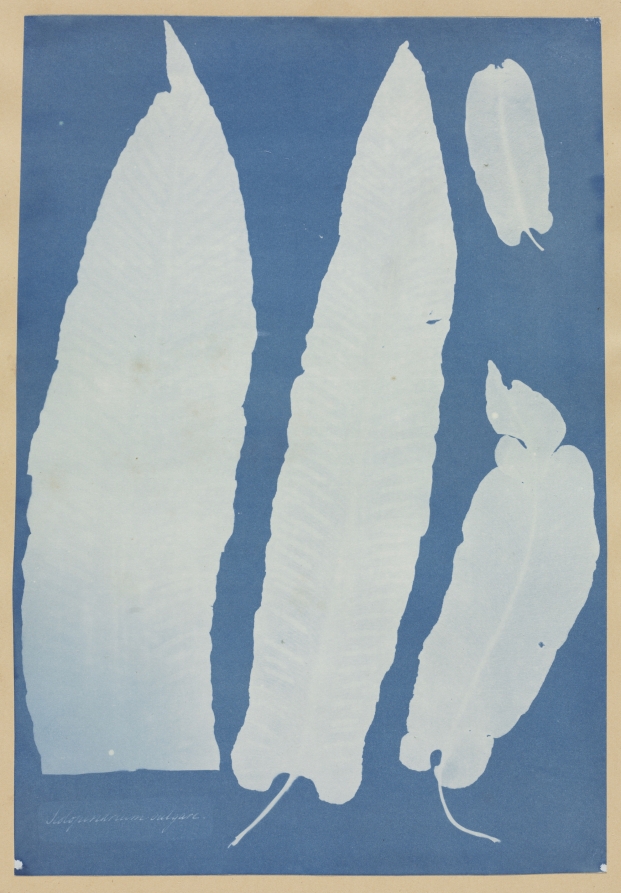
Anna Atkins made this study of hart’s-tongue fern in 1852–54 using cyanotype, a process that produces pale silhouettes against blue. Placing plants directly on light-sensitive paper allowed her to record their contours without a camera. Her botanical work helped establish photography as a tool for scientific illustration.

1852–54

Scolopendrium Vulgare

Anna Atkins made this study of hart’s-tongue fern in 1852–54 using cyanotype, a process that produces pale silhouettes against blue. Placing plants directly on light-sensitive paper allowed her to record their contours without a camera. Her botanical work helped establish photography as a tool for scientific illustration.

2365 × 3400 px

Open in Studio
Source & credits
Creator / date
Anna Atkins (British, 1799–1871) · 1852–54
Source credit
Scolopendrium Vulgare, 1852–54. Anna Atkins (British, 1799–1871). Cyanotype; image: 33.3 x 22.9 cm (13 1/8 x 9 in.); paper: 48.3 x 37.5 cm (19 x 14 3/4 in.); matted: 61 x 50.8 cm (24 x 20 in.). The Cleveland Museum of Art, Norman O. Stone and Ella A. Stone Memorial Fund, 1995.26
Original file
2365 × 3400 px · JPG · 5.0 MB
Additional museum file
Full-resolution TIFF master ↗ (large file)
A plate from Anna Atkins’s Photographs of British Algae, the first book illustrated with photographs, made by laying the plant directly on sensitised paper. The specimen prints itself in white against Prussian blue: part record, part composition.

1843–53

Photographs of British Algae: Cyanotype Impressions

A plate from Anna Atkins’s Photographs of British Algae, the first book illustrated with photographs, made by laying the plant directly on sensitised paper. The specimen prints itself in white against Prussian blue: part record, part composition.

3266 × 4000 px

Open in Studio
Source & credits
Creator / date
Anna Atkins · 1843–53
Source credit
Gilman Collection, Purchase, The Horace W. Goldsmith Foundation Gift, through Joyce and Robert Menschel, 2005. Open Access image, The Metropolitan Museum of Art.
Original file
3266 × 4000 px · JPG
Atkins placed a single red alga on cyanotype paper and let the sun draw its branching structure. Every filament is held in place by contact alone, so the image carries the plant’s exact form without an intervening hand.

ca. 1853

Rhodomenia Polycarpa

Atkins placed a single red alga on cyanotype paper and let the sun draw its branching structure. Every filament is held in place by contact alone, so the image carries the plant’s exact form without an intervening hand.

3266 × 4000 px

Open in Studio
Source & credits
Creator / date
Anna Atkins · ca. 1853
Source credit
Gilman Collection, Purchase, The Horace W. Goldsmith Foundation Gift, through Joyce and Robert Menschel, 2005. Open Access image, The Metropolitan Museum of Art.
Original file
3266 × 4000 px · JPG
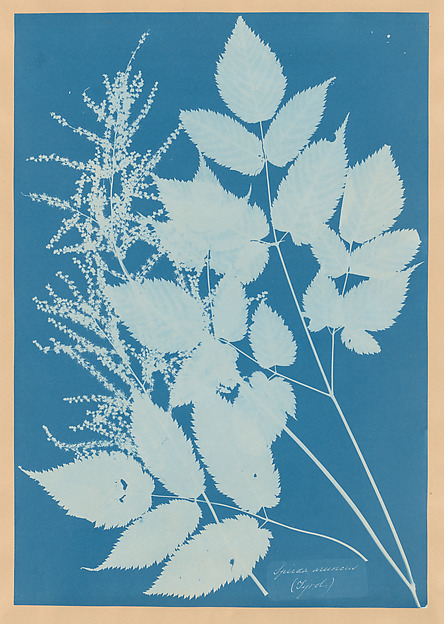
A flowering sprig from the Tyrol is pressed flat and printed by light, its leaves reduced to overlapping silhouettes. Atkins made these later plates from borrowed specimens, extending her study well beyond the British coast.

1851–54

Spiraea aruncus (Tyrol)

A flowering sprig from the Tyrol is pressed flat and printed by light, its leaves reduced to overlapping silhouettes. Atkins made these later plates from borrowed specimens, extending her study well beyond the British coast.

2779 × 3907 px

Open in Studio
Source & credits
Creator / date
Anna Atkins · 1851–54
Source credit
Purchase, Alfred Stieglitz Society Gifts, 2004. Open Access image, The Metropolitan Museum of Art.
Original file
2779 × 3907 px · JPG
One of William Henry Fox Talbot’s earliest salted paper prints: a fern laid on paper and exposed to daylight. The process he called photogenic drawing turned the specimen into an image without a camera.

1839

Felce

One of William Henry Fox Talbot’s earliest salted paper prints: a fern laid on paper and exposed to daylight. The process he called photogenic drawing turned the specimen into an image without a camera.

2938 × 3802 px

Open in Studio
Source & credits
Creator / date
William Henry Fox Talbot · 1839
Source credit
Harris Brisbane Dick Fund, 1936. Open Access image, The Metropolitan Museum of Art.
Original file
2938 × 3802 px · JPG
Two specimens share a single sheet: a fern above, an alga below, each printed by contact. Talbot’s pairing reads as a comparison, setting the structure of a land plant against that of a seaweed.

1839

1. Felce. 2. Alga

Two specimens share a single sheet: a fern above, an alga below, each printed by contact. Talbot’s pairing reads as a comparison, setting the structure of a land plant against that of a seaweed.

2819 × 3466 px

Open in Studio
Source & credits
Creator / date
William Henry Fox Talbot · 1839
Source credit
Harris Brisbane Dick Fund, 1936. Open Access image, The Metropolitan Museum of Art.
Original file
2819 × 3466 px · JPG
An albumen print made through a glass negative rather than by contact, so the fern appears with its own shadows and depth. The shift from silhouette to photograph turns the plant from a flat outline into an object in space.

1855–60

[Botanical Specimen: Fern]

An albumen print made through a glass negative rather than by contact, so the fern appears with its own shadows and depth. The shift from silhouette to photograph turns the plant from a flat outline into an object in space.

2785 × 3870 px

Open in Studio
Source & credits
Creator / date
Maker unknown · 1855–60
Source credit
Gift of Simon Lowinsky, in memory of his uncle, Herbert Jonas, 2003. Open Access image, The Metropolitan Museum of Art.
Original file
2785 × 3870 px · JPG
Zeshin painted in lacquer rather than ink, which gives the weed a slight relief and a low sheen. He was the nineteenth century's great exponent of the medium, choosing subjects the material could flatter: water, black lacquer surfaces and weed.

19th century

Seaweed

Zeshin painted in lacquer rather than ink, which gives the weed a slight relief and a low sheen. He was the nineteenth century's great exponent of the medium, choosing subjects the material could flatter: water, black lacquer surfaces and weed.

1884 × 2343 px

Open in Studio
Source & credits
Creator / date
Shibata Zeshin (Japanese, 1807–1891) · 19th century
Source credit
The Howard Mansfield Collection, Purchase, Rogers Fund, 1936. The Metropolitan Museum of Art.
Original file
1884 × 2343 px · JPG
A surimono — the privately commissioned woodblock print made for poetry clubs — turned here to a study of seaweed varieties. Surimono were printed on the finest paper and with the most expensive pigments of any ukiyo-e work.

19th century

Various Seaweed

A surimono — the privately commissioned woodblock print made for poetry clubs — turned here to a study of seaweed varieties. Surimono were printed on the finest paper and with the most expensive pigments of any ukiyo-e work.

3501 × 3871 px

Open in Studio
Source & credits
Creator / date
Kubo Shunman (Japanese, 1757–1820) · 19th century
Source credit
H. O. Havemeyer Collection, Bequest of Mrs. H. O. Havemeyer, 1929. The Metropolitan Museum of Art.
Original file
3501 × 3871 px · JPG
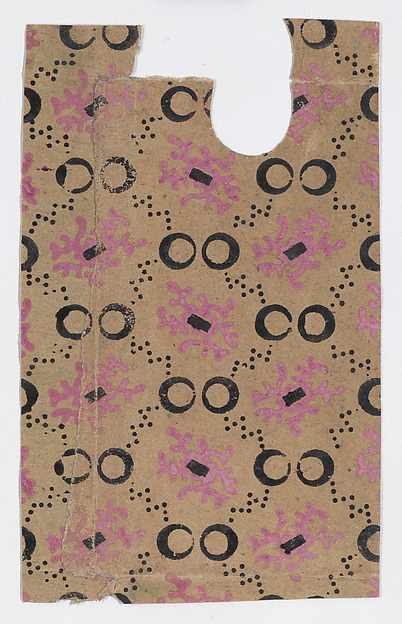
A decorative sheet building a repeat from coral branches and circles. Stock like this was made for wallpaper, ceramics and printed textiles: natural history abstracted until it tiles.

19th century

Sheet with pattern of coral and circles

A decorative sheet building a repeat from coral branches and circles. Stock like this was made for wallpaper, ceramics and printed textiles: natural history abstracted until it tiles.

1199 × 1861 px

Open in Studio
Source & credits
Creator / date
Anonymous, European · 19th century
Source credit
Harris Brisbane Dick Fund, 1939. The Metropolitan Museum of Art.
Original file
1199 × 1861 px · JPG
An American watercolour of shells laid in seaweed: two natural structures set against each other, the hard spiral and the wet, branching frond. Nims painted in the mid-nineteenth century, when drawing from specimens was taught as a discipline in its own right.

1800s

Shells in Seaweed

An American watercolour of shells laid in seaweed: two natural structures set against each other, the hard spiral and the wet, branching frond. Nims painted in the mid-nineteenth century, when drawing from specimens was taught as a discipline in its own right.

3400 × 2422 px

Open in Studio
Source & credits
Creator / date
Mary Altha Nims (American, 1817–1907) · 1800s
Source credit
Gift of Richard Seymour Bayham. Cleveland Museum of Art.
Original file
3400 × 2422 px · JPG
One of a pair of hanging scrolls in ink on paper. Rinkyo painted the seaweed as a few wet strokes that spread into the paper, letting the material behave like the subject rather than describing it line by line.

1573–1615

Fish and Seaweed

One of a pair of hanging scrolls in ink on paper. Rinkyo painted the seaweed as a few wet strokes that spread into the paper, letting the material behave like the subject rather than describing it line by line.

1485 × 3400 px

Open in Studio
Source & credits
Creator / date
Rinkyo (Japanese, 16th century) · 1573–1615
Source credit
Mr. and Mrs. William H. Marlatt Fund. Cleveland Museum of Art.
Original file
1485 × 3400 px · JPG
The pair to the scroll beside it, showing how Momoyama ink painters arranged rock, fish and weed as a single rhythm across two hanging surfaces. Scrolls of this kind were hung for a season and changed with it.

1573–1615

Fish and Rock; Fish and Seaweed

The pair to the scroll beside it, showing how Momoyama ink painters arranged rock, fish and weed as a single rhythm across two hanging surfaces. Scrolls of this kind were hung for a season and changed with it.

3022 × 3400 px

Open in Studio
Source & credits
Creator / date
Rinkyo (Japanese, 16th century) · 1573–1615
Source credit
Mr. and Mrs. William H. Marlatt Fund. Cleveland Museum of Art.
Original file
3022 × 3400 px · JPG
A plate from Deliciae Naturae Selectae, Georg Wolfgang Knorr’s great selection of shells, corals and fossils, engraved and hand-coloured in Nuremberg between 1751 and 1767. The specimens are arranged so that spiral form, not species, drives the composition.

1751–67

Plate A. XIII, from "Deliciae Naturae Selectae"

A plate from Deliciae Naturae Selectae, Georg Wolfgang Knorr’s great selection of shells, corals and fossils, engraved and hand-coloured in Nuremberg between 1751 and 1767. The specimens are arranged so that spiral form, not species, drives the composition.

× px

Small archival scan: best for reference and screen use, not large prints.

Open in Studio
Source & credits
Creator / date
Georg Wolfgang Knorr · 1751–67
Source credit
Bequest of Mrs. Charles Wrightsman, 2019. The Metropolitan Museum of Art.
Original file
Dimensions unavailable · JPG
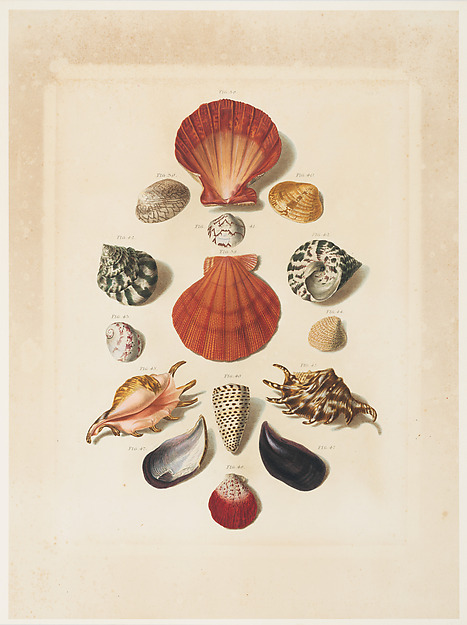
The companion plate to A. XIII, with a different arrangement of the same shell types. Knorr grouped specimens by shape, which is why the pages read as pattern studies as much as natural history.

1751–67

Plate A. XII, from "Deliciae Naturae Selectae"

The companion plate to A. XIII, with a different arrangement of the same shell types. Knorr grouped specimens by shape, which is why the pages read as pattern studies as much as natural history.

× px

Small archival scan: best for reference and screen use, not large prints.

Open in Studio
Source & credits
Creator / date
Georg Wolfgang Knorr · 1751–67
Source credit
Bequest of Mrs. Charles Wrightsman, 2019. The Metropolitan Museum of Art.
Original file
Dimensions unavailable · JPG
Regenfuss engraved his shells from life in Augsburg and coloured the plates himself, so each copy of the book carries his hand at one remove. The arrangement owes as much to the cabinet of curiosities as to natural history: shells were set down in rows so that their whorls, ribs and spires could be compared as forms.

1758

Plate V, from "Choix de Coquillages et de Crustacés"

Regenfuss engraved his shells from life in Augsburg and coloured the plates himself, so each copy of the book carries his hand at one remove. The arrangement owes as much to the cabinet of curiosities as to natural history: shells were set down in rows so that their whorls, ribs and spires could be compared as forms.

× px

Small archival scan: best for reference and screen use, not large prints.

Open in Studio
Source & credits
Creator / date
Franz Michael Regenfuss · 1758
Source credit
Bequest of Mrs. Charles Wrightsman, 2019. The Metropolitan Museum of Art.
Original file
Dimensions unavailable · JPG
A second plate from the same volume, where crustaceans are drawn beside the shells they shared a shoreline with. Eighteenth-century collectors read these pages as portraits, and the plates were often cut out and framed separately from the text they belonged to.

1758

Plate IX, from "Choix de Coquillages et de Crustacés"

A second plate from the same volume, where crustaceans are drawn beside the shells they shared a shoreline with. Eighteenth-century collectors read these pages as portraits, and the plates were often cut out and framed separately from the text they belonged to.

× px

Small archival scan: best for reference and screen use, not large prints.

Open in Studio
Source & credits
Creator / date
Franz Michael Regenfuss · 1758
Source credit
Bequest of Mrs. Charles Wrightsman, 2019. The Metropolitan Museum of Art.
Original file
Dimensions unavailable · JPG
Atkins laid a rounded green alga directly on sensitised paper and let the sun record its edge, producing a disc of Prussian blue with a paler rim where the plant lifted away from the sheet. She issued her seaweed volumes part by part to subscribers, which made her among the first to publish a book illustrated with photographs.

ca. 1853

Codium bursa

Atkins laid a rounded green alga directly on sensitised paper and let the sun record its edge, producing a disc of Prussian blue with a paler rim where the plant lifted away from the sheet. She issued her seaweed volumes part by part to subscribers, which made her among the first to publish a book illustrated with photographs.

× px

Small archival scan: best for reference and screen use, not large prints.

Open in Studio
Source & credits
Creator / date
Anna Atkins · ca. 1853
Source credit
Gilman Collection, Purchase, The Horace W. Goldsmith Foundation Gift, through Joyce and Robert Menschel. The Metropolitan Museum of Art.
Original file
Dimensions unavailable · JPG
The long thongs of Himanthalia trail across the page like a drawing made with a single stroke, though nothing was drawn: the specimen itself blocked the light. Atkins labelled each plate in her own hand with the alga’s Latin name, so the scientific record and the image were produced by the same person in the same act.

ca. 1853

Himanthalia lorea

The long thongs of Himanthalia trail across the page like a drawing made with a single stroke, though nothing was drawn: the specimen itself blocked the light. Atkins labelled each plate in her own hand with the alga’s Latin name, so the scientific record and the image were produced by the same person in the same act.

× px

Small archival scan: best for reference and screen use, not large prints.

Open in Studio
Source & credits
Creator / date
Anna Atkins · ca. 1853
Source credit
Gilman Collection, Purchase, The Horace W. Goldsmith Foundation Gift, through Joyce and Robert Menschel. The Metropolitan Museum of Art.
Original file
Dimensions unavailable · JPG
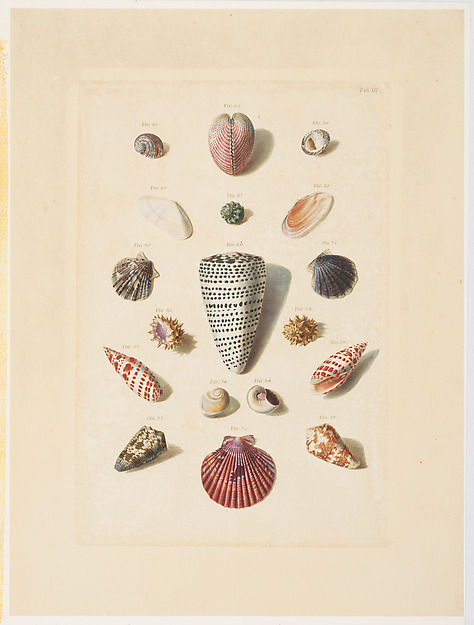
A plate from Choix de Coquillages et de Crustacés by Franz Michael Regenfuss, who engraved and coloured his own plates in 1758. The shells are given a metallic sheen unusual in natural history illustration of the period.

1758

Plate III, from "Choix de Coquillages et de Crustacés"

A plate from Choix de Coquillages et de Crustacés by Franz Michael Regenfuss, who engraved and coloured his own plates in 1758. The shells are given a metallic sheen unusual in natural history illustration of the period.

× px

Small archival scan: best for reference and screen use, not large prints.

Open in Studio
Source & credits
Creator / date
Franz Michael Regenfuss · 1758
Source credit
Bequest of Mrs. Charles Wrightsman, 2019. The Metropolitan Museum of Art.
Original file
Dimensions unavailable · JPG
The companion plate to III, showing crustaceans and shells together. Regenfuss drew the specimens at an even scale so that their surfaces could be compared directly.

1758

Plate IV, from "Choix de Coquillages et de Crustacés"

The companion plate to III, showing crustaceans and shells together. Regenfuss drew the specimens at an even scale so that their surfaces could be compared directly.

× px

Small archival scan: best for reference and screen use, not large prints.

Open in Studio
Source & credits
Creator / date
Franz Michael Regenfuss · 1758
Source credit
Bequest of Mrs. Charles Wrightsman, 2019. The Metropolitan Museum of Art.
Original file
Dimensions unavailable · JPG
Pears on a dark aquatint ground, from George Brookshaw’s Pomona Britannica of 1807. Brookshaw recorded the fruit grown in the gardens at Hampton Court Palace, then the most celebrated around London, and gave nearly every plate the same deep background so the fruit would seem lit from within.

1807

Pomona Britannica: No. 82 - Pears

Pears on a dark aquatint ground, from George Brookshaw’s Pomona Britannica of 1807. Brookshaw recorded the fruit grown in the gardens at Hampton Court Palace, then the most celebrated around London, and gave nearly every plate the same deep background so the fruit would seem lit from within.

× px

Small archival scan: best for reference and screen use, not large prints.

Open in Studio
Source & credits
Creator / date
George Brookshaw · 1807
Source credit
Gift of The Print Club of Cleveland in honor of Arnold M. Davis. 1955.313. Cleveland Museum of Art.
Original file
Dimensions unavailable · JPG
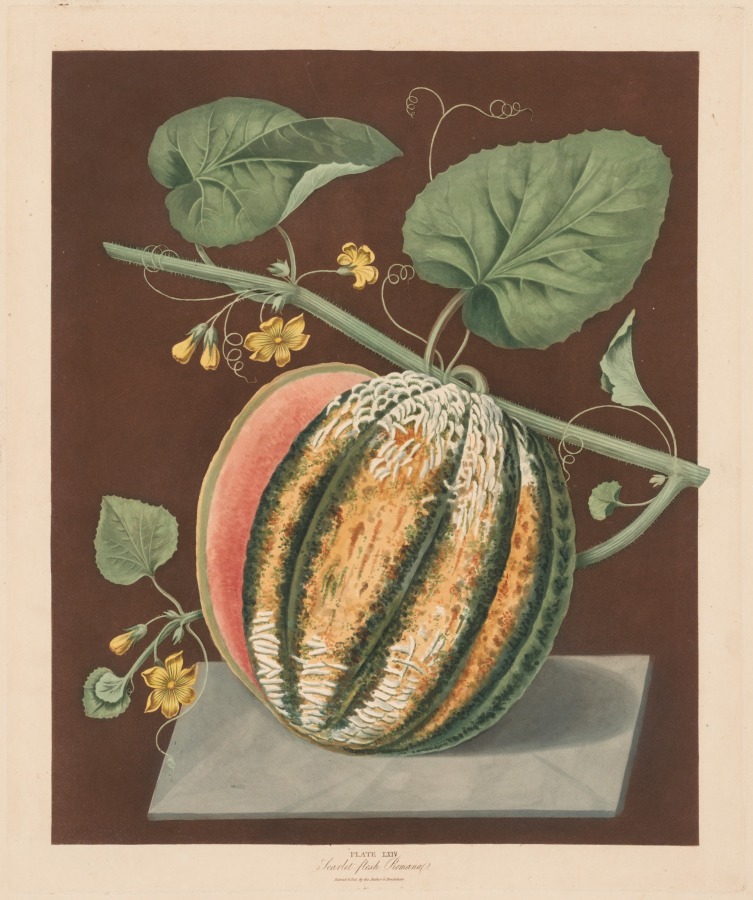
The Scarlet Flesh Romana melon from Pomona Britannica, published 1812. Against Brookshaw’s dark ground the netted skin of the melon reads as a pattern of its own.

1812

Pomona Britannica: No. 64 - Scarlet Flesh Romana Melon

The Scarlet Flesh Romana melon from Pomona Britannica, published 1812. Against Brookshaw’s dark ground the netted skin of the melon reads as a pattern of its own.

× px

Small archival scan: best for reference and screen use, not large prints.

Open in Studio
Source & credits
Creator / date
George Brookshaw · 1812
Source credit
Gift of The Print Club of Cleveland in honor of Arnold M. Davis. 1955.312. Cleveland Museum of Art.
Original file
Dimensions unavailable · JPG
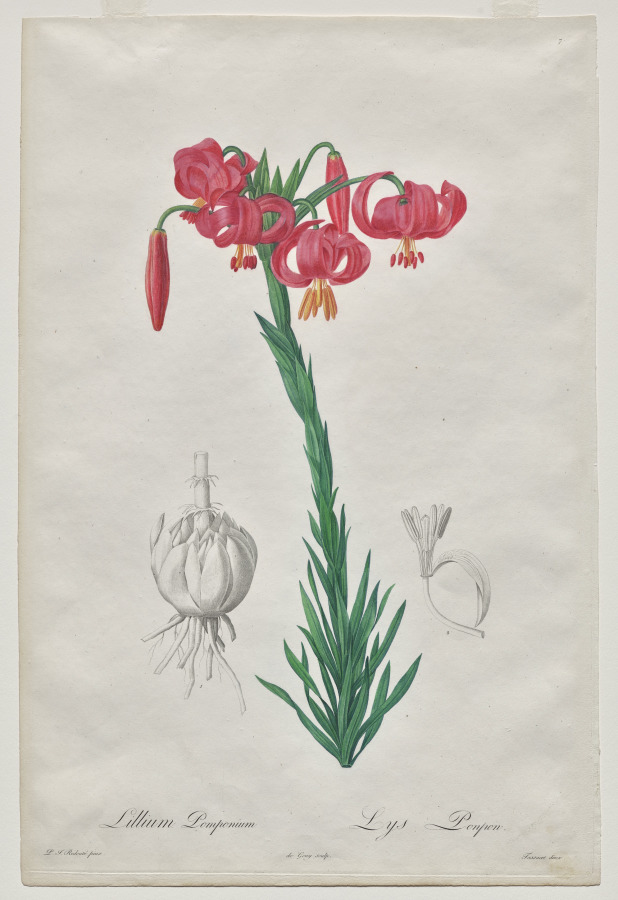
The turban lily, plate 7 of Les Liliacées, by Pierre-Joseph Redouté between 1802 and 1816. Court painter to Marie Antoinette and later to Empress Joséphine, Redouté was called the Raphael of flowers, and his stipple engravings were printed in colour and finished by hand.

1802–16

Lillium Pomponium (Turban Lily), plate 7 from Les Liliacées

The turban lily, plate 7 of Les Liliacées, by Pierre-Joseph Redouté between 1802 and 1816. Court painter to Marie Antoinette and later to Empress Joséphine, Redouté was called the Raphael of flowers, and his stipple engravings were printed in colour and finished by hand.

× px

Small archival scan: best for reference and screen use, not large prints.

Open in Studio
Source & credits
Creator / date
Pierre-Joseph Redouté · 1802–16
Source credit
Nancy F. and Joseph P. Keithley Collection Gift. 2020.164. Cleveland Museum of Art.
Original file
Dimensions unavailable · JPG
The Stately Crinum, hand-coloured engraving from Curtis’s Botanical Magazine of 1823. Curtis’s made botanical illustration a serial publication, issuing new plates to subscribers month after month.

1823

The Botanical Magazine or Flower Garden Displayed: Stately Crinum

The Stately Crinum, hand-coloured engraving from Curtis’s Botanical Magazine of 1823. Curtis’s made botanical illustration a serial publication, issuing new plates to subscribers month after month.

× px

Small archival scan: best for reference and screen use, not large prints.

Open in Studio
Source & credits
Creator / date
Curtis’s Botanical Magazine · 1823
Source credit
Gift of Mrs. A. B. Leavelle, Stanford, Cal., in memory of her mother, Wilma Ball Morgan (Mrs. Daniel E. Morgan). 1955.147. Cleveland Museum of Art.
Original file
Dimensions unavailable · JPG