← Open CollectionsPublic-domain source library
Marbling & Decorative Papers
Marbled papers bring flowing colour into the intimate space of a book. Traditionally, makers float colours on a prepared liquid surface, draw them into patterns and transfer them onto paper. These nineteenth-century endpapers show how this craft turned the inside covers of bound volumes into decorative compositions, with rhythms that balance careful handling and fluid movement.
Original means the unmodified digital file supplied by the linked archive, not an upscaled or reconstructed image. Sign in for free downloads. Studio uses a working preview up to 2048 px.
Public domain · 1869
Marbled endpaper — 1869
This marbled sheet lines the inside front cover of The Snakes of Australia, an Illustrated Catalogue, published in 1869. Decorative endpapers give a bound book a visual transition between its cover and printed pages. Here the paper’s flowing pattern offers a contrast to the ordered illustrations and text of a natural-history volume.
5168 × 6925 px · Unmodified source file
Open in StudioSource & licensing
- Creator / date
- Thomas Richards, Government Printmaster (source attribution) · 1869
- Source credit
- The snakes of Australia, an illustrated catalogue (1869)
- Usage notes
- Wikimedia Commons identifies this reproduction as public domain. See the linked licensing section for its basis and jurisdictional scope. Credit to the creator and source is encouraged; Visual Bounty claims no exclusive rights. No guarantee of worldwide public-domain status.
- Original file
- 5168 × 6925 px · JPG · 5.7 MB
- Source checked
- 2026-11-02 · editorial approval separate
Public domain · c. 1880
French marbled paper — c. 1880
A detail of marbled endpapers from a French-bound volume of Giacomo Leopardi’s Œuvres, dating to around 1880. The paper belongs to the decorative craft of bookbinding, where colour and pattern enrich the experience of opening a volume. Marbling creates its distinctive movement by transferring floating colours from a liquid surface to paper.
3486 × 3486 px · Unmodified source file
Open in StudioSource & licensing
- Creator / date
- Paper maker unknown; scan by Aristeas · c. 1880
- Source credit
- Own work
- Usage notes
- Wikimedia Commons identifies this reproduction as public domain. See the linked licensing section for its basis and jurisdictional scope. Credit to the creator and source is encouraged; Visual Bounty claims no exclusive rights. No guarantee of worldwide public-domain status.
- Original file
- 3486 × 3486 px · JPG · 3.7 MB
- Source checked
- 2026-11-02 · editorial approval separate
Public domain · 1723
Marbled binding — A Treatise upon the Small-Pox, 1723
The boards of Sir Richard Blackmore’s 1723 medical tract are wrapped in a combed marbled paper, its bands drawn through the wet colour with a stylus while the bath was still open. Waves of ochre, red and blue cross the sheet at an angle, recording the movement of the maker’s hand rather than a repeatable pattern.
2271 × 3925 px · Unmodified source file
Open in StudioSource & licensing
- Creator / date
- Marbler unknown; binding for Sir Richard Blackmore’s A Treatise upon the Small-Pox (London, 1723) · 1723
- Source credit
- Marbled paper on cover from a 1723 book, A Treatise upon the Small-Pox. Scan via Wikimedia Commons.
- Usage notes
- Wikimedia Commons identifies this reproduction as public domain, the underlying work dating from 1723. Credit to the contributing archive is encouraged.
- Original file
- 2271 × 3925 px · JPG · 0.8 MB
- Source checked
- 2026-11-03 · editorial approval separate
Public domain · 1728
Marbled endpaper — Gallia christiana, 1728
A sheet of marbled paper, likely French, lines the opening of a 1728 volume of Gallia christiana, the monastic history compiled by the Congrégation de Saint-Maur. Small, dense curls of colour fill the page edge to edge: close-grained work made for binders who needed a surface both durable and inexpensive.
1250 × 2000 px · Unmodified source file
Open in StudioSource & licensing
- Creator / date
- Marbler unknown; endpaper in Gallia christiana, tome IV (1728) · 1728
- Source credit
- Marbled paper from a 1728 book, Gallia christiana tome IV. Scan via Wikimedia Commons.
- Usage notes
- Wikimedia Commons identifies this reproduction as public domain, the underlying work dating from 1728. Credit to the contributing archive is encouraged.
- Original file
- 1250 × 2000 px · JPG · 0.4 MB
- Source checked
- 2026-11-03 · editorial approval separate
CC0 · Public domain · Manuscript early 1300s; marbled leaf later
Marbled flyleaf — Book of Hours, Walters W.90
Centuries after this Book of Hours was written in north-eastern France, a binder closed it with a marbled flyleaf. The stone-pattern sheet sits beside a fourteenth-century manuscript as a later, quieter layer of the book’s history.
1261 × 1800 px · Unmodified source file
Open in StudioSource & licensing
- Creator / date
- Manuscript: north-eastern France, early 14th century; marbled flyleaf added later · Manuscript early 1300s; marbled leaf later
- Source credit
- Book of Hours, Marbled paper, Walters Manuscript W.90, back flyleaf. Walters Art Museum, Baltimore, via Wikimedia Commons.
- Usage notes
- The Walters Art Museum releases its manuscript photography under CC0. Credit to the museum is encouraged; CC0 does not imply endorsement.
- Original file
- 1261 × 1800 px · JPG · 0.7 MB
- Source checked
- 2026-11-03 · editorial approval separate
CC0 · Public domain · Rebound c. 1820
Marbled board lining — Book of Hours (Use of Rome), Walters W.183
Inside the lower board of a Book of Hours rebound in France around 1820, marbled paper covers the turn-ins. The binding is not original to the manuscript, and the sheet records nineteenth-century French bookbinding practice as clearly as it decorates the cover.
1209 × 1800 px · Unmodified source file
Open in StudioSource & licensing
- Creator / date
- Manuscript: France, 15th century; rebound in France c. 1820 · Rebound c. 1820
- Source credit
- Book of Hours (Use of Rome), Marbled paper, Walters Manuscript W.183, lower board inside. Walters Art Museum, Baltimore, via Wikimedia Commons.
- Usage notes
- The Walters Art Museum releases its manuscript photography under CC0. Credit to the museum is encouraged; CC0 does not imply endorsement.
- Original file
- 1209 × 1800 px · JPG · 1.0 MB
- Source checked
- 2026-11-03 · editorial approval separate
Public domain · 1772–79
Marbled binding — Livre de Vases after Boucher, 1772–79
A bound album of vase designs, engraved by Gabriel Huquier after François Boucher, is wrapped in marbled paper; open swirls of colour meet the exact line of the plates inside. The pairing is typical of the period: a hand-made surface protecting work of measured precision.
2059 × 1545 px · Unmodified source file
Open in StudioSource & licensing
- Creator / date
- Engraved by Gabriel Huquier after François Boucher; marbler unknown · 1772–79
- Source credit
- Marbled paper on the binding of Livre de Vases (Book of Vases), after François Boucher. Cooper Hewitt, via Wikimedia Commons.
- Usage notes
- Wikimedia Commons identifies this reproduction as public domain, the object dating from 1772–79. Credit to the contributing museum is encouraged.
- Original file
- 2059 × 1545 px · JPG · 4.0 MB
- Source checked
- 2026-11-03 · editorial approval separate
Public domain · 1842
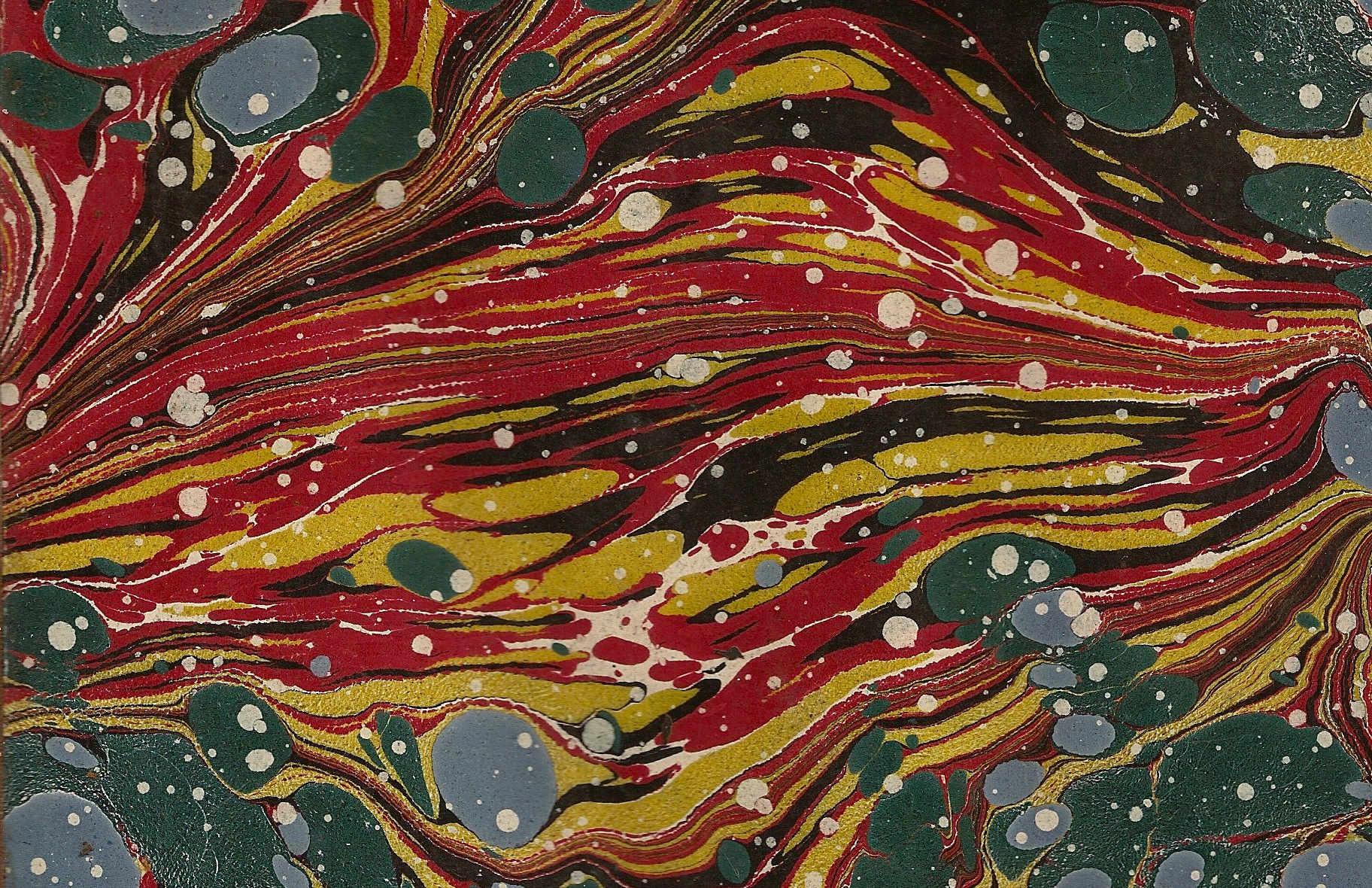
Marbled endpaper — Encyclopaedia Britannica, 7th edition (1842)
The endpaper of a Scottish-published Britannica opens with a broad, freely flowing marbled pattern, made in the years when such sheets were produced in quantity for commercial binders. Wide arcs of colour show a bath worked quickly, at the scale of a whole edition.
1824 × 1180 px · Unmodified source file
Open in StudioSource & licensing
- Creator / date
- Marbler unknown; Encyclopaedia Britannica, 7th edition (Scotland, 1842) · 1842
- Source credit
- Marbled endpaper from a book published in Scotland in 1842 (Encyclopaedia Britannica, 7th edition). Scan via Wikimedia Commons.
- Usage notes
- Wikimedia Commons identifies this reproduction as public domain, the underlying work dating from 1842. Credit to the contributor is encouraged.
- Original file
- 1824 × 1180 px · JPEG · 1.3 MB
- Source checked
- 2026-11-03 · editorial approval separate
Public-domain status is reported by the linked source and may vary by jurisdiction. Check the source record for your intended use. No exclusive rights or Visual Bounty marketplace license are offered for these images.