← Open CollectionsPublic-domain source library
Gold Leaf: Japanese Folding Screens
Folding screens were furniture first: a portable wall, light enough to move, hinged so it could stand. Painters then used that long horizontal field as a sequence, so that a screen is read while walking past it, its seasons or stations following one another across the panels. Gold leaf provided the light that interior dimness needed, and ink alone could carry weather. These screens, from Muromachi stables to Edo flower painting, include a pair recording the arrival of Portuguese merchants and a tea-room partition of Chinese mountains.
Original means the unmodified digital file supplied by the linked archive, not an upscaled or reconstructed image. Sign in for free downloads. Studio uses a working preview up to 2048 px.
CC0 · Public domain · c. 1600
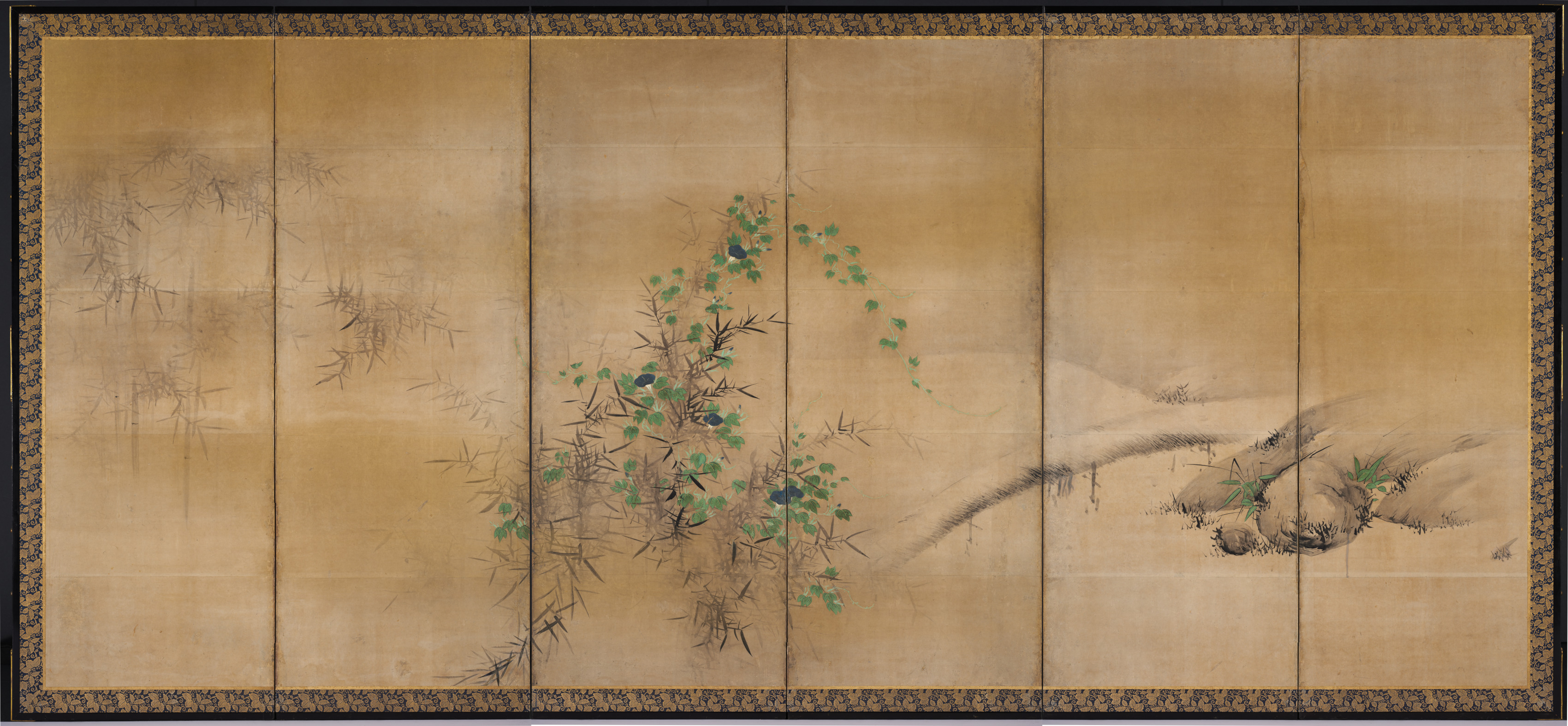
Winter and Summer Flowers
White camellias behind a large pine on one screen, blue morning glories through bamboo on the other, with mountains and a bridge implied between. Seasonal flowers arranged as an interior rather than a landscape.
3400 × 1574 px · Unmodified source file
Open in StudioSource & licensing
- Creator / date
- Kaihō Yūshō (Japanese, 1533–1615) · c. 1600
- Source credit
- The Cleveland Museum of Art, 1987.40.2. Open Access.
- Usage notes
- Released by the Cleveland Museum of Art under CC0 1.0. Credit to the museum is encouraged; CC0 does not imply endorsement.
- Original file
- 3400 × 1574 px · JPG · 0.0 MB
- Source checked
- 2026-11-04 · editorial approval separate
CC0 · Public domain · c. 1600
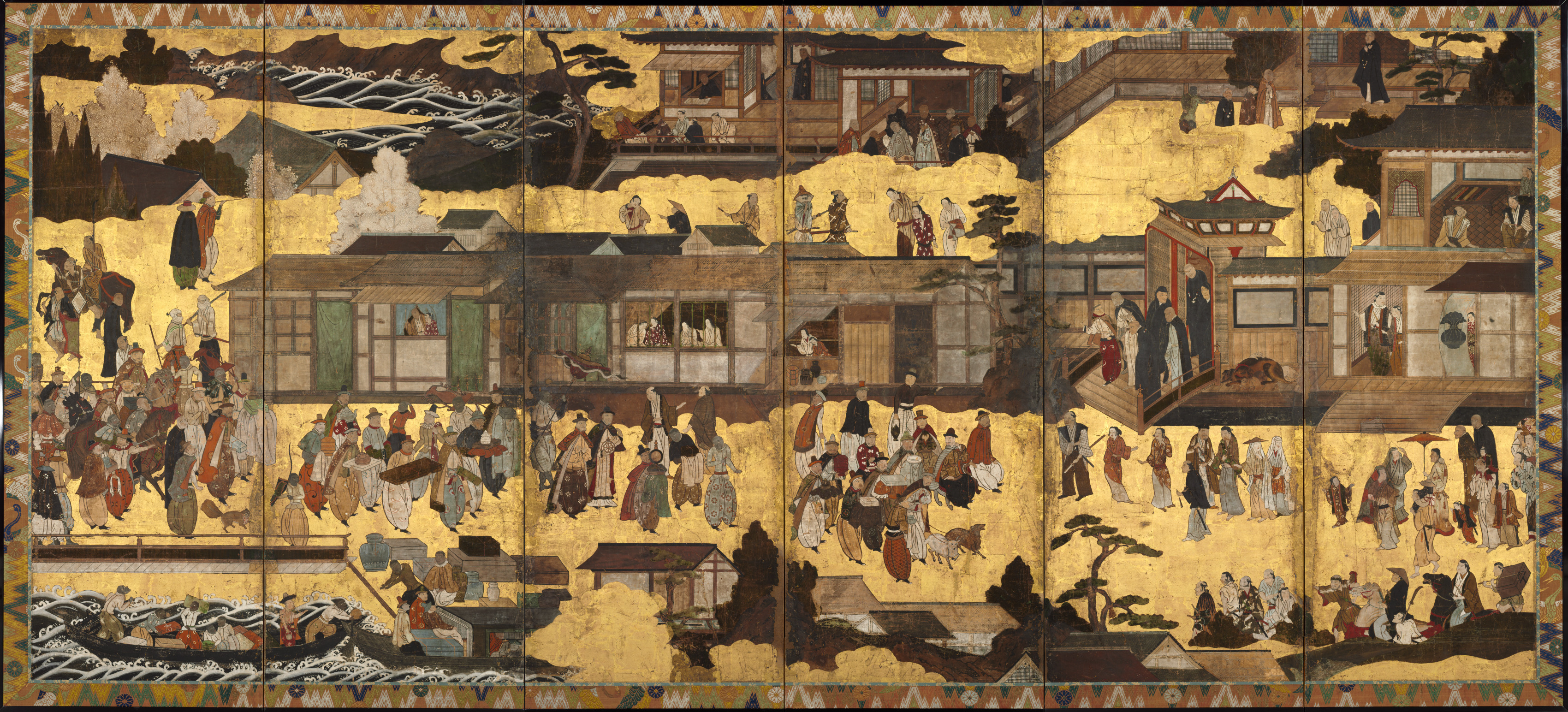
Arrival of the "Southern Barbarians"
One screen of a pair recording the arrival of Portuguese merchants in about 1600, with a multinational crew and Jesuit priests. The Japanese called them nanban, southern barbarians.
3400 × 1544 px · Unmodified source file
Open in StudioSource & licensing
- Creator / date
- Japan, Momoyama period (1573–1615), maker unknown · c. 1600
- Source credit
- The Cleveland Museum of Art, 1960.193.1. Open Access.
- Usage notes
- Released by the Cleveland Museum of Art under CC0 1.0. Credit to the museum is encouraged; CC0 does not imply endorsement.
- Original file
- 3400 × 1544 px · JPG · 0.0 MB
- Source checked
- 2026-11-04 · editorial approval separate
CC0 · Public domain · c. 1600
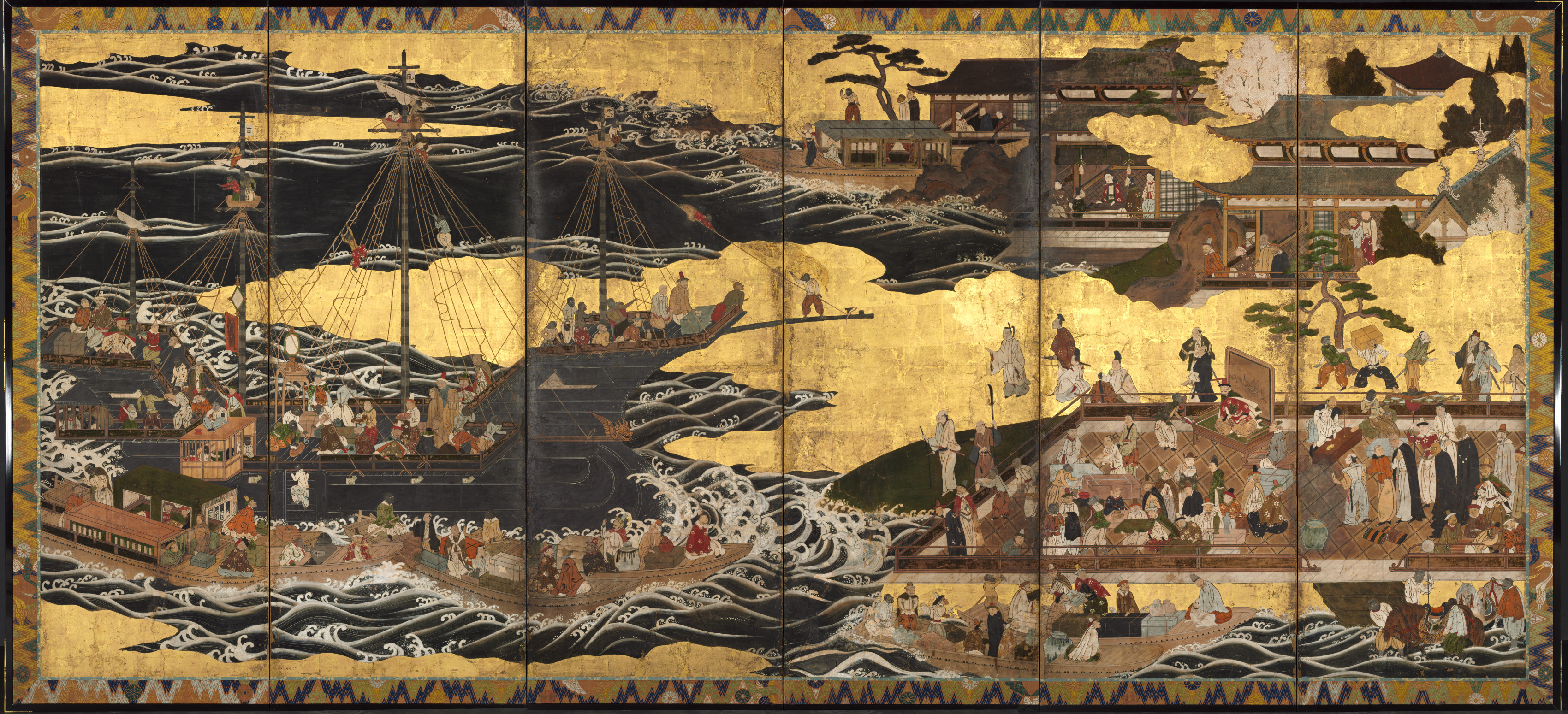
Arrival of the "Southern Barbarians"
The companion screen, continuing the procession through the port. Nanban screens were made in pairs so the encounter could be viewed as a panorama.
3400 × 1549 px · Unmodified source file
Open in StudioSource & licensing
- Creator / date
- Japan, Momoyama period (1573–1615), maker unknown · c. 1600
- Source credit
- The Cleveland Museum of Art, 1960.193.2. Open Access.
- Usage notes
- Released by the Cleveland Museum of Art under CC0 1.0. Credit to the museum is encouraged; CC0 does not imply endorsement.
- Original file
- 3400 × 1549 px · JPG · 0.0 MB
- Source checked
- 2026-11-04 · editorial approval separate
CC0 · Public domain · early 1500s
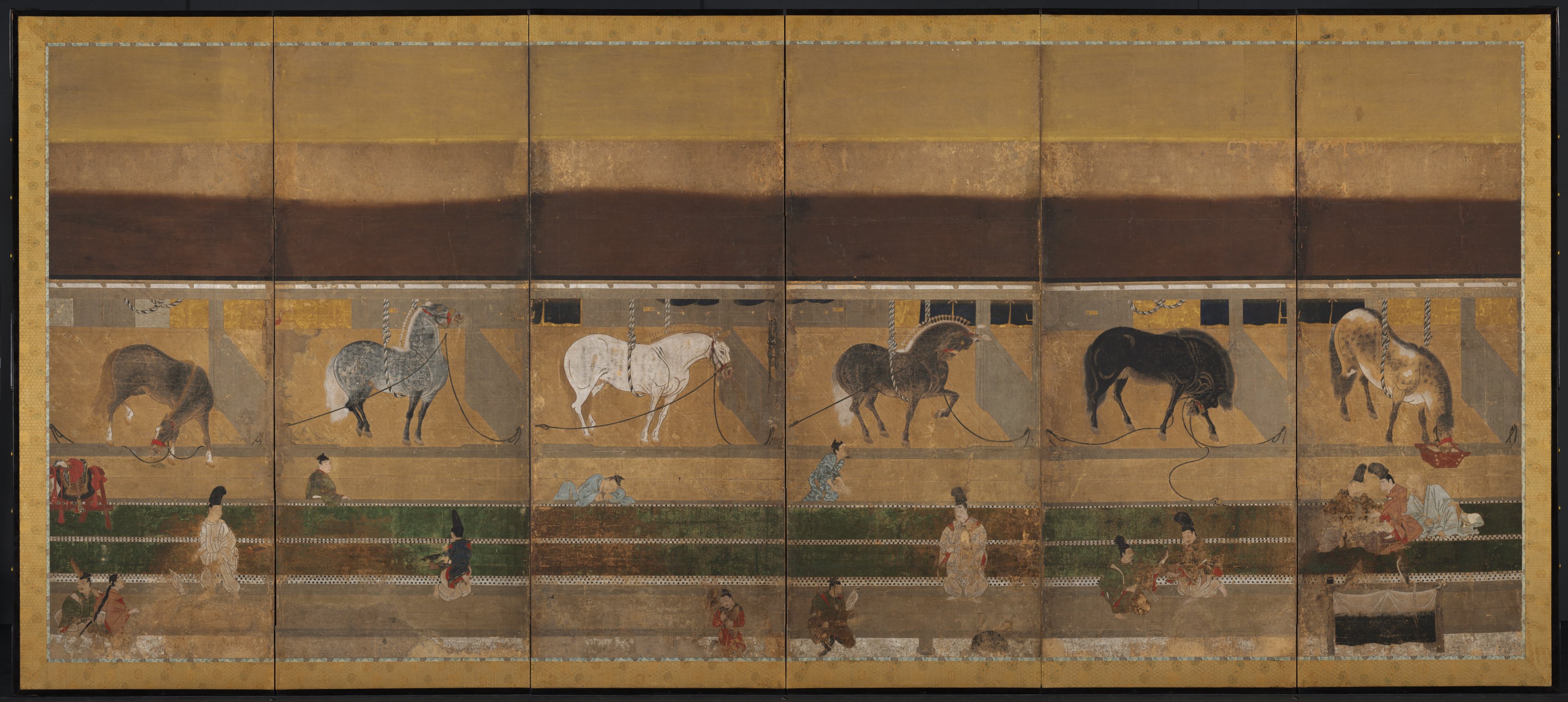
Horse Stable
Prized horses in stables are the nominal subject, but much of the action is on the veranda, where falconry is the focus. Screens of this kind described the pastimes of the military elite.
3400 × 1522 px · Unmodified source file
Open in StudioSource & licensing
- Creator / date
- Japan, Muromachi period (1392–1573), maker unknown · early 1500s
- Source credit
- The Cleveland Museum of Art, 1934.373.2. Open Access.
- Usage notes
- Released by the Cleveland Museum of Art under CC0 1.0. Credit to the museum is encouraged; CC0 does not imply endorsement.
- Original file
- 3400 × 1522 px · JPG · 0.0 MB
- Source checked
- 2026-11-04 · editorial approval separate
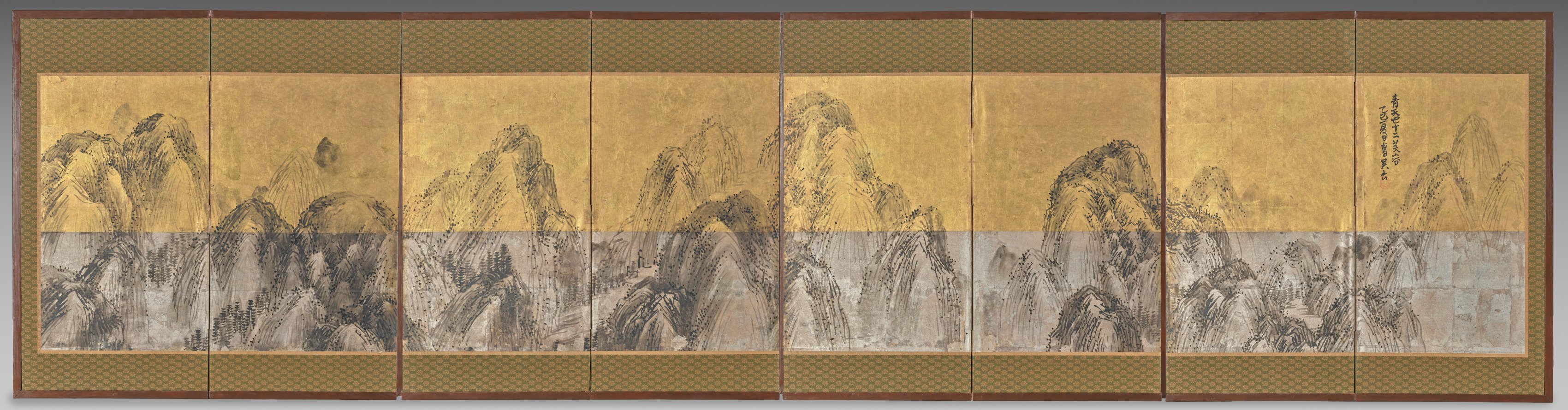
CC0 · Public domain · 1785
Seventy-Two Peaks Under the Blue Sky with Mount Furong
An eight-panel screen low enough to serve as a partition in a tea room, its inscription identifying the 72-peak Heng range in Hunan. Ink and gold make a blue sky over stacked peaks.
3400 × 889 px · Unmodified source file
Open in StudioSource & licensing
- Creator / date
- Matsumura Goshun (Japanese, 1752–1811) · 1785
- Source credit
- The Cleveland Museum of Art, 1980.28. Open Access.
- Usage notes
- Released by the Cleveland Museum of Art under CC0 1.0. Credit to the museum is encouraged; CC0 does not imply endorsement.
- Original file
- 3400 × 889 px · JPG · 0.0 MB
- Source checked
- 2026-11-04 · editorial approval separate
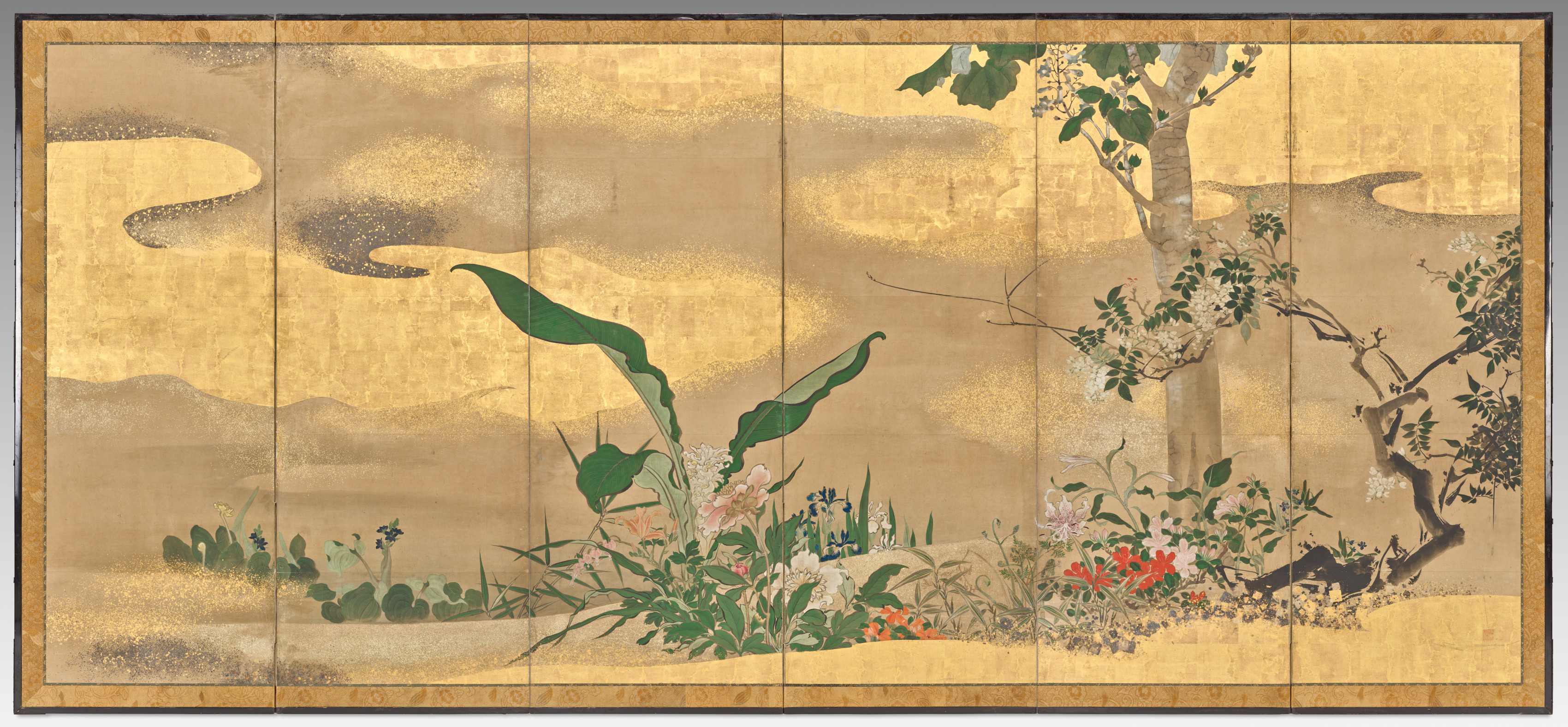
CC0 · Public domain · early to mid-1700s
Flowers and Trees of the Four Seasons (right screen)
The right screen of a pair painted by Watanabe Shikō, who combined close observation of plants with an interest in scientific realism learned from his patron Konoe Iehiro.
3400 × 1576 px · Unmodified source file
Open in StudioSource & licensing
- Creator / date
- Watanabe Shikō (Japanese, 1683–1755) · early to mid-1700s
- Source credit
- The Cleveland Museum of Art, 2021.132.1. Open Access.
- Usage notes
- Released by the Cleveland Museum of Art under CC0 1.0. Credit to the museum is encouraged; CC0 does not imply endorsement.
- Original file
- 3400 × 1576 px · JPG · 0.0 MB
- Source checked
- 2026-11-04 · editorial approval separate
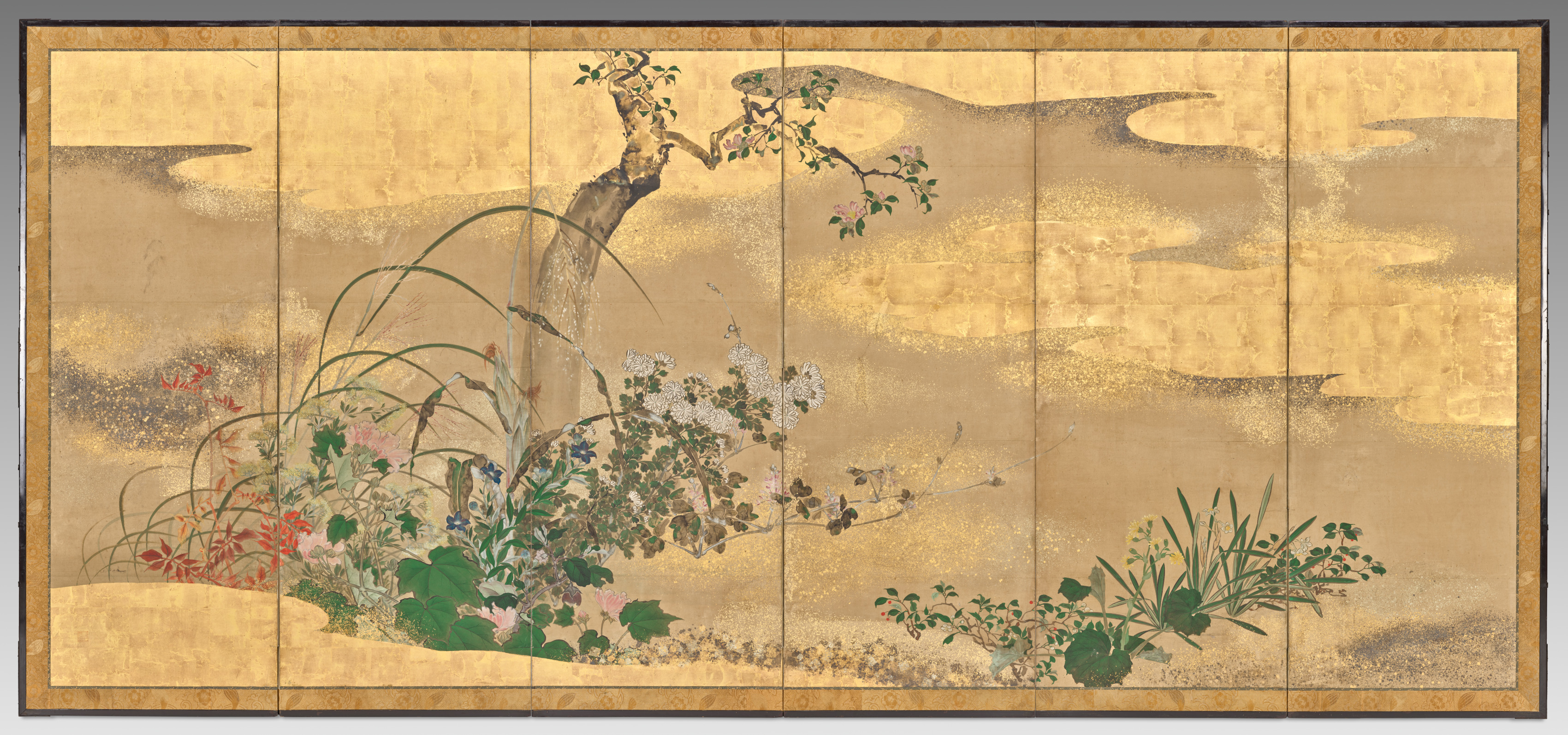
CC0 · Public domain · early to mid-1700s
Flowers and Trees of the Four Seasons (left screen)
The left screen of the pair, continuing the seasonal sequence. Each plant is identified and drawn accurately, but the composition is arranged for the sweep of the screen rather than for botany.
3400 × 1594 px · Unmodified source file
Open in StudioSource & licensing
- Creator / date
- Watanabe Shikō (Japanese, 1683–1755) · early to mid-1700s
- Source credit
- The Cleveland Museum of Art, 2021.132.2. Open Access.
- Usage notes
- Released by the Cleveland Museum of Art under CC0 1.0. Credit to the museum is encouraged; CC0 does not imply endorsement.
- Original file
- 3400 × 1594 px · JPG · 0.0 MB
- Source checked
- 2026-11-04 · editorial approval separate
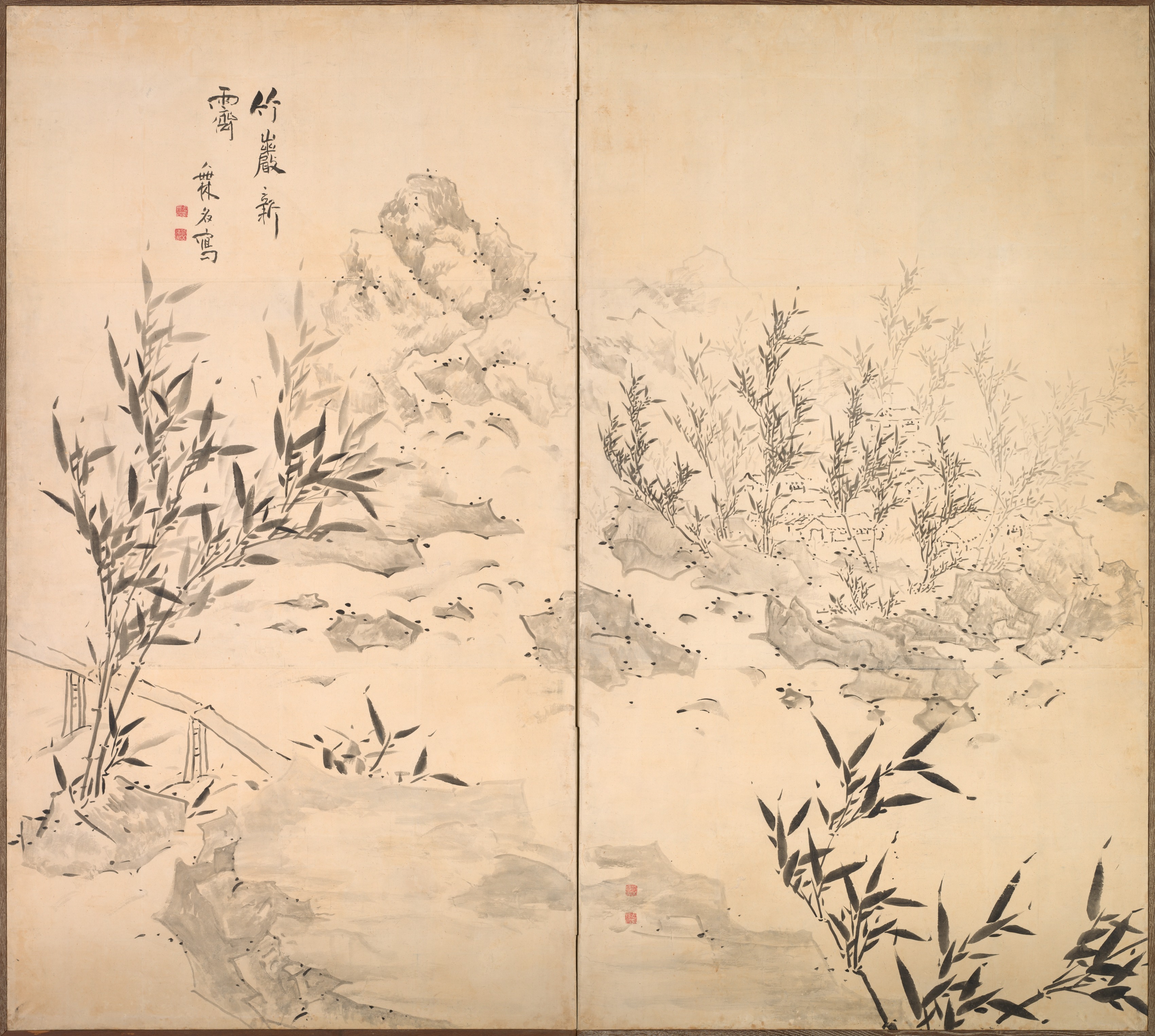
CC0 · Public domain · mid-1700s
Bamboo and Rocks in Clearing Skies
A two-panel screen whose title appears in a design from Taiga’s Brush Methods, conveying scenery and spirit refreshed by rain. Ink alone carries the weather.
3400 × 3051 px · Unmodified source file
Open in StudioSource & licensing
- Creator / date
- Ike Taiga (Japanese, 1723–1776) · mid-1700s
- Source credit
- The Cleveland Museum of Art, 1958.337. Open Access.
- Usage notes
- Released by the Cleveland Museum of Art under CC0 1.0. Credit to the museum is encouraged; CC0 does not imply endorsement.
- Original file
- 3400 × 3051 px · JPG · 0.0 MB
- Source checked
- 2026-11-04 · editorial approval separate
CC0 · Public domain · early 1800s
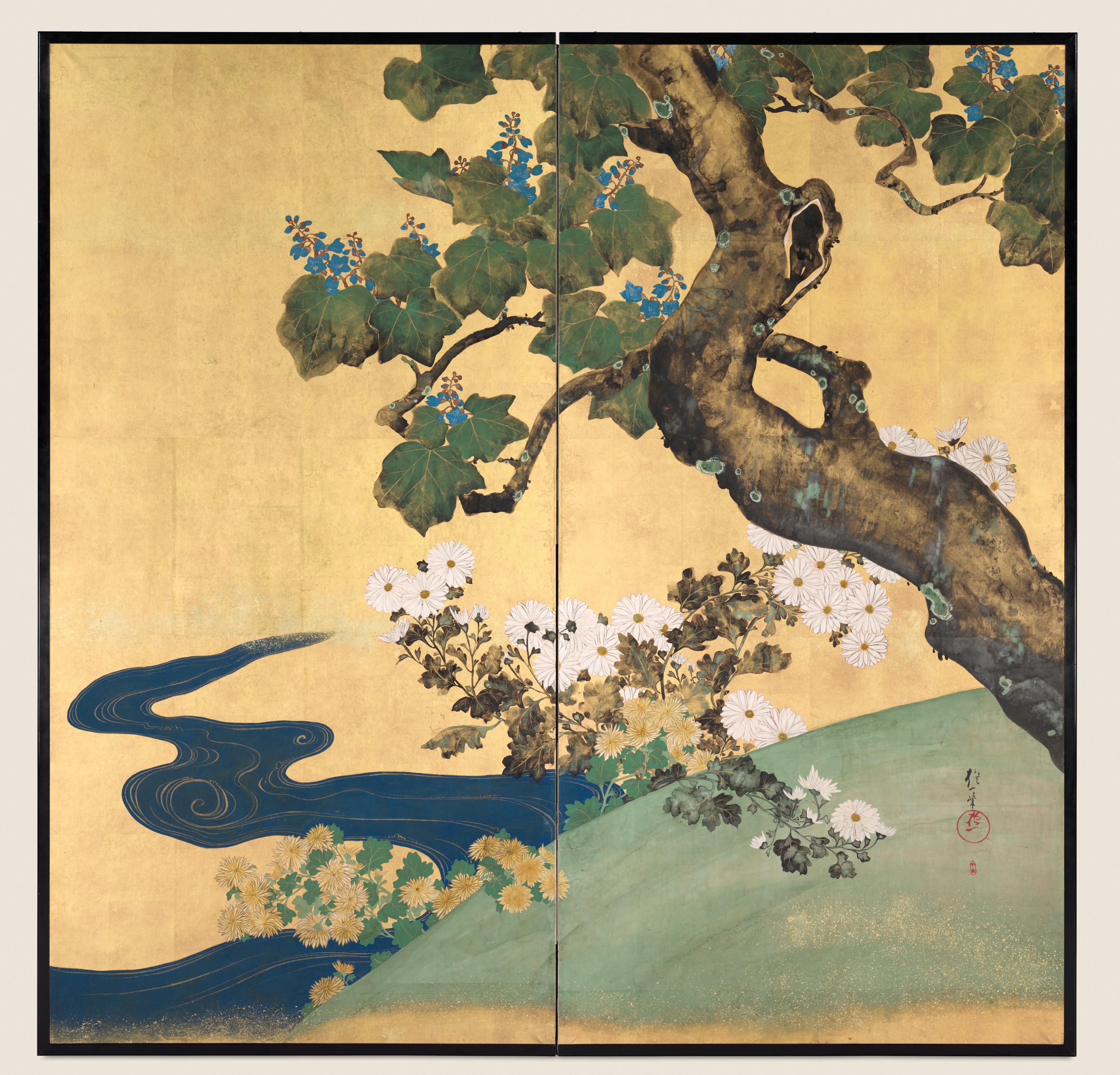
Paulownias and Chrysanthemums
Sakai Hōitsu used tarashikomi, dripping ink and colour so that it pools on the surface, to make paulownia leaves and chrysanthemums look wet. The technique is a kind of controlled accident.
3400 × 3264 px · Unmodified source file
Open in StudioSource & licensing
- Creator / date
- Sakai Hōitsu (Japanese, 1761–1828) · early 1800s
- Source credit
- The Cleveland Museum of Art, 1964.386. Open Access.
- Usage notes
- Released by the Cleveland Museum of Art under CC0 1.0. Credit to the museum is encouraged; CC0 does not imply endorsement.
- Original file
- 3400 × 3264 px · JPG · 0.0 MB
- Source checked
- 2026-11-04 · editorial approval separate
CC0 · Public domain · early-mid 1700s
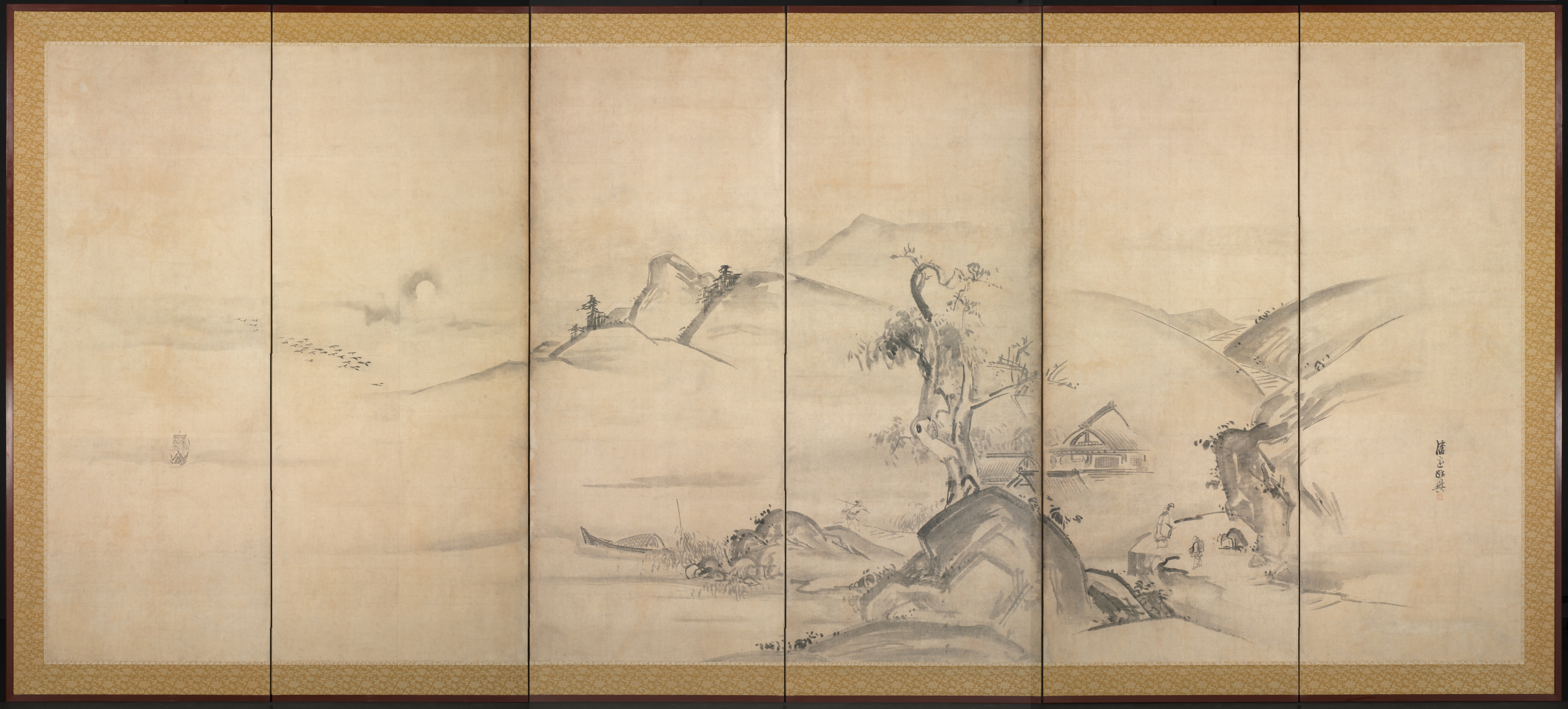
Eight Views of Xiao-Xiang
Watanabe Shikō recreated the Xiao and Xiang rivers of China on a pair of eight-panel screens, combining Kano school structure with Rimpa colour.
3400 × 1538 px · Unmodified source file
Open in StudioSource & licensing
- Creator / date
- Watanabe Shikō (Japanese, 1683–1755) · early-mid 1700s
- Source credit
- The Cleveland Museum of Art, 1968.267. Open Access.
- Usage notes
- Released by the Cleveland Museum of Art under CC0 1.0. Credit to the museum is encouraged; CC0 does not imply endorsement.
- Original file
- 3400 × 1538 px · JPG · 0.0 MB
- Source checked
- 2026-11-04 · editorial approval separate
Public-domain status is reported by the linked source and may vary by jurisdiction. Check the source record for your intended use. No exclusive rights or Visual Bounty marketplace license are offered for these images.