← Open Collections

Public-domain source library

Japanese Pattern Books

Two strands of Japanese decorative design meet here: chiyogami patterned papers and Kamisaka Sekka’s butterfly studies. Hirose Kikuo, owner of Ise-Tatsu Shoten, compiled Chiyogamishū in 1926 from Edo-period examples. Sekka, an illustrator active in Kyoto, explored variations in wing shape, colour and pattern in Chō senshu (Thousand Butterflies, 1904). A third strand follows the dye-stencil itself: cut-paper katagami made for textile workshops, shown alongside the stencil-printed silk robes they produced.

Explore the works and their histories through the original collections and institutions that preserve them. Source images are available to download, with creative exploration in Studio.

Works
24
Sources
4
Makers
9
Dates
1926 · 1904 · ca. 1680
Slender bamboo stems form a vertical rhythm, punctuated by red blossoms. This decorative-paper design appears in Hirose Kikuo’s 1926 collection, which drew on chiyogami from the Edo period.

1926

Chiyogamishū — Bamboo and red blossoms

Slender bamboo stems form a vertical rhythm, punctuated by red blossoms. This decorative-paper design appears in Hirose Kikuo’s 1926 collection, which drew on chiyogami from the Edo period.

5344 × 3456 px

Open in Studio
Source & credits
Creator / date
Hirose Kikuo (compiler); based on Edo-period decorative papers · 1926
Source credit
Source: NDL Image Bank, National Diet Library, Japan (https://www.ndl.go.jp/en/imagebank/theme/chiyogamishu). 千代紙集, Hirose Kikuo (compiler); based on Edo-period decorative papers, 1926, scan 6. Origin: Japan; Edo decorative-paper tradition, Taishō-period compilation.
Original file
5344 × 3456 px · JPG · 2.9 MB
Interlocking shapes shift from green through pale tones to pink, making colour as important as the repeating motif. Hirose Kikuo, owner of Ise-Tatsu Shoten, assembled this chiyogami collection from Edo-period examples.

1926

Chiyogamishū — Green and pink interlocking motifs

Interlocking shapes shift from green through pale tones to pink, making colour as important as the repeating motif. Hirose Kikuo, owner of Ise-Tatsu Shoten, assembled this chiyogami collection from Edo-period examples.

5344 × 3456 px

Open in Studio
Source & credits
Creator / date
Hirose Kikuo (compiler); based on Edo-period decorative papers · 1926
Source credit
Source: NDL Image Bank, National Diet Library, Japan (https://www.ndl.go.jp/en/imagebank/theme/chiyogamishu). 千代紙集, Hirose Kikuo (compiler); based on Edo-period decorative papers, 1926, scan 8. Origin: Japan; Edo decorative-paper tradition, Taishō-period compilation.
Original file
5344 × 3456 px · JPG · 2.8 MB
Small framed motifs turn the sheet into a colourful grid, balancing variety with repetition. The design belongs to Chiyogamishū, Hirose Kikuo’s 1926 collection of decorative papers based on Edo-period work.

1926

Chiyogamishū — Multicoloured square medallions

Small framed motifs turn the sheet into a colourful grid, balancing variety with repetition. The design belongs to Chiyogamishū, Hirose Kikuo’s 1926 collection of decorative papers based on Edo-period work.

5344 × 3456 px

Open in Studio
Source & credits
Creator / date
Hirose Kikuo (compiler); based on Edo-period decorative papers · 1926
Source credit
Source: NDL Image Bank, National Diet Library, Japan (https://www.ndl.go.jp/en/imagebank/theme/chiyogamishu). 千代紙集, Hirose Kikuo (compiler); based on Edo-period decorative papers, 1926, scan 10. Origin: Japan; Edo decorative-paper tradition, Taishō-period compilation.
Original file
5344 × 3456 px · JPG · 3.4 MB
Red rosettes sit over a blue lattice, layering rounded floral forms with a geometric structure. The pattern is part of the Edo-derived decorative-paper tradition gathered in Hirose Kikuo’s Chiyogamishū.

1926

Chiyogamishū — Red rosettes on blue lattice

Red rosettes sit over a blue lattice, layering rounded floral forms with a geometric structure. The pattern is part of the Edo-derived decorative-paper tradition gathered in Hirose Kikuo’s Chiyogamishū.

5344 × 3456 px

Open in Studio
Source & credits
Creator / date
Hirose Kikuo (compiler); based on Edo-period decorative papers · 1926
Source credit
Source: NDL Image Bank, National Diet Library, Japan (https://www.ndl.go.jp/en/imagebank/theme/chiyogamishu). 千代紙集, Hirose Kikuo (compiler); based on Edo-period decorative papers, 1926, scan 12. Origin: Japan; Edo decorative-paper tradition, Taishō-period compilation.
Original file
5344 × 3456 px · JPG · 3.6 MB
Pale blossoms fill a red ground, turning individual flowers into an all-over pattern. Published in Hirose Kikuo’s 1926 Chiyogamishū, the design reflects the collection’s interest in Edo-period decorative papers.

1926

Chiyogamishū — White blossoms on red

Pale blossoms fill a red ground, turning individual flowers into an all-over pattern. Published in Hirose Kikuo’s 1926 Chiyogamishū, the design reflects the collection’s interest in Edo-period decorative papers.

5344 × 3456 px

Open in Studio
Source & credits
Creator / date
Hirose Kikuo (compiler); based on Edo-period decorative papers · 1926
Source credit
Source: NDL Image Bank, National Diet Library, Japan (https://www.ndl.go.jp/en/imagebank/theme/chiyogamishu). 千代紙集, Hirose Kikuo (compiler); based on Edo-period decorative papers, 1926, scan 13. Origin: Japan; Edo decorative-paper tradition, Taishō-period compilation.
Original file
5344 × 3456 px · JPG · 3.6 MB
Alternating light and dark triangles create narrow bands of repeating geometry. This sheet shows the geometric side of chiyogami alongside the floral designs in Hirose Kikuo’s 1926 collection.

1926

Chiyogamishū — Alternating geometric triangles

Alternating light and dark triangles create narrow bands of repeating geometry. This sheet shows the geometric side of chiyogami alongside the floral designs in Hirose Kikuo’s 1926 collection.

5344 × 3456 px

Open in Studio
Source & credits
Creator / date
Hirose Kikuo (compiler); based on Edo-period decorative papers · 1926
Source credit
Source: NDL Image Bank, National Diet Library, Japan (https://www.ndl.go.jp/en/imagebank/theme/chiyogamishu). 千代紙集, Hirose Kikuo (compiler); based on Edo-period decorative papers, 1926, scan 15. Origin: Japan; Edo decorative-paper tradition, Taishō-period compilation.
Original file
5344 × 3456 px · JPG · 4.0 MB
Several geometric repeats share one sheet, inviting comparison between their scale, spacing and rhythm. The design comes from Hirose Kikuo’s collection of chiyogami based on Edo-period examples.

1926

Chiyogamishū — Geometric pattern sampler

Several geometric repeats share one sheet, inviting comparison between their scale, spacing and rhythm. The design comes from Hirose Kikuo’s collection of chiyogami based on Edo-period examples.

5344 × 3456 px

Open in Studio
Source & credits
Creator / date
Hirose Kikuo (compiler); based on Edo-period decorative papers · 1926
Source credit
Source: NDL Image Bank, National Diet Library, Japan (https://www.ndl.go.jp/en/imagebank/theme/chiyogamishu). 千代紙集, Hirose Kikuo (compiler); based on Edo-period decorative papers, 1926, scan 16. Origin: Japan; Edo decorative-paper tradition, Taishō-period compilation.
Original file
5344 × 3456 px · JPG · 3.4 MB
Chrysanthemum forms spread across the paper in a dense floral repeat. Their radiating petals provide a different kind of rhythm from the grids and stripes elsewhere in Hirose Kikuo’s Chiyogamishū.

1926

Chiyogamishū — Chrysanthemum pattern

Chrysanthemum forms spread across the paper in a dense floral repeat. Their radiating petals provide a different kind of rhythm from the grids and stripes elsewhere in Hirose Kikuo’s Chiyogamishū.

5344 × 3456 px

Open in Studio
Source & credits
Creator / date
Hirose Kikuo (compiler); based on Edo-period decorative papers · 1926
Source credit
Source: NDL Image Bank, National Diet Library, Japan (https://www.ndl.go.jp/en/imagebank/theme/chiyogamishu). 千代紙集, Hirose Kikuo (compiler); based on Edo-period decorative papers, 1926, scan 20. Origin: Japan; Edo decorative-paper tradition, Taishō-period compilation.
Original file
5344 × 3456 px · JPG · 3.5 MB
Warm-coloured butterflies become a study in varied wing shapes and surface patterns. They come from Chō senshu, or Thousand Butterflies, by Kamisaka Sekka, an illustrator active in Kyoto.

1904

Chō senshu, volume 1 — Butterflies in warm colours

Warm-coloured butterflies become a study in varied wing shapes and surface patterns. They come from Chō senshu, or Thousand Butterflies, by Kamisaka Sekka, an illustrator active in Kyoto.

6460 × 4420 px

Open in Studio
Source & credits
Creator / date
Kamisaka Sekka (1866–1942) · 1904
Source credit
Source: NDL Image Bank, National Diet Library, Japan (https://www.ndl.go.jp/en/imagebank/theme/chosenshu). 蝶千種. 1, Kamisaka Sekka (1866–1942), 1904, scan 3. Origin: Kyoto, Japan; Meiji-period decorative design.
Original file
6460 × 4420 px · JPG · 2.6 MB
Green and yellow outlines simplify butterflies into bold, flowing silhouettes. In his 1904 Chō senshu, Kyoto-based Kamisaka Sekka explores the butterfly as a decorative motif rather than limiting it to a single naturalistic form.

1904

Chō senshu, volume 1 — Green and yellow butterfly silhouettes

Green and yellow outlines simplify butterflies into bold, flowing silhouettes. In his 1904 Chō senshu, Kyoto-based Kamisaka Sekka explores the butterfly as a decorative motif rather than limiting it to a single naturalistic form.

6460 × 4420 px

Open in Studio
Source & credits
Creator / date
Kamisaka Sekka (1866–1942) · 1904
Source credit
Source: NDL Image Bank, National Diet Library, Japan (https://www.ndl.go.jp/en/imagebank/theme/chosenshu). 蝶千種. 1, Kamisaka Sekka (1866–1942), 1904, scan 6. Origin: Kyoto, Japan; Meiji-period decorative design.
Original file
6460 × 4420 px · JPG · 2.2 MB
Blue and green wings are arranged across an open ground, allowing each silhouette to stand out. This plate is part of Kamisaka Sekka’s Chō senshu, a collection devoted to variations on butterfly design.

1904

Chō senshu, volume 1 — Blue and green butterflies

Blue and green wings are arranged across an open ground, allowing each silhouette to stand out. This plate is part of Kamisaka Sekka’s Chō senshu, a collection devoted to variations on butterfly design.

6460 × 4420 px

Open in Studio
Source & credits
Creator / date
Kamisaka Sekka (1866–1942) · 1904
Source credit
Source: NDL Image Bank, National Diet Library, Japan (https://www.ndl.go.jp/en/imagebank/theme/chosenshu). 蝶千種. 1, Kamisaka Sekka (1866–1942), 1904, scan 10. Origin: Kyoto, Japan; Meiji-period decorative design.
Original file
6460 × 4420 px · JPG · 3.0 MB
Stripes and angular shapes turn butterfly wings into miniature patterned surfaces. Created by Kyoto-based illustrator Kamisaka Sekka, the plate shows how a familiar natural form can support many decorative variations.

1904

Chō senshu, volume 1 — Geometric butterfly wings

Stripes and angular shapes turn butterfly wings into miniature patterned surfaces. Created by Kyoto-based illustrator Kamisaka Sekka, the plate shows how a familiar natural form can support many decorative variations.

6460 × 4420 px

Open in Studio
Source & credits
Creator / date
Kamisaka Sekka (1866–1942) · 1904
Source credit
Source: NDL Image Bank, National Diet Library, Japan (https://www.ndl.go.jp/en/imagebank/theme/chosenshu). 蝶千種. 1, Kamisaka Sekka (1866–1942), 1904, scan 13. Origin: Kyoto, Japan; Meiji-period decorative design.
Original file
6460 × 4420 px · JPG · 2.6 MB
A katazome pattern book from about 1680: stencil-dyeing designs gathered for textile workshops and printed so a dyer could order repeats by eye. Nearly three centuries before industrial swatch books, Japanese pattern houses were already publishing their designs as catalogues.

ca. 1680

Book of Designs (Katazome mihonchō) 型染見本帳

A katazome pattern book from about 1680: stencil-dyeing designs gathered for textile workshops and printed so a dyer could order repeats by eye. Nearly three centuries before industrial swatch books, Japanese pattern houses were already publishing their designs as catalogues.

4000 × 3218 px

Open in Studio
Source & credits
Creator / date
Unidentified Japanese artist · ca. 1680
Source credit
Rogers Fund, 1923. The Metropolitan Museum of Art.
Original file
4000 × 3218 px · JPG
The first volume of a 1667 pattern book for kosode, the robe that preceded the modern kimono. Printed in ink and red on paper, it carried current designs into circulation so a cutting shop in another province could follow the season.

1667

Kosode Pattern Book (On-Hiinagata), vol. 1

The first volume of a 1667 pattern book for kosode, the robe that preceded the modern kimono. Printed in ink and red on paper, it carried current designs into circulation so a cutting shop in another province could follow the season.

1653 × 1305 px

Open in Studio
Source & credits
Creator / date
Anonymous, Japanese · 1667
Source credit
Gift of Betty and Paul Nomura, in memory of Nomura Shōjirō, 2018. The Metropolitan Museum of Art.
Original file
1653 × 1305 px · JPG
Volume two of the same 1667 set, printing the designs that did not fit the first. Read together the two books work as an index of motifs: scattered florals, geometric bands and small repeats, each one laid out ready to be cut on cloth.

1667

Kosode Pattern Book (On-Hiinagata), vol. 2

Volume two of the same 1667 set, printing the designs that did not fit the first. Read together the two books work as an index of motifs: scattered florals, geometric bands and small repeats, each one laid out ready to be cut on cloth.

1672 × 1309 px

Open in Studio
Source & credits
Creator / date
Anonymous, Japanese · 1667
Source credit
Gift of Betty and Paul Nomura, in memory of Nomura Shōjirō, 2018. The Metropolitan Museum of Art.
Original file
1672 × 1309 px · JPG
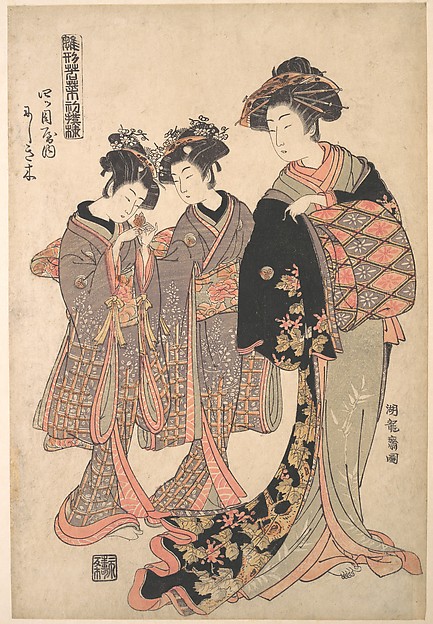
Koryūsai borrowed the pattern book's name for a series of prints, which were themselves one of the ways new robe designs circulated. The kimono carries the information here: layered figured silks, the obi knotted at the front, a small crest repeated across the fabric.

1776

The Courtesan Nishikigi, from "A Pattern Book of the Year's First Designs"

Koryūsai borrowed the pattern book's name for a series of prints, which were themselves one of the ways new robe designs circulated. The kimono carries the information here: layered figured silks, the obi knotted at the front, a small crest repeated across the fabric.

2672 × 3848 px

Open in Studio
Source & credits
Creator / date
Isoda Koryūsai (Japanese, 1735–1790) · 1776
Source credit
The Howard Mansfield Collection, Purchase, Rogers Fund, 1936. The Metropolitan Museum of Art.
Original file
2672 × 3848 px · JPG
A companion sheet from the same 1776 series. Each print worked as a picture and as a record of dress, and the patterns on the robes were read as closely as the faces: figured silk, resist-dyed grounds and embroidered hems.

1776

The Courtesan Sayoginu, from "A Pattern Book of the Year's First Designs"

A companion sheet from the same 1776 series. Each print worked as a picture and as a record of dress, and the patterns on the robes were read as closely as the faces: figured silk, resist-dyed grounds and embroidered hems.

2671 × 3901 px

Open in Studio
Source & credits
Creator / date
Isoda Koryūsai (Japanese, 1735–1790) · 1776
Source credit
The Howard Mansfield Collection, Purchase, Rogers Fund, 1936. The Metropolitan Museum of Art.
Original file
2671 × 3901 px · JPG
A Japanese stencil print (kappa-zuri) of the twelve Buddhas with Kobo Daishi, founder of Shingon Buddhism, printed from a cut stencil and coloured by hand. Stencil printing let a devotional image be repeated in quantity, with the colour added afterwards, plate by plate.

Late 1600s

Twelve Buddhas and Kobo Daishi (Jusanbutsu)

A Japanese stencil print (kappa-zuri) of the twelve Buddhas with Kobo Daishi, founder of Shingon Buddhism, printed from a cut stencil and coloured by hand. Stencil printing let a devotional image be repeated in quantity, with the colour added afterwards, plate by plate.

1640 × 3400 px

Open in Studio
Source & credits
Creator / date
Unknown Japanese workshop · Late 1600s
Source credit
Gift of Donald J. Wineman in memory of his wife, Susan. Cleveland Museum of Art.
Original file
1640 × 3400 px · JPG
A cut-paper katagami carrying the imagery of Matsukaze, the Noh play in which two salt-makers’ daughters return as spirits. Stencils were cut by specialists and sold to dyeing workshops, so a single design could travel across an entire region and reappear, years later, on a robe made for someone who never saw the paper.

19th century

Stencil with Theme from Matsukaze

A cut-paper katagami carrying the imagery of Matsukaze, the Noh play in which two salt-makers’ daughters return as spirits. Stencils were cut by specialists and sold to dyeing workshops, so a single design could travel across an entire region and reappear, years later, on a robe made for someone who never saw the paper.

× px

Small archival scan: best for reference and screen use, not large prints.

Open in Studio
Source & credits
Creator / date
Unknown Japanese designer · 19th century
Source credit
Gift of Mrs. Horace Havemeyer, 1942. The Metropolitan Museum of Art.
Original file
Dimensions unavailable · JPG
Waves and shoreline cut into mulberry paper, strengthened with silk threads so the bridges of the design would not tear under repeated paste. Coastal motifs circulated widely in Edo-period dyeing, where water and shore stood for travel, distance and return.

19th century

Stencil with Pattern of Seascape on White Ground

Waves and shoreline cut into mulberry paper, strengthened with silk threads so the bridges of the design would not tear under repeated paste. Coastal motifs circulated widely in Edo-period dyeing, where water and shore stood for travel, distance and return.

× px

Small archival scan: best for reference and screen use, not large prints.

Open in Studio
Source & credits
Creator / date
Unknown Japanese designer · 19th century
Source credit
Gift of Mrs. Horace Havemeyer, 1942. The Metropolitan Museum of Art.
Original file
Dimensions unavailable · JPG
A summer kosode in open gauze, its ferns printed through a stencil rather than resist-dyed. The lighter weave and the printed pattern together answer the season: the design sits on the surface, allowed to fade the way a real fern does, rather than being reserved in the fibre.

late 18th–early 19th century

Robe (Kosode) with Ferns

A summer kosode in open gauze, its ferns printed through a stencil rather than resist-dyed. The lighter weave and the printed pattern together answer the season: the design sits on the surface, allowed to fade the way a real fern does, rather than being reserved in the fibre.

× px

Small archival scan: best for reference and screen use, not large prints.

Open in Studio
Source & credits
Creator / date
Unknown Japanese designer · late 18th–early 19th century
Source credit
Purchase, Roy R. and Marie S. Neuberger Foundation Inc. and several members of The Chairman’s Council Gifts, 2000 Benefit Fund, and funds from various donors, 2001. The Metropolitan Museum of Art.
Original file
Dimensions unavailable · JPG
Blossom and butterfly scattered across plain silk, printed through stencils in a repeat that never falls into a grid. Edo-period pattern designers worked in the space between the motifs, and the looseness here is deliberate: a repeating print made to look as though it happened on its own.

late 18th–early 19th century

Robe (Kosode) with Cherry Blossoms and Butterflies

Blossom and butterfly scattered across plain silk, printed through stencils in a repeat that never falls into a grid. Edo-period pattern designers worked in the space between the motifs, and the looseness here is deliberate: a repeating print made to look as though it happened on its own.

× px

Small archival scan: best for reference and screen use, not large prints.

Open in Studio
Source & credits
Creator / date
Unknown Japanese designer · late 18th–early 19th century
Source credit
Purchase, Roy R. and Marie S. Neuberger Foundation Inc. and several members of The Chairman’s Council Gifts, 2000 Benefit Fund, and funds from various donors, 2001. The Metropolitan Museum of Art.
Original file
Dimensions unavailable · JPG
A paper katagami cut for resist dyeing, the bridges of paper left standing holding the whole design. Cut stencils of this kind were used across kimono lengths, and their grids are still the closest thing in the archive to a ready-made repeat.

19th century

Stencil

A paper katagami cut for resist dyeing, the bridges of paper left standing holding the whole design. Cut stencils of this kind were used across kimono lengths, and their grids are still the closest thing in the archive to a ready-made repeat.

× px

Small archival scan: best for reference and screen use, not large prints.

Open in Studio
Source & credits
Creator / date
Unrecorded Japanese stencil cutter · 19th century
Source credit
Gift of Mrs. Horace Havemeyer, 1950. The Metropolitan Museum of Art.
Original file
Dimensions unavailable · JPG
Kasuri, the Japanese ikat, is woven from threads dyed before the loom, so every small cross was bound by hand and then aligned in the cloth. Ramie makes the garment cool enough for summer and crisp enough to hold the grid.

19th century

Woman’s Summer Kimono with Design of Small Crosses

Kasuri, the Japanese ikat, is woven from threads dyed before the loom, so every small cross was bound by hand and then aligned in the cloth. Ramie makes the garment cool enough for summer and crisp enough to hold the grid.

× px

Small archival scan: best for reference and screen use, not large prints.

Open in Studio
Source & credits
Creator / date
Unrecorded Japanese weaver · 19th century
Source credit
Gift of John B. Elliott through the Mercer Trust, 1999. The Metropolitan Museum of Art.
Original file
Dimensions unavailable · JPG