← Open CollectionsPublic-domain source library
Indonesian Batik
Batik is drawn in wax and dyed in indigo and soga brown, a technique Java has refined over centuries. These cloths date from the nineteenth and early twentieth centuries and cover the forms Javanese dress depends on: sarong, kain panjang, slendang and head cloth. North-coast workshops worked in brighter palettes and added gold leaf, while the courts of Central Java held to the older browns and blues.
Original means the unmodified digital file supplied by the linked archive, not an upscaled or reconstructed image. Sign in for free downloads. Studio uses a working preview up to 2048 px.
CC0 · Public domain · 19th–early 20th century
Slendang (Shoulder Cloth)
A long shoulder cloth from Central Java, wax-resist dyed on cotton before it was ever worn. A slendang is carried over one shoulder and used as much for carrying as for dress, so the cloth is long, light and made to be folded.
861 × 3400 px · Unmodified source file
Open in StudioSource & licensing
- Creator / date
- Central Java, maker unknown · 19th–early 20th century
- Source credit
- Gift of Mrs. James J. Tracy. The Cleveland Museum of Art, Open Access.
- Usage notes
- The Cleveland Museum of Art releases this image under CC0 as part of its Open Access programme. Credit to the museum is encouraged; CC0 does not imply endorsement.
- Original file
- 861 × 3400 px · JPG · 2.6 MB
- Source checked
- 2026-11-03 · editorial approval separate
CC0 · Public domain · 19th–early 20th century
Slendang (Shoulder Cloth)
Woven in silk rather than cotton, this shoulder cloth comes from the north coast of Java, where harbour towns traded cloth across the Indian Ocean world. Silk takes wax and dye differently from cotton, and the resist lines come out finer for it.
876 × 3400 px · Unmodified source file
Open in StudioSource & licensing
- Creator / date
- Java, North Coast, maker unknown · 19th–early 20th century
- Source credit
- Sundry Purchase Fund. The Cleveland Museum of Art, Open Access.
- Usage notes
- The Cleveland Museum of Art releases this image under CC0 as part of its Open Access programme. Credit to the museum is encouraged; CC0 does not imply endorsement.
- Original file
- 876 × 3400 px · JPG · 2.2 MB
- Source checked
- 2026-11-03 · editorial approval separate
CC0 · Public domain · early 20th century
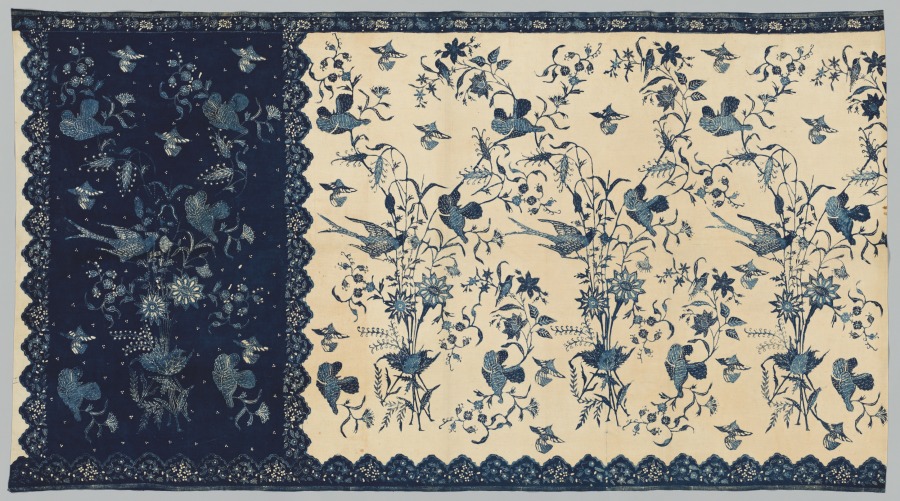
Sarong
A sarong is a tube of cloth, sewn along one edge and wrapped at the waist so the pattern meets itself when worn. This one comes from Indramayu, a north-coast town whose workshops are known for colour and for designs shared with the Chinese and Arab trading communities.
3400 × 1892 px · Unmodified source file
Open in StudioSource & licensing
- Creator / date
- Indramayu, north coast of Java, maker unknown · early 20th century
- Source credit
- Gift of Mrs. James J. Tracy. The Cleveland Museum of Art, Open Access.
- Usage notes
- The Cleveland Museum of Art releases this image under CC0 as part of its Open Access programme. Credit to the museum is encouraged; CC0 does not imply endorsement.
- Original file
- 3400 × 1892 px · JPG · 2.3 MB
- Source checked
- 2026-11-03 · editorial approval separate
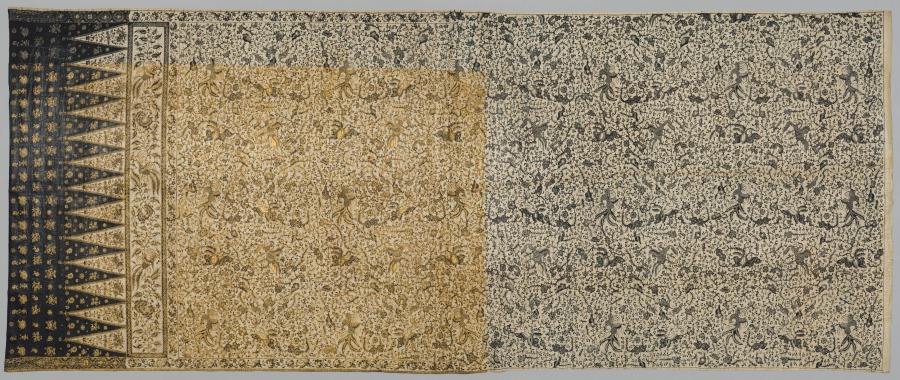
CC0 · Public domain · 19th century
Sarong
Gold leaf is applied over the finished batik, catching the light as the cloth moves. The treatment belongs to the north coast, where long-distance trade encouraged richer surfaces than the indigo and soga brown of the interior.
3400 × 1434 px · Unmodified source file
Open in StudioSource & licensing
- Creator / date
- Java, North Coast, maker unknown · 19th century
- Source credit
- Purchase from the J. H. Wade Fund. The Cleveland Museum of Art, Open Access.
- Usage notes
- The Cleveland Museum of Art releases this image under CC0 as part of its Open Access programme. Credit to the museum is encouraged; CC0 does not imply endorsement.
- Original file
- 3400 × 1434 px · JPG · 2.7 MB
- Source checked
- 2026-11-03 · editorial approval separate
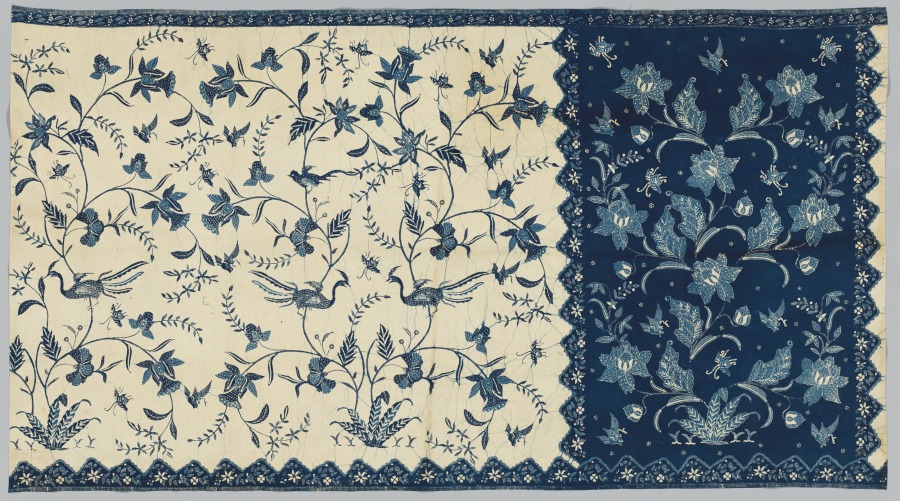
CC0 · Public domain · mid-19th century
Sarong
Mid-nineteenth-century cotton, dyed by wax resist in the north-coast workshops. Batik of this period was made either by hand with a canting, a small pen-like copper reservoir, or with a stamped copper block, and each leaves its own signature in the line.
3400 × 1892 px · Unmodified source file
Open in StudioSource & licensing
- Creator / date
- Java, North Coast, maker unknown · mid-19th century
- Source credit
- Gift of Mrs. James J. Tracy. The Cleveland Museum of Art, Open Access.
- Usage notes
- The Cleveland Museum of Art releases this image under CC0 as part of its Open Access programme. Credit to the museum is encouraged; CC0 does not imply endorsement.
- Original file
- 3400 × 1892 px · JPG · 2.3 MB
- Source checked
- 2026-11-03 · editorial approval separate
CC0 · Public domain · 19th century
Ceremonial Cloth (Kampo)
A kampo is a ceremonial cloth, made for ritual rather than everyday dress. Because it was never worn hard, the dye and wax survive in unusually good condition, preserving detail that ordinary working cloth would long since have lost.
3400 × 2217 px · Unmodified source file
Open in StudioSource & licensing
- Creator / date
- Central Java, maker unknown · 19th century
- Source credit
- Purchase from the J. H. Wade Fund. The Cleveland Museum of Art, Open Access.
- Usage notes
- The Cleveland Museum of Art releases this image under CC0 as part of its Open Access programme. Credit to the museum is encouraged; CC0 does not imply endorsement.
- Original file
- 3400 × 2217 px · JPG · 3.5 MB
- Source checked
- 2026-11-03 · editorial approval separate
CC0 · Public domain · late 19th century
Head Cloth
Square cloths were folded and tied for the head, or knotted into a sash. The square sets its own discipline on a batik designer: the pattern has to hold up when the cloth is turned in any direction.
3390 × 3400 px · Unmodified source file
Open in StudioSource & licensing
- Creator / date
- Central Java, maker unknown · late 19th century
- Source credit
- Purchase from the J. H. Wade Fund. The Cleveland Museum of Art, Open Access.
- Usage notes
- The Cleveland Museum of Art releases this image under CC0 as part of its Open Access programme. Credit to the museum is encouraged; CC0 does not imply endorsement.
- Original file
- 3390 × 3400 px · JPG · 4.1 MB
- Source checked
- 2026-11-03 · editorial approval separate
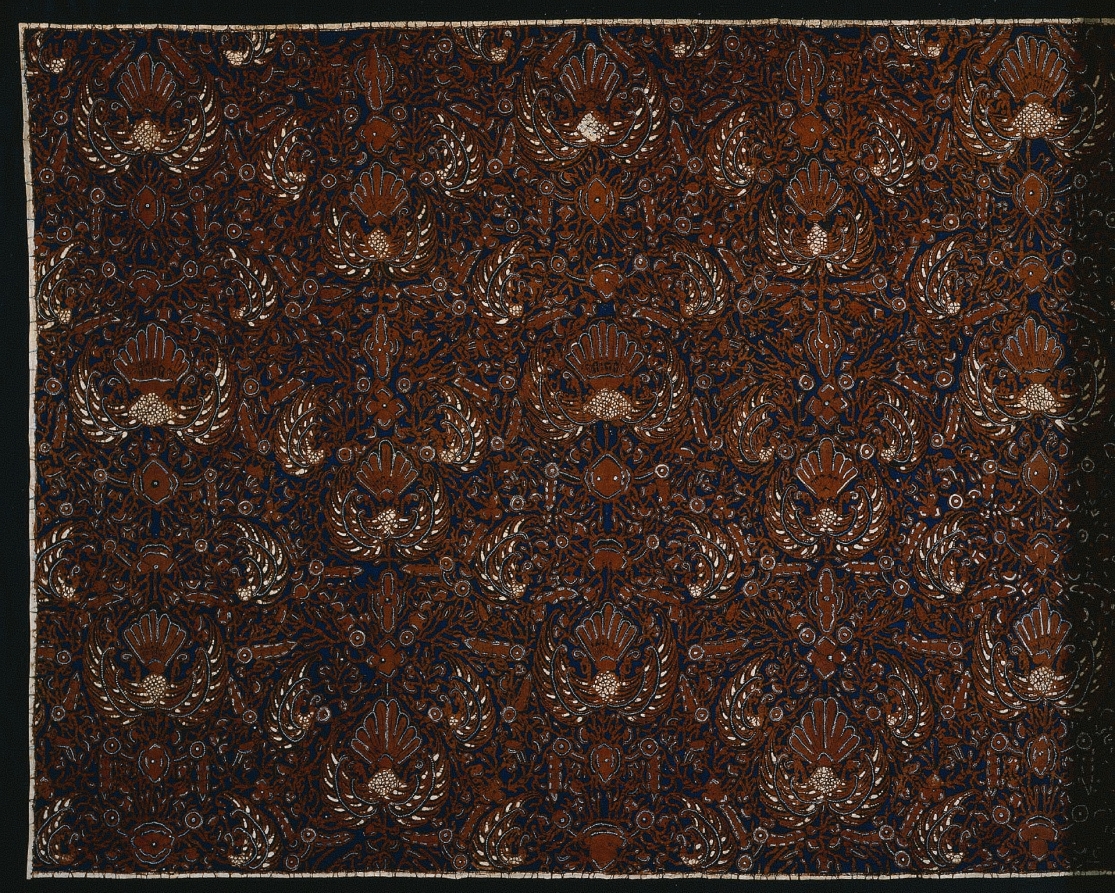
CC0 · Public domain · 19th century
Kain Panjang (Skirt)
A kain panjang is a long rectangle wrapped as a skirt, and its proportions let a designer build a rhythm along the length of the cloth. It remained the standard dress cloth of Java long after batik became a workshop industry.
1917 × 1536 px · Unmodified source file
Open in StudioSource & licensing
- Creator / date
- Central Java, maker unknown · 19th century
- Source credit
- Gift of Mrs. James J. Tracy. The Cleveland Museum of Art, Open Access.
- Usage notes
- The Cleveland Museum of Art releases this image under CC0 as part of its Open Access programme. Credit to the museum is encouraged; CC0 does not imply endorsement.
- Original file
- 1917 × 1536 px · JPG · 3.2 MB
- Source checked
- 2026-11-03 · editorial approval separate
CC0 · Public domain · 19th century
Slendang
A shoulder cloth from Central Java, narrower than a sarong and made to hang. Nineteenth-century Javanese batik was largely a household industry, with the waxing often done by women while dyeing and trading were organised separately.
829 × 3400 px · Unmodified source file
Open in StudioSource & licensing
- Creator / date
- Central Java, maker unknown · 19th century
- Source credit
- Purchase from the J. H. Wade Fund. The Cleveland Museum of Art, Open Access.
- Usage notes
- The Cleveland Museum of Art releases this image under CC0 as part of its Open Access programme. Credit to the museum is encouraged; CC0 does not imply endorsement.
- Original file
- 829 × 3400 px · JPG · 2.6 MB
- Source checked
- 2026-11-03 · editorial approval separate
Public-domain status is reported by the linked source and may vary by jurisdiction. Check the source record for your intended use. No exclusive rights or Visual Bounty marketplace license are offered for these images.