← Open CollectionsPublic-domain source library
Mineral and Gold: Himalayan Thangkas
A thangka is a painting on cloth, sized with animal glue and ground so the surface takes mineral pigment without drinking it, then mounted in silk so it can be rolled and carried. The best were painted to be read: a central figure whose gestures and attributes state exactly who is present, surrounded by teachers, protectors and narrative incident. This selection runs from the twelfth-century beginnings of Tibetan painting, when Indian and Nepalese workshop models still governed proportion and colour, through Yuan court commissions and Ming embroidery, to eighteenth-century diagrammatic mandalas. Several pieces are notable for their materials — silk tapestry with pearls, gold thread on satin — as much as for their subjects.
Original means the unmodified digital file supplied by the linked archive, not an upscaled or reconstructed image. Sign in for free downloads. Studio uses a working preview up to 2048 px.
CC0 · Public domain · c. 1150–1200
Tantric Buddha Vairochana as Vajrasattva
A tantric Buddha at the centre of a field of smaller figures, the body built from flat planes of mineral colour and outlined in red. It belongs to the earliest phase of Tibetan thangka painting, when Indian and Nepalese models were still followed closely.
2220 × 3400 px · Unmodified source file
Open in StudioSource & licensing
- Creator / date
- Unknown artist, Central Tibet · c. 1150–1200
- Source credit
- The Cleveland Museum of Art, 1989.104. Open Access.
- Usage notes
- Released by the Cleveland Museum of Art under CC0 1.0. Credit to the museum is encouraged; CC0 does not imply endorsement.
- Original file
- 2220 × 3400 px · JPG · 0.0 MB
- Source checked
- 2026-11-05 · editorial approval separate
CC0 · Public domain · early 1200s
Achala, King of the Wrathful Ones
Achala, the immovable protector, stands amid flame with a sword raised against ignorance and a noose to bind delusion. Unusually, the image is woven silk with pearls rather than painted — the kind of luxury textile made in Hangzhou for Tibetan monasteries.
2485 × 3400 px · Unmodified source file
Open in StudioSource & licensing
- Creator / date
- Unknown artist, China, Zhejiang Province, probably Hangzhou · early 1200s
- Source credit
- The Cleveland Museum of Art, 1992.72. Open Access.
- Usage notes
- Released by the Cleveland Museum of Art under CC0 1.0. Credit to the museum is encouraged; CC0 does not imply endorsement.
- Original file
- 2485 × 3400 px · JPG · 0.0 MB
- Source checked
- 2026-11-05 · editorial approval separate
CC0 · Public domain · c. 1236–1310
Portraits of Two Lineage Masters of the Kagyu Order
Phagmo Drupa and Tashipel, two teachers of the Kagyu order, sit side by side in monastic robes with hands in the gesture of teaching. Lineage portraits are records of transmission: pupil beside teacher, the teaching passed hand to hand.
2606 × 3400 px · Unmodified source file
Open in StudioSource & licensing
- Creator / date
- Unknown artist, Central Tibet · c. 1236–1310
- Source credit
- The Cleveland Museum of Art, 1987.146. Open Access.
- Usage notes
- Released by the Cleveland Museum of Art under CC0 1.0. Credit to the museum is encouraged; CC0 does not imply endorsement.
- Original file
- 2606 × 3400 px · JPG · 0.0 MB
- Source checked
- 2026-11-05 · editorial approval separate
CC0 · Public domain · c. 1260s, mounted 2020
Green Tara
Green Tara sits with one leg lowered, ready to step down to help, the right hand open in the gesture of giving. The painting is attributed to Aniko, the Nepalese artist whose workshop became the model for Tibetan painting under the Yuan court.
2877 × 3400 px · Unmodified source file
Open in StudioSource & licensing
- Creator / date
- Aniko (Nepalese, active in Tibet mid- to late 1200s) · c. 1260s, mounted 2020
- Source credit
- The Cleveland Museum of Art, 1970.156. Open Access.
- Usage notes
- Released by the Cleveland Museum of Art under CC0 1.0. Credit to the museum is encouraged; CC0 does not imply endorsement.
- Original file
- 2877 × 3400 px · JPG · 0.0 MB
- Source checked
- 2026-11-05 · editorial approval separate
CC0 · Public domain · c. 1300s
Nagarjuna with a Buddhist Master
Nagarjuna, the second-century philosopher of emptiness, sits beside a later teacher under an arch of flame and scrolling vine. Nepalese painting of this moment sets figures against saturated red grounds with fine gold detailing.
2636 × 3400 px · Unmodified source file
Open in StudioSource & licensing
- Creator / date
- Unknown artist, Nepal · c. 1300s
- Source credit
- The Cleveland Museum of Art, 1985.186. Open Access.
- Usage notes
- Released by the Cleveland Museum of Art under CC0 1.0. Credit to the museum is encouraged; CC0 does not imply endorsement.
- Original file
- 2636 × 3400 px · JPG · 0.0 MB
- Source checked
- 2026-11-05 · editorial approval separate
CC0 · Public domain · 1st half of 1300s
Guardian Kings: Dhrtarastra and Virupaksa
Two of the four kings who hold the cardinal directions, armoured and booted, each carrying the emblem of his quarter. Painted in Yuan-dynasty Sino-Tibetan style, they borrow the bulk and heavy armour of Chinese temple guardians.
1623 × 3400 px · Unmodified source file
Open in StudioSource & licensing
- Creator / date
- Unknown artist, Sino-Tibet, Yuan dynasty · 1st half of 1300s
- Source credit
- The Cleveland Museum of Art, 1989.476. Open Access.
- Usage notes
- Released by the Cleveland Museum of Art under CC0 1.0. Credit to the museum is encouraged; CC0 does not imply endorsement.
- Original file
- 1623 × 3400 px · JPG · 0.0 MB
- Source checked
- 2026-11-05 · editorial approval separate
CC0 · Public domain · c. 1440–70
Tsong Khapa, Founder of the Geluk Order
Tsong Khapa sits with a sword and a book at either shoulder — wisdom and scripture — and his hands in the gesture of teaching. The yellow hat becomes, in later paintings, the sign by which his order is recognised.
2792 × 3400 px · Unmodified source file
Open in StudioSource & licensing
- Creator / date
- Unknown artist, Central Tibet · c. 1440–70
- Source credit
- The Cleveland Museum of Art, 1981.33. Open Access.
- Usage notes
- Released by the Cleveland Museum of Art under CC0 1.0. Credit to the museum is encouraged; CC0 does not imply endorsement.
- Original file
- 2792 × 3400 px · JPG · 0.0 MB
- Source checked
- 2026-11-05 · editorial approval separate
CC0 · Public domain · c. 1500
Eleven-Headed, Thousand-Armed Bodhisattva of Compassion
Avalokiteshvara shown with eleven heads stacked in tiers and a fan of a thousand arms, each palm holding an eye. The format is a meditation image rather than a portrait: every hand an instrument of help, every eye an act of attention.
2483 × 3400 px · Unmodified source file
Open in StudioSource & licensing
- Creator / date
- Unknown artist, Western Tibet · c. 1500
- Source credit
- The Cleveland Museum of Art, 1982.147. Open Access.
- Usage notes
- Released by the Cleveland Museum of Art under CC0 1.0. Credit to the museum is encouraged; CC0 does not imply endorsement.
- Original file
- 2483 × 3400 px · JPG · 0.0 MB
- Source checked
- 2026-11-05 · editorial approval separate
CC0 · Public domain · 1368–1424
Thangka with the Seventh Bodhisattva
A bodhisattva surrounded by attendants, worked in silk and gold thread on a satin ground. Needlework of this quality moved through gift economies of its own, given to monasteries rather than bought.
1600 × 3400 px · Unmodified source file
Open in StudioSource & licensing
- Creator / date
- Unknown artist, China, Ming dynasty · 1368–1424
- Source credit
- The Cleveland Museum of Art, 1991.2. Open Access.
- Usage notes
- Released by the Cleveland Museum of Art under CC0 1.0. Credit to the museum is encouraged; CC0 does not imply endorsement.
- Original file
- 1600 × 3400 px · JPG · 0.0 MB
- Source checked
- 2026-11-05 · editorial approval separate
CC0 · Public domain · 1600s
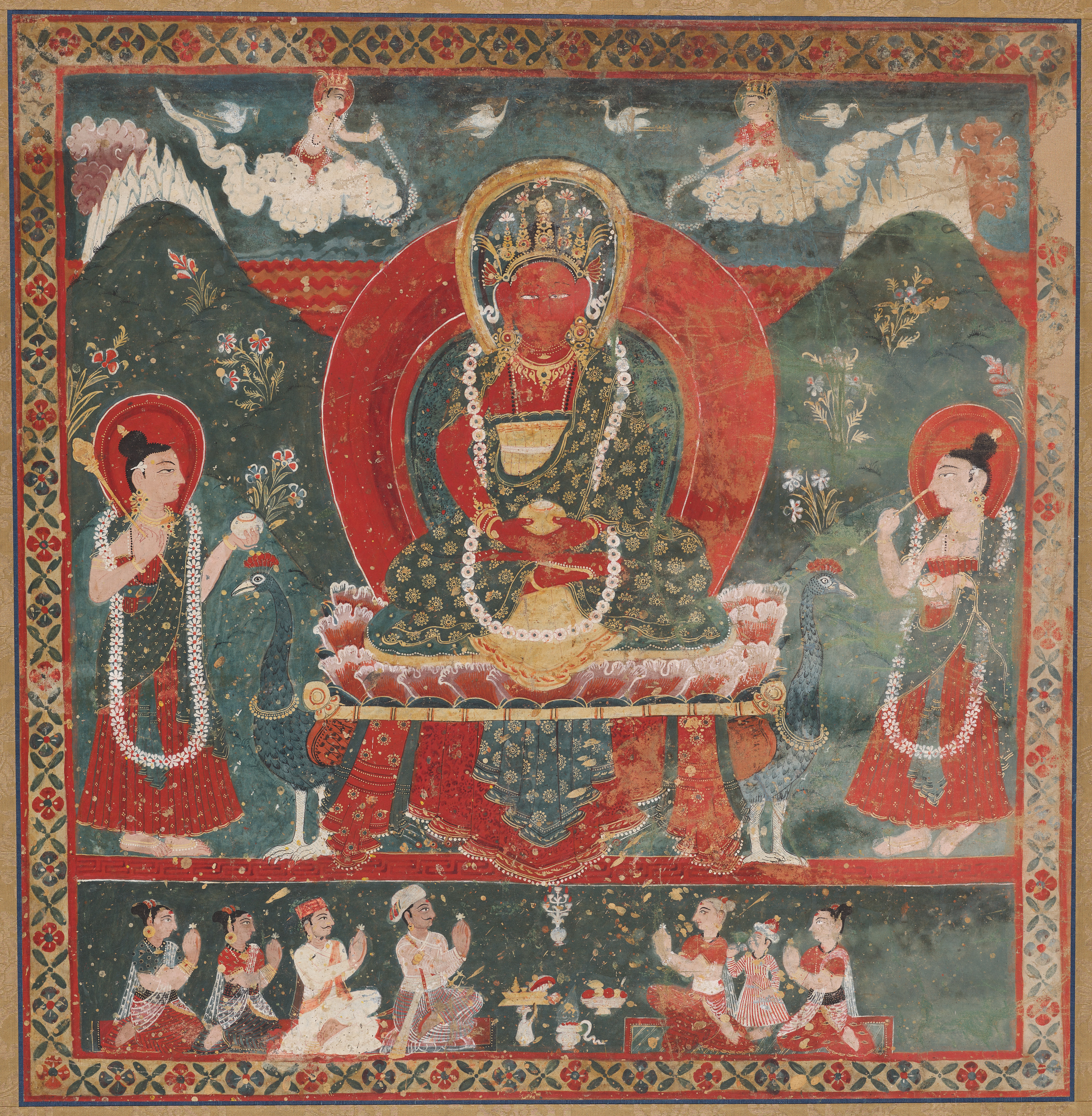
Thangka with Amitayus
Amitayus, the Buddha of infinite life, holds the vase of long life in his lap. Devotion to this figure was practical: such paintings were commissioned for longevity, for a living patron rather than a dead one.
3327 × 3400 px · Unmodified source file
Open in StudioSource & licensing
- Creator / date
- Unknown artist, Nepal · 1600s
- Source credit
- The Cleveland Museum of Art, 1991.1081. Open Access.
- Usage notes
- Released by the Cleveland Museum of Art under CC0 1.0. Credit to the museum is encouraged; CC0 does not imply endorsement.
- Original file
- 3327 × 3400 px · JPG · 0.0 MB
- Source checked
- 2026-11-05 · editorial approval separate
CC0 · Public domain · painting c. 1650; top and bottom borders c. 1350
Vajrapani and Garuda
Vajrapani, bodhisattva of power, is painted at the centre of an older embroidered mount whose silk borders carry a garuda. Assembled from parts of different dates, the thangka shows a working image repaired and re-dressed over centuries.
1472 × 3400 px · Unmodified source file
Open in StudioSource & licensing
- Creator / date
- Choying Dorje, the Tenth Black Hat Karmapa (Tibetan, 1604–1674) · painting c. 1650; top and bottom borders c. 1350
- Source credit
- The Cleveland Museum of Art, 1989.11. Open Access.
- Usage notes
- Released by the Cleveland Museum of Art under CC0 1.0. Credit to the museum is encouraged; CC0 does not imply endorsement.
- Original file
- 1472 × 3400 px · JPG · 0.0 MB
- Source checked
- 2026-11-05 · editorial approval separate
CC0 · Public domain · early 1700s
Mandala
A mandala draws a deity’s palace as concentric rings: fire, a vajra fence, the charnel grounds, then the square palace with its four gates. It is a guide for meditation and initiation, not a picture to be looked at from outside.
2206 × 3400 px · Unmodified source file
Open in StudioSource & licensing
- Creator / date
- Unknown artist, Tibet · early 1700s
- Source credit
- The Cleveland Museum of Art, 1915.316. Open Access.
- Usage notes
- Released by the Cleveland Museum of Art under CC0 1.0. Credit to the museum is encouraged; CC0 does not imply endorsement.
- Original file
- 2206 × 3400 px · JPG · 0.0 MB
- Source checked
- 2026-11-05 · editorial approval separate
Public-domain status is reported by the linked source and may vary by jurisdiction. Check the source record for your intended use. No exclusive rights or Visual Bounty marketplace license are offered for these images.