← Open CollectionsPublic-domain source library
Faience and Gold: Egyptian Amulets and Adornment
Egyptian jewellery was made to be seen in movement and, just as often, to keep working in a tomb. The materials carry meaning on their own: gold because it does not corrode, turquoise and lapis for the colours of the sky and the flood, carnelian for blood, and faience — quartz paste glazed and fired — because it could be moulded into any shape and glazed the deep blue of the river. Amulets are the same logic at pocket scale: a frog for rebirth, a baboon for Thoth, Bes for the household. This selection runs from a First Intermediate period baboon to Ptolemaic gold inlay, and mixes worn ornament with pieces made only for the dead.
Original means the unmodified digital file supplied by the linked archive, not an upscaled or reconstructed image. Sign in for free downloads. Studio uses a working preview up to 2048 px.
CC0 · Public domain · 100–1 BCE
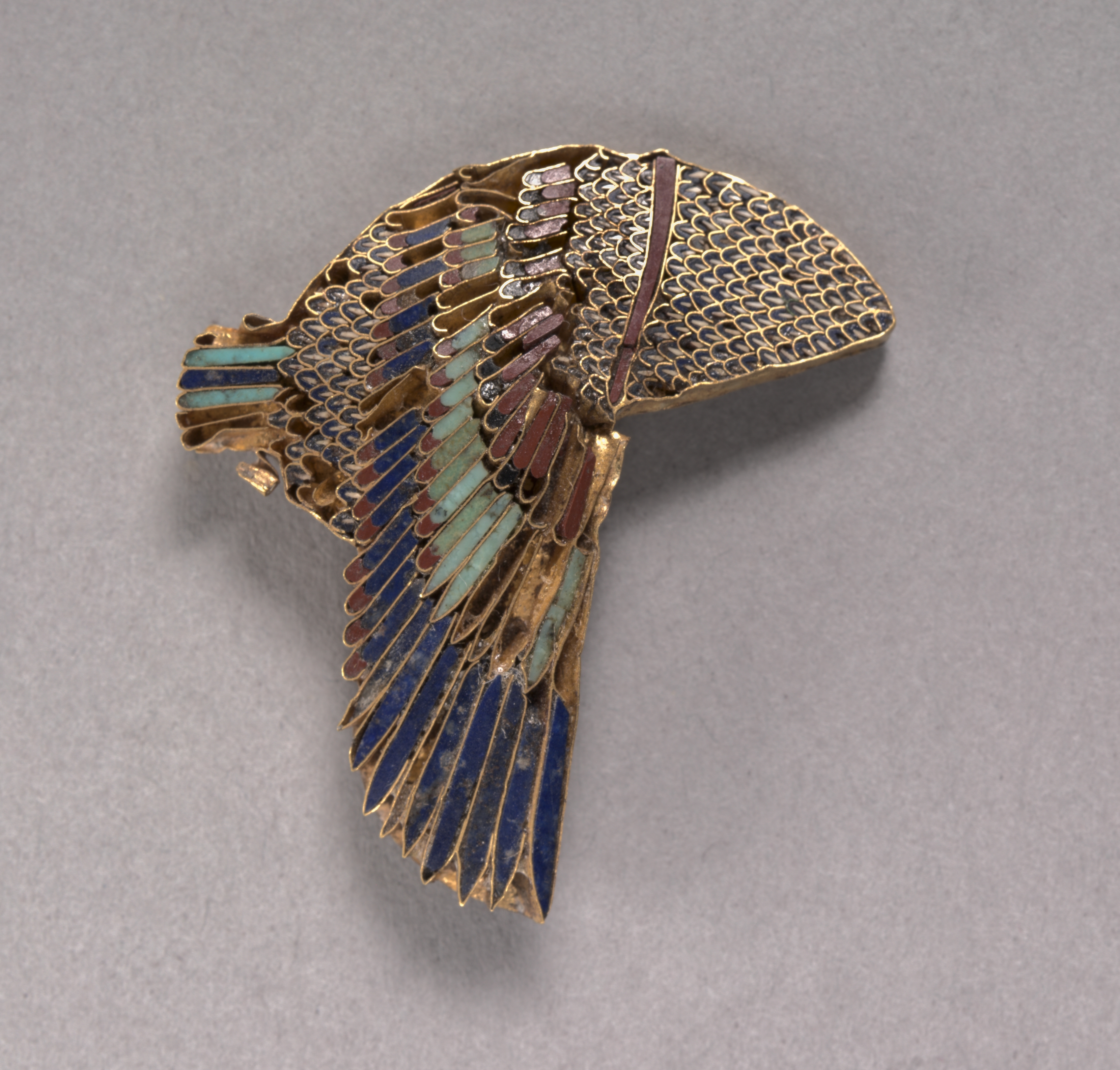
Vulture Headdress Inlay
The vulture headdress belonged to queens and to goddesses: the bird’s body sits over the crown with one wing sweeping down each side of the face. This gold inlay, its cells filled with cut stone, was built into a composite figure rather than worn — the kind of lapidary work Ptolemaic workshops made for temple and tomb.
3400 × 3248 px · Unmodified source file
Open in StudioSource & licensing
- Creator / date
- Egypt, Greco-Roman period (332 BCE–395 CE), Ptolemaic dynasty (305–30 BCE), maker unknown · 100–1 BCE
- Source credit
- The Cleveland Museum of Art, 1920.1991. Open Access.
- Usage notes
- Released by the Cleveland Museum of Art under CC0 1.0. Credit to the museum is encouraged; CC0 does not imply endorsement.
- Original file
- 3400 × 3248 px · JPG · 0.0 MB
- Source checked
- 2026-11-05 · editorial approval separate
CC0 · Public domain · 1980–1801 BCE
Sidelock (one of a pair)
A royal wig was a structure of its own. This electrum sidelock, one of a pair, was formed over a gesso core so the metal curls could hang beside the face without pulling it out of shape. Middle Kingdom royal jewellery survives mostly in pieces like this, separated from the body it dressed.
1992 × 3004 px · Unmodified source file
Open in StudioSource & licensing
- Creator / date
- Egypt, Middle Kingdom (2040–1648 BCE), Dynasty 12, maker unknown · 1980–1801 BCE
- Source credit
- The Cleveland Museum of Art, 1914.795.a. Open Access.
- Usage notes
- Released by the Cleveland Museum of Art under CC0 1.0. Credit to the museum is encouraged; CC0 does not imply endorsement.
- Original file
- 1992 × 3004 px · JPG · 0.0 MB
- Source checked
- 2026-11-05 · editorial approval separate
CC0 · Public domain · c. 1353–1337 BCE
Finger Ring with Frog
A gold ring cast with a frog on the bezel. In the Amarna period the frog carried fertility and the daily return of life out of water, and rings of this kind were personal ornaments rather than grave goods.
2563 × 2592 px · Unmodified source file
Open in StudioSource & licensing
- Creator / date
- Egypt, New Kingdom (1540–1069 BCE), Dynasty 18, reign of Akhenaten, maker unknown · c. 1353–1337 BCE
- Source credit
- The Cleveland Museum of Art, 1916.658. Open Access.
- Usage notes
- Released by the Cleveland Museum of Art under CC0 1.0. Credit to the museum is encouraged; CC0 does not imply endorsement.
- Original file
- 2563 × 2592 px · JPG · 0.0 MB
- Source checked
- 2026-11-05 · editorial approval separate
CC0 · Public domain · 1391–1353 BCE
Ring: Gazelle Eating Thicket
Faience — quartz paste glazed and fired — could be moulded and coloured in several tones, which made small scenes possible. Here a gazelle stretches up to browse a thicket, the whole landscape carried across the width of a ring.
3400 × 2707 px · Unmodified source file
Open in StudioSource & licensing
- Creator / date
- Egypt, New Kingdom, Dynasty 18, Amenhotep III–Akhenaten, maker unknown · 1391–1353 BCE
- Source credit
- The Cleveland Museum of Art, 1992.51. Open Access.
- Usage notes
- Released by the Cleveland Museum of Art under CC0 1.0. Credit to the museum is encouraged; CC0 does not imply endorsement.
- Original file
- 3400 × 2707 px · JPG · 0.0 MB
- Source checked
- 2026-11-05 · editorial approval separate
CC0 · Public domain · 945–715 BCE
Ring with Aegis of Nephthys
An aegis is the broad collar and head of a deity, carried on a staff or worn at the chest. Nephthys, sister of Isis and guardian of the dead, appears in turquoise faience on a ring made for private devotion.
2876 × 3400 px · Unmodified source file
Open in StudioSource & licensing
- Creator / date
- Egypt, Third Intermediate (1069–715 BCE), Dynasty 22, maker unknown · 945–715 BCE
- Source credit
- The Cleveland Museum of Art, 1916.659. Open Access.
- Usage notes
- Released by the Cleveland Museum of Art under CC0 1.0. Credit to the museum is encouraged; CC0 does not imply endorsement.
- Original file
- 2876 × 3400 px · JPG · 0.0 MB
- Source checked
- 2026-11-05 · editorial approval separate
CC0 · Public domain · c. 1391–1337 BCE
Lotus Blossom Necklace Terminal
The lotus opens at dawn and closes at night, so Egypt used it for rebirth and for beauty at once. This terminal closed a broad necklace, modelled in faience and inlaid with colour so the blossom still reads at a distance.
2367 × 2043 px · Unmodified source file
Open in StudioSource & licensing
- Creator / date
- Egypt, New Kingdom, Dynasty 18, Amenhotep III–Akhenaten, maker unknown · c. 1391–1337 BCE
- Source credit
- The Cleveland Museum of Art, 1984.176. Open Access.
- Usage notes
- Released by the Cleveland Museum of Art under CC0 1.0. Credit to the museum is encouraged; CC0 does not imply endorsement.
- Original file
- 2367 × 2043 px · JPG · 0.0 MB
- Source checked
- 2026-11-05 · editorial approval separate
CC0 · Public domain · 1540–1296 BCE
Fragment of a Necklace
What survives is the part that matters: steatite, glass, carnelian and faience beads in graded sizes and repeating intervals. Egyptian jewellery is built from that rhythm of colour and scale, and the pattern is legible even in fragments.
3400 × 2255 px · Unmodified source file
Open in StudioSource & licensing
- Creator / date
- Egypt, New Kingdom (1540–1069 BCE), Dynasty 18, maker unknown · 1540–1296 BCE
- Source credit
- The Cleveland Museum of Art, 1915.15. Open Access.
- Usage notes
- Released by the Cleveland Museum of Art under CC0 1.0. Credit to the museum is encouraged; CC0 does not imply endorsement.
- Original file
- 3400 × 2255 px · JPG · 0.0 MB
- Source checked
- 2026-11-05 · editorial approval separate
CC0 · Public domain · 1069–715 BCE
Pendant
Gold worked into openwork and set with turquoise. At this scale the design depends on silhouette: legible at a glance, changing as the body moves.
2004 × 2505 px · Unmodified source file
Open in StudioSource & licensing
- Creator / date
- Egypt, Third Intermediate (1069–715 BCE), Dynasties 21–22, maker unknown · 1069–715 BCE
- Source credit
- The Cleveland Museum of Art, 1989.39. Open Access.
- Usage notes
- Released by the Cleveland Museum of Art under CC0 1.0. Credit to the museum is encouraged; CC0 does not imply endorsement.
- Original file
- 2004 × 2505 px · JPG · 0.0 MB
- Source checked
- 2026-11-05 · editorial approval separate
CC0 · Public domain · c. 1380–1330 BCE
Frog Amulet
Frogs emerge with the Nile flood and stand for the goddess Heqet and for rebirth. Polychrome faience imitates the living mottling of the animal in glazed quartz.
1805 × 1444 px · Unmodified source file
Open in StudioSource & licensing
- Creator / date
- Egypt, New Kingdom (1540–1069 BCE), Dynasty 18, maker unknown · c. 1380–1330 BCE
- Source credit
- The Cleveland Museum of Art, 1980.123. Open Access.
- Usage notes
- Released by the Cleveland Museum of Art under CC0 1.0. Credit to the museum is encouraged; CC0 does not imply endorsement.
- Original file
- 1805 × 1444 px · JPG · 0.0 MB
- Source checked
- 2026-11-05 · editorial approval separate
CC0 · Public domain · c. 1069–715 BCE
Amulet of Bastet
Bastet, cat goddess of the home and of protection, carved in hematite — a hard iron oxide that takes a polish and holds fine detail. The weight and dark sheen of the stone were part of the amulet’s character, not an afterthought.
2076 × 2595 px · Unmodified source file
Open in StudioSource & licensing
- Creator / date
- Egypt, Third Intermediate (1069–715 BCE), maker unknown · c. 1069–715 BCE
- Source credit
- The Cleveland Museum of Art, 1973.29. Open Access.
- Usage notes
- Released by the Cleveland Museum of Art under CC0 1.0. Credit to the museum is encouraged; CC0 does not imply endorsement.
- Original file
- 2076 × 2595 px · JPG · 0.0 MB
- Source checked
- 2026-11-05 · editorial approval separate
CC0 · Public domain · 30 BCE–395 CE
Amulet of Bes
Bes, the dwarf god with a lion’s face, guarded households, mothers and children, and appears on furniture, mirrors and amulets rather than in temples. This one is modelled in the round in polychrome faience.
2810 × 3400 px · Unmodified source file
Open in StudioSource & licensing
- Creator / date
- Egypt, Greco-Roman period, Roman empire (30 BCE–395 CE), maker unknown · 30 BCE–395 CE
- Source credit
- The Cleveland Museum of Art, 1940.650. Open Access.
- Usage notes
- Released by the Cleveland Museum of Art under CC0 1.0. Credit to the museum is encouraged; CC0 does not imply endorsement.
- Original file
- 2810 × 3400 px · JPG · 0.0 MB
- Source checked
- 2026-11-05 · editorial approval separate
CC0 · Public domain · 2123–2040 BCE
Amulet of a Walking Baboon
The baboon is Thoth, god of writing and reckoning, and also the animal that greets the rising sun. Shown walking and glazed turquoise, it belongs to the First Intermediate period, when small figures were made with unusual freedom.
3400 × 2692 px · Unmodified source file
Open in StudioSource & licensing
- Creator / date
- Egypt, First Intermediate period (2123–2040 BCE), maker unknown · 2123–2040 BCE
- Source credit
- The Cleveland Museum of Art, 1914.793.1. Open Access.
- Usage notes
- Released by the Cleveland Museum of Art under CC0 1.0. Credit to the museum is encouraged; CC0 does not imply endorsement.
- Original file
- 3400 × 2692 px · JPG · 0.0 MB
- Source checked
- 2026-11-05 · editorial approval separate
Public-domain status is reported by the linked source and may vary by jurisdiction. Check the source record for your intended use. No exclusive rights or Visual Bounty marketplace license are offered for these images.