← Open CollectionsPublic-domain source library
Cut and Bitten: Dürer’s Prints
Albrecht Dürer worked in two graphic media that behave nothing alike. In a woodcut the image is left standing on the block and everything else is cut away, so the line is broad and the knife bites back against the drawing. In an engraving a burin pushes a furrow through copper, and the same hand can render silk, fur, cloud and skin at a scale of millimetres. Working in Nuremberg between 1497 and 1514, Dürer used both to make prints that travelled further than any painting of his time. These twelve sheets run from the Apocalypse woodcuts to the three master engravings.
Original means the unmodified digital file supplied by the linked archive, not an upscaled or reconstructed image. Sign in for free downloads. Studio uses a working preview up to 2048 px.
CC0 · Public domain · c. 1497
St. Jerome in Penitence
Jerome in the wilderness as a gaunt penitent kneeling before a crucifix: the learned translator of the Bible turned ascetic. One of Dürer’s earliest engravings.
2466 × 3400 px · Unmodified source file
Open in StudioSource & licensing
- Creator / date
- Albrecht Dürer (German, 1471–1528) · c. 1497
- Source credit
- The Cleveland Museum of Art, 1966.175. Open Access.
- Usage notes
- Released by the Cleveland Museum of Art under CC0 1.0. Credit to the museum is encouraged; CC0 does not imply endorsement.
- Original file
- 2466 × 3400 px · JPG · 0.0 MB
- Source checked
- 2026-11-04 · editorial approval separate
CC0 · Public domain · c. 1497
The Promenade
Death stalks a fashionable couple strolling in the countryside, balancing an hourglass on his head. Death as a companion rather than an interruption was a familiar figure in Dürer’s Nuremberg.
2145 × 3400 px · Unmodified source file
Open in StudioSource & licensing
- Creator / date
- Albrecht Dürer (German, 1471–1528) · c. 1497
- Source credit
- The Cleveland Museum of Art, 1953.139. Open Access.
- Usage notes
- Released by the Cleveland Museum of Art under CC0 1.0. Credit to the museum is encouraged; CC0 does not imply endorsement.
- Original file
- 2145 × 3400 px · JPG · 0.0 MB
- Source checked
- 2026-11-04 · editorial approval separate
CC0 · Public domain · c. 1498
The Four Horsemen, from The Apocalypse
In 1498 Dürer published a book illustrating the Revelation of John with fifteen woodcuts, the first time an artist printed and marketed his own illustrated book.
2451 × 3400 px · Unmodified source file
Open in StudioSource & licensing
- Creator / date
- Albrecht Dürer (German, 1471–1528) · c. 1498
- Source credit
- The Cleveland Museum of Art, 1932.313. Open Access.
- Usage notes
- Released by the Cleveland Museum of Art under CC0 1.0. Credit to the museum is encouraged; CC0 does not imply endorsement.
- Original file
- 2451 × 3400 px · JPG · 0.0 MB
- Source checked
- 2026-11-04 · editorial approval separate
CC0 · Public domain · c. 1498
The Virgin and Child with a Monkey
Catholic theology taught the Virgin as born without original sin, and Dürer carries the idea into botany and zoology: the enclosed garden, the monkey and the butterfly all mark her purity.
2263 × 3400 px · Unmodified source file
Open in StudioSource & licensing
- Creator / date
- Albrecht Dürer (German, 1471–1528) · c. 1498
- Source credit
- The Cleveland Museum of Art, 1964.29. Open Access.
- Usage notes
- Released by the Cleveland Museum of Art under CC0 1.0. Credit to the museum is encouraged; CC0 does not imply endorsement.
- Original file
- 2263 × 3400 px · JPG · 0.0 MB
- Source checked
- 2026-11-04 · editorial approval separate
CC0 · Public domain · c. 1498
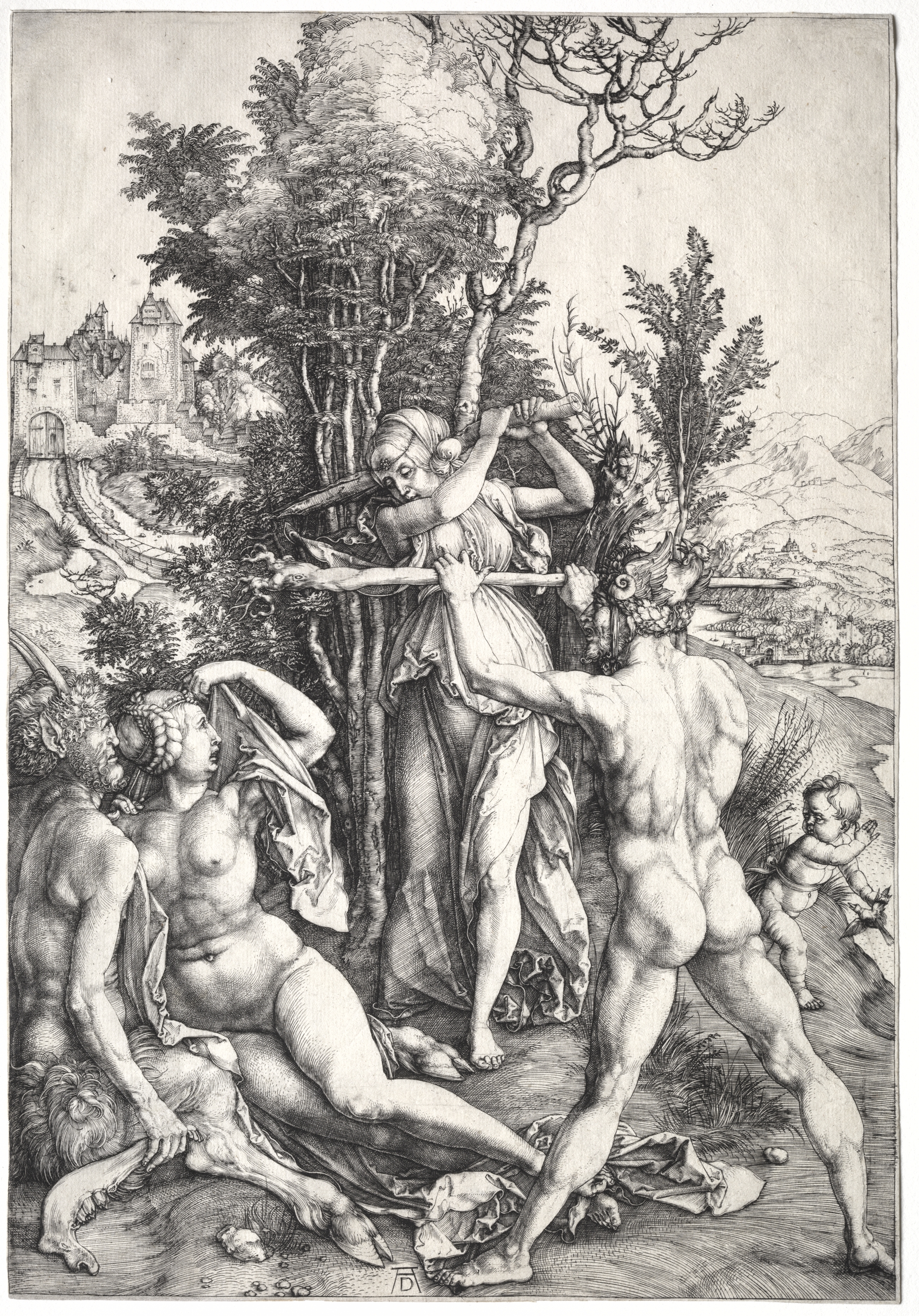
Hercules at the Crossroad
Dürer travelled from Nuremberg to Italy in 1494–95 and is thought to have stopped in Mantua to meet Mantegna. This engraving shows the classical research he brought home: Hercules choosing between virtue and pleasure.
2359 × 3400 px · Unmodified source file
Open in StudioSource & licensing
- Creator / date
- Albrecht Dürer (German, 1471–1528) · c. 1498
- Source credit
- The Cleveland Museum of Art, 1961.170. Open Access.
- Usage notes
- Released by the Cleveland Museum of Art under CC0 1.0. Credit to the museum is encouraged; CC0 does not imply endorsement.
- Original file
- 2359 × 3400 px · JPG · 0.0 MB
- Source checked
- 2026-11-04 · editorial approval separate
CC0 · Public domain · 1504
Adam and Eve
His iconic 1504 engraving, which spread natural symbolism across Europe. Both figures are built on classical sculptural models, and the animals around them are keyed to the four humours.
2629 × 3400 px · Unmodified source file
Open in StudioSource & licensing
- Creator / date
- Albrecht Dürer (German, 1471–1528) · 1504
- Source credit
- The Cleveland Museum of Art, 1944.473. Open Access.
- Usage notes
- Released by the Cleveland Museum of Art under CC0 1.0. Credit to the museum is encouraged; CC0 does not imply endorsement.
- Original file
- 2629 × 3400 px · JPG · 0.0 MB
- Source checked
- 2026-11-04 · editorial approval separate
CC0 · Public domain · c. 1503–5
The Flight into Egypt
A woodcut from the Life of the Virgin composed close to a scene in the Mirror of Holiness, a popular devotional text. Landscape, not the holy family, takes the most space.
2446 × 3400 px · Unmodified source file
Open in StudioSource & licensing
- Creator / date
- Albrecht Dürer (German, 1471–1528) · c. 1503–5
- Source credit
- The Cleveland Museum of Art, 1959.99.14. Open Access.
- Usage notes
- Released by the Cleveland Museum of Art under CC0 1.0. Credit to the museum is encouraged; CC0 does not imply endorsement.
- Original file
- 2446 × 3400 px · JPG · 0.0 MB
- Source checked
- 2026-11-04 · editorial approval separate
CC0 · Public domain · 1510
The Last Supper
The Eucharist traces to the Last Supper, when Christ said of the wine, “This is my blood.” The scene posed one hard problem for artists, Judas among the disciples, and Dürer seats John at Christ’s breast while Judas turns away.
2521 × 3400 px · Unmodified source file
Open in StudioSource & licensing
- Creator / date
- Albrecht Dürer (German, 1471–1528) · 1510
- Source credit
- The Cleveland Museum of Art, 1926.112. Open Access.
- Usage notes
- Released by the Cleveland Museum of Art under CC0 1.0. Credit to the museum is encouraged; CC0 does not imply endorsement.
- Original file
- 2521 × 3400 px · JPG · 0.0 MB
- Source checked
- 2026-11-04 · editorial approval separate
CC0 · Public domain · c. 1510–11
The Life of the Virgin
The frontispiece of the woodcut series, recutting a devotional image of the Virgin and Child standing in a crescent moon. Issued as a book in 1511, the series made him a publisher as well as an artist.
2891 × 3400 px · Unmodified source file
Open in StudioSource & licensing
- Creator / date
- Albrecht Dürer (German, 1471–1528) · c. 1510–11
- Source credit
- The Cleveland Museum of Art, 1959.99. Open Access.
- Usage notes
- Released by the Cleveland Museum of Art under CC0 1.0. Credit to the museum is encouraged; CC0 does not imply endorsement.
- Original file
- 2891 × 3400 px · JPG · 0.0 MB
- Source checked
- 2026-11-04 · editorial approval separate
CC0 · Public domain · 1512
St. Jerome Seated near a Pollard Willow
Of the hundreds of prints Dürer made, only three were drypoints, scratched directly into copper with a needle so the burr holds ink and the line comes up velvety and soft.
2961 × 3400 px · Unmodified source file
Open in StudioSource & licensing
- Creator / date
- Albrecht Dürer (German, 1471–1528) · 1512
- Source credit
- The Cleveland Museum of Art, 1925.72. Open Access.
- Usage notes
- Released by the Cleveland Museum of Art under CC0 1.0. Credit to the museum is encouraged; CC0 does not imply endorsement.
- Original file
- 2961 × 3400 px · JPG · 0.0 MB
- Source checked
- 2026-11-04 · editorial approval separate
CC0 · Public domain · 1513
Knight, Death, and the Devil
One of his three “masterworks,” with Melencolia and St Jerome in his Study. A mounted soldier rides past Death and the Devil without turning, in engraving so fine that Dürer printed it carefully and charged accordingly.
2643 × 3400 px · Unmodified source file
Open in StudioSource & licensing
- Creator / date
- Albrecht Dürer (German, 1471–1528) · 1513
- Source credit
- The Cleveland Museum of Art, 1965.231. Open Access.
- Usage notes
- Released by the Cleveland Museum of Art under CC0 1.0. Credit to the museum is encouraged; CC0 does not imply endorsement.
- Original file
- 2643 × 3400 px · JPG · 0.0 MB
- Source checked
- 2026-11-04 · editorial approval separate
CC0 · Public domain · 1514
Melencolia I
Dürer’s most argued-over print. Melancholy was bound to the creative temperament, and he surrounds the winged figure with the tools of geometry, a sleeping hound, a bat and a magic square whose rows all sum to 34.
2693 × 3400 px · Unmodified source file
Open in StudioSource & licensing
- Creator / date
- Albrecht Dürer (German, 1471–1528) · 1514
- Source credit
- The Cleveland Museum of Art, 1926.211. Open Access.
- Usage notes
- Released by the Cleveland Museum of Art under CC0 1.0. Credit to the museum is encouraged; CC0 does not imply endorsement.
- Original file
- 2693 × 3400 px · JPG · 0.0 MB
- Source checked
- 2026-11-04 · editorial approval separate
Public-domain status is reported by the linked source and may vary by jurisdiction. Check the source record for your intended use. No exclusive rights or Visual Bounty marketplace license are offered for these images.