← Open CollectionsPublic-domain source library
Carved and Cast: Ancient American Sculpture
Before the Spanish arrival, American sculptors worked jade, limestone, greenstone, shell, wood and gold with a technical command that European collections were slow to recognise. The Olmec polished jadeite by abrasion; Maya carvers dressed limestone into stelae built to be read in raking light; Veracruz workshops shaped ballgame equipment in stone as ceremony rather than equipment; Chimú and Wari artisans inlaid shell and gold into wood; and the metalsmiths of Colombia and Panama cast gold by the lost-wax method with a precision that made whole pendant families possible. This selection runs from an Olmec jade head of the first millennium BCE to Aztec cast gold, pairing the monumental with the handheld.
Original means the unmodified digital file supplied by the linked archive, not an upscaled or reconstructed image. Sign in for free downloads. Studio uses a working preview up to 2048 px.
CC0 · Public domain · c. 900–300 BCE
Head Fragment
Jadeite was the hardest and most precious stone in Mesoamerica and the Olmec worked it by abrasion, drilling and long polishing rather than by carving. This head, separated from the body it belonged to, keeps the soft swelling of the cheek and brow that Olmec sculptors used instead of detail.
3400 × 3242 px · Unmodified source file
Open in StudioSource & licensing
- Creator / date
- Mesoamerica, Mexico, Olmec, maker unknown · c. 900–300 BCE
- Source credit
- The Cleveland Museum of Art, 1961.31. Open Access.
- Usage notes
- Released by the Cleveland Museum of Art under CC0 1.0. Credit to the museum is encouraged; CC0 does not imply endorsement.
- Original file
- 3400 × 3242 px · JPG · 0.0 MB
- Source checked
- 2026-11-05 · editorial approval separate
CC0 · Public domain · c. 1200–600 BCE
Kneeling Figure
A small kneeling figure with the hands set on the knees, a posture of offering or attendance found across Olmec sculpture. The body is reduced to a few dense volumes: the stone is not described, it is displaced.
3400 × 3398 px · Unmodified source file
Open in StudioSource & licensing
- Creator / date
- Mexico, Guerrero, Olmec, maker unknown · c. 1200–600 BCE
- Source credit
- The Cleveland Museum of Art, 1951.179. Open Access.
- Usage notes
- Released by the Cleveland Museum of Art under CC0 1.0. Credit to the museum is encouraged; CC0 does not imply endorsement.
- Original file
- 3400 × 3398 px · JPG · 0.0 MB
- Source checked
- 2026-11-05 · editorial approval separate
CC0 · Public domain · 692
Front Face of a Stela
Maya stelae join an image and a text to fix a date: this one carries the year 692 and belonged to the city known as El Perú, or Waka’. The front of the stone was dressed flat so the ruler and the glyphs could be read together as a single record.
2328 × 3400 px · Unmodified source file
Open in StudioSource & licensing
- Creator / date
- Mesoamerica, Guatemala, El Perú (Waka’), Maya, maker unknown · 692
- Source credit
- The Cleveland Museum of Art, 1967.29. Open Access.
- Usage notes
- Released by the Cleveland Museum of Art under CC0 1.0. Credit to the museum is encouraged; CC0 does not imply endorsement.
- Original file
- 2328 × 3400 px · JPG · 0.0 MB
- Source checked
- 2026-11-05 · editorial approval separate
CC0 · Public domain · c. 795
Panel with Royal Woman
A limestone panel carved with a royal woman in the dress and posture used for court portraiture along the Usumacinta. Panels like this were set into architecture, so the relief was designed for raking light rather than for a viewer standing square on.
3400 × 2939 px · Unmodified source file
Open in StudioSource & licensing
- Creator / date
- Guatemala or Mexico, Usumacinta River region, Maya, maker unknown · c. 795
- Source credit
- The Cleveland Museum of Art, 1962.32. Open Access.
- Usage notes
- Released by the Cleveland Museum of Art under CC0 1.0. Credit to the museum is encouraged; CC0 does not imply endorsement.
- Original file
- 3400 × 2939 px · JPG · 0.0 MB
- Source checked
- 2026-11-05 · editorial approval separate
CC0 · Public domain · 600–900
Shell with Seated Noble
A conch shell carved with a seated noble. The Maya cut shell as an ornament and as a support for fine relief, and the spiral of the shell becomes the frame the figure sits inside, so the material and the subject shape each other.
2401 × 3400 px · Unmodified source file
Open in StudioSource & licensing
- Creator / date
- Mexico or Central America, Maya, maker unknown · 600–900
- Source credit
- The Cleveland Museum of Art, 1965.550. Open Access.
- Usage notes
- Released by the Cleveland Museum of Art under CC0 1.0. Credit to the museum is encouraged; CC0 does not imply endorsement.
- Original file
- 2401 × 3400 px · JPG · 0.0 MB
- Source checked
- 2026-11-05 · editorial approval separate
CC0 · Public domain · 600–900
Ballgame Hip Protector (Yoke)
The ballgame yoke was the padded weight worn at the hip to strike the ball, and greenstone versions like this one were made as ceremonial objects — too heavy to wear in play. The shape is the equipment, carved in stone as a permanent statement of the game’s importance.
3400 × 2162 px · Unmodified source file
Open in StudioSource & licensing
- Creator / date
- Mexico, Gulf Coast, Classic Veracruz, maker unknown · 600–900
- Source credit
- The Cleveland Museum of Art, 1973.213. Open Access.
- Usage notes
- Released by the Cleveland Museum of Art under CC0 1.0. Credit to the museum is encouraged; CC0 does not imply endorsement.
- Original file
- 3400 × 2162 px · JPG · 0.0 MB
- Source checked
- 2026-11-05 · editorial approval separate
CC0 · Public domain · c. 900–1100
Ballgame Palma
A palma was the thin stone finial mounted on the yoke, rising above the player’s chest during the game. Carved as a blade with relief along its face, it turns a piece of protective gear into a plaque meant to be seen.
2291 × 3400 px · Unmodified source file
Open in StudioSource & licensing
- Creator / date
- Mexico, Gulf Coast, Classic Veracruz, maker unknown · c. 900–1100
- Source credit
- The Cleveland Museum of Art, 1973.3. Open Access.
- Usage notes
- Released by the Cleveland Museum of Art under CC0 1.0. Credit to the museum is encouraged; CC0 does not imply endorsement.
- Original file
- 2291 × 3400 px · JPG · 0.0 MB
- Source checked
- 2026-11-05 · editorial approval separate
CC0 · Public domain · 1325–1521
Seated Male Carrying Maize
A seated man holding a maize cob, carved in the compact, frontal manner of Aztec stonework. Maize was the substance of daily life and of the calendar, and a figure carrying it is at once a farmer and an emblem of the world’s provision.
3400 × 3171 px · Unmodified source file
Open in StudioSource & licensing
- Creator / date
- Central Mexico, Aztec style, maker unknown · 1325–1521
- Source credit
- The Cleveland Museum of Art, 1949.555. Open Access.
- Usage notes
- Released by the Cleveland Museum of Art under CC0 1.0. Credit to the museum is encouraged; CC0 does not imply endorsement.
- Original file
- 3400 × 3171 px · JPG · 0.0 MB
- Source checked
- 2026-11-05 · editorial approval separate
CC0 · Public domain · after 1325
Figure of a Warrior
Cast in a gold-silver-copper alloy, the mixture Aztec metalsmiths used because it flows well and takes a warm colour. The warrior is modelled by the lost-wax method, so the detail — stance, weapon, ornament — comes from wax before it exists in metal at all.
2597 × 3400 px · Unmodified source file
Open in StudioSource & licensing
- Creator / date
- Central Mexico, Tetzcoco (?), Aztec, maker unknown · after 1325
- Source credit
- The Cleveland Museum of Art, 1984.37. Open Access.
- Usage notes
- Released by the Cleveland Museum of Art under CC0 1.0. Credit to the museum is encouraged; CC0 does not imply endorsement.
- Original file
- 2597 × 3400 px · JPG · 0.0 MB
- Source checked
- 2026-11-05 · editorial approval separate
CC0 · Public domain · c. 500–200 BCE
Plaque
Gold hammered thin and cut into an image with raised, symmetrical forms — Chavín design built on mirroring, so the figure reads equally either way up. Plaques of this kind were probably sewn to cloth, which means the wearer’s movement was part of the work.
3400 × 2464 px · Unmodified source file
Open in StudioSource & licensing
- Creator / date
- Peru, North Coast, Chongoyape (?), Chavín style, maker unknown · c. 500–200 BCE
- Source credit
- The Cleveland Museum of Art, 1938.431. Open Access.
- Usage notes
- Released by the Cleveland Museum of Art under CC0 1.0. Credit to the museum is encouraged; CC0 does not imply endorsement.
- Original file
- 3400 × 2464 px · JPG · 0.0 MB
- Source checked
- 2026-11-05 · editorial approval separate
CC0 · Public domain · 1185–1275
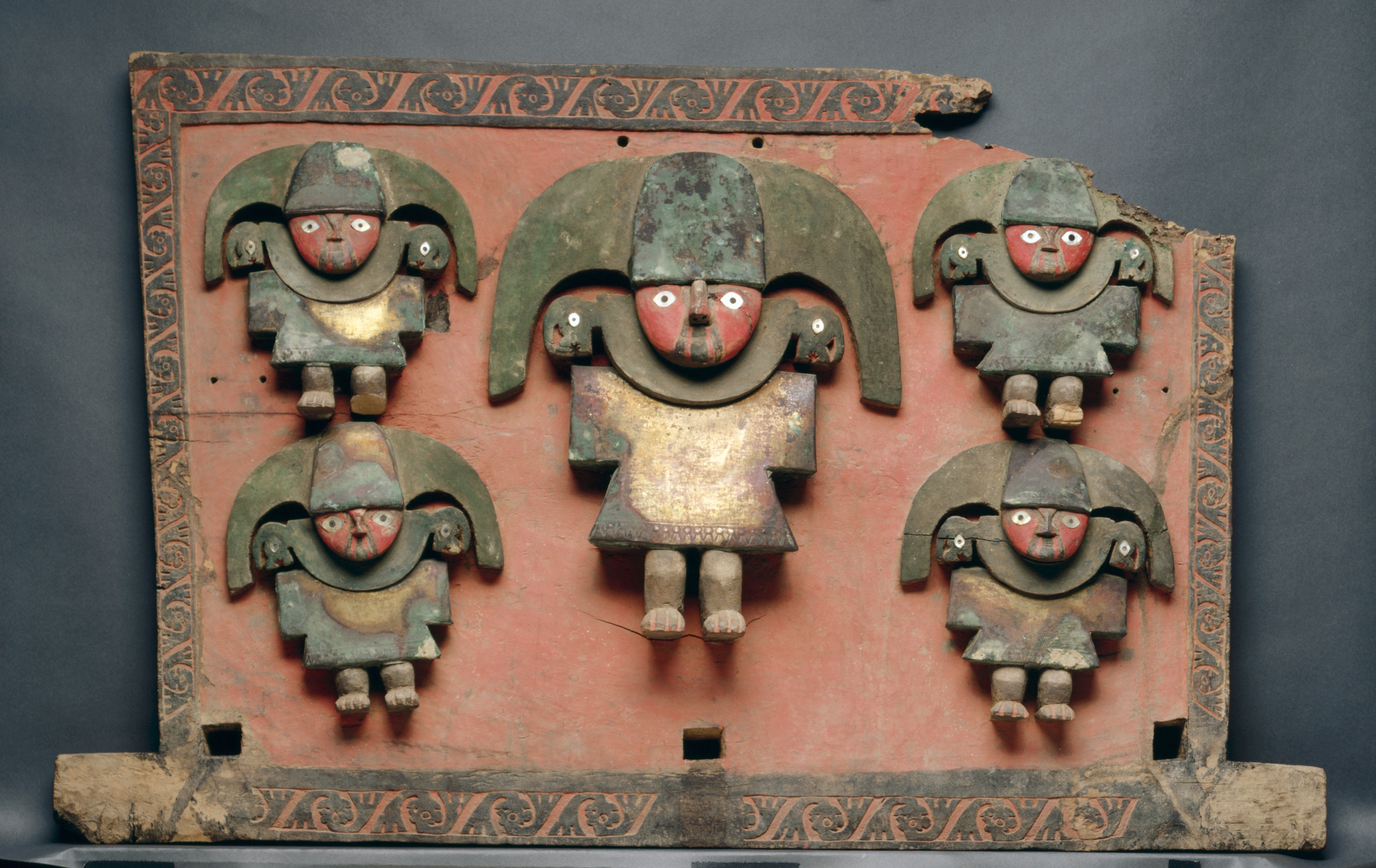
Backrest of a Litter
Carved wood with gold alloy, pigment and shell inlay: the back of a litter in which a lord was carried. Chimú display was built on surfaces — gold sheet, inlay, colour — and the object was made to be seen at a distance and from below, above the crowd.
3400 × 2383 px · Unmodified source file
Open in StudioSource & licensing
- Creator / date
- Central Andes, North Coast, Chimú people, maker unknown · 1185–1275
- Source credit
- The Cleveland Museum of Art, 1952.233. Open Access.
- Usage notes
- Released by the Cleveland Museum of Art under CC0 1.0. Credit to the museum is encouraged; CC0 does not imply endorsement.
- Original file
- 3400 × 2383 px · JPG · 0.0 MB
- Source checked
- 2026-11-05 · editorial approval separate
CC0 · Public domain · 770–890
Sacrificer Container
A carved wooden container still holding cinnabar, the red mercury ore used for offering and burial. Wari workshops made small vessels for ritual paraphernalia, and the figure carved on the wood carries the role the object served.
3381 × 3400 px · Unmodified source file
Open in StudioSource & licensing
- Creator / date
- Central Andes, Wari style, maker unknown · 770–890
- Source credit
- The Cleveland Museum of Art, 2007.193. Open Access.
- Usage notes
- Released by the Cleveland Museum of Art under CC0 1.0. Credit to the museum is encouraged; CC0 does not imply endorsement.
- Original file
- 3381 × 3400 px · JPG · 0.0 MB
- Source checked
- 2026-11-05 · editorial approval separate
CC0 · Public domain · 400–1000
Finial with Bird
A cast gold finial for a staff, the bird’s crest and beak exaggerated until the head reads as an emblem rather than a species. Sinú founders worked with lost-wax casting and could reproduce a shape exactly, which is why pendants and finials in this style come in close families.
2710 × 3400 px · Unmodified source file
Open in StudioSource & licensing
- Creator / date
- Isthmian Region (Colombia), Sinú (Zenú), maker unknown · 400–1000
- Source credit
- The Cleveland Museum of Art, 2015.3. Open Access.
- Usage notes
- Released by the Cleveland Museum of Art under CC0 1.0. Credit to the museum is encouraged; CC0 does not imply endorsement.
- Original file
- 2710 × 3400 px · JPG · 0.0 MB
- Source checked
- 2026-11-05 · editorial approval separate
CC0 · Public domain · 1000–1550
Feline Pendant
A gold feline worn at the chest, cast so the animal’s body doubles as the loop for the cord. In the Isthmian region gold was worn by the living and buried with the dead, and the same pendant type appears in both contexts.
3400 × 2550 px · Unmodified source file
Open in StudioSource & licensing
- Creator / date
- Isthmian Region, Panama–Costa Rica, Veraguas-Chiriquí style, maker unknown · 1000–1550
- Source credit
- The Cleveland Museum of Art, 2015.11. Open Access.
- Usage notes
- Released by the Cleveland Museum of Art under CC0 1.0. Credit to the museum is encouraged; CC0 does not imply endorsement.
- Original file
- 3400 × 2550 px · JPG · 0.0 MB
- Source checked
- 2026-11-05 · editorial approval separate
CC0 · Public domain · 600–800
Seated Lord with Removable Headdress
Maya figurines from Jaina Island were made in moulds, then finished by hand, and many were buried with the dead rather than used in life. The headdress lifts off this one, which means the figure could be dressed for a particular occasion — and that the object was handled, not just displayed.
2459 × 3400 px · Unmodified source file
Open in StudioSource & licensing
- Creator / date
- Mesoamerica, Maya, probably Jaina Island, maker unknown · 600–800
- Source credit
- The Cleveland Museum of Art, 2012.33. Open Access.
- Usage notes
- Released by the Cleveland Museum of Art under CC0 1.0. Credit to the museum is encouraged; CC0 does not imply endorsement.
- Original file
- 2459 × 3400 px · JPG · 0.0 MB
- Source checked
- 2026-11-05 · editorial approval separate
Public-domain status is reported by the linked source and may vary by jurisdiction. Check the source record for your intended use. No exclusive rights or Visual Bounty marketplace license are offered for these images.