← Open Collections

Public-domain source library

Alphabets & Letterforms

Before type, the decorated alphabet was drawn by hand and sold as a pattern sheet: plate after plate of capitals for sign painters, embroiderers and goldsmiths to copy. These engravings run from the 1460s to the 1750s, passing through ribbon alphabets, blackwork pattern sheets and rocaille capitals. Each set is a working document rather than a book page, made to be traced until the paper wore out.

Explore the works and their histories through the original collections and institutions that preserve them. Source images are available to download, with creative exploration in Studio.

Works
12
Sources
1
Makers
7
Dates
1466–67 · 1542 · early 17th century
One plate from the earliest engraved alphabet series in Europe, cut in the 1460s. Master E.S. set the letter in a frame of ornament and let the letterform itself carry the ornament, a decision every decorated alphabet after this one answers to.

1466–67

The Letter E, from The Alphabet

One plate from the earliest engraved alphabet series in Europe, cut in the 1460s. Master E.S. set the letter in a frame of ornament and let the letterform itself carry the ornament, a decision every decorated alphabet after this one answers to.

× px

Small archival scan: best for reference and screen use, not large prints.

Open in Studio
Source & credits
Creator / date
Master E.S. (German) · 1466–67
Source credit
Gift of Mr. and Mrs. L. von Hoffmann, 2013. The Metropolitan Museum of Art.
Original file
Dimensions unavailable · JPG
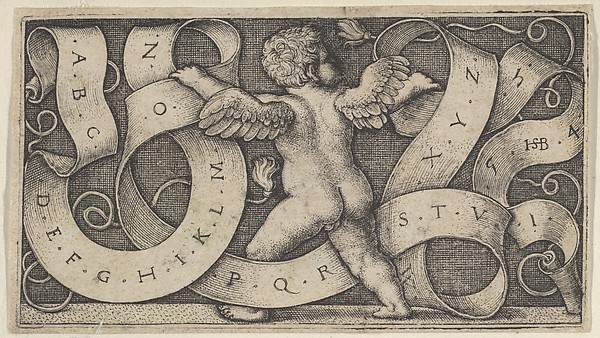
Beham winds the whole alphabet into a ribbon carried by a winged figure, so the sequence of letters becomes a single looping line. It is a designer’s trick as much as a print: the alphabet read as ornament, not as text.

1542

Genius Surrounded by a Banderole Showing the Alphabet

Beham winds the whole alphabet into a ribbon carried by a winged figure, so the sequence of letters becomes a single looping line. It is a designer’s trick as much as a print: the alphabet read as ornament, not as text.

× px

Small archival scan: best for reference and screen use, not large prints.

Open in Studio
Source & credits
Creator / date
Sebald Beham (German) · 1542
Source credit
Rogers Fund, 1962. The Metropolitan Museum of Art.
Original file
Dimensions unavailable · JPG
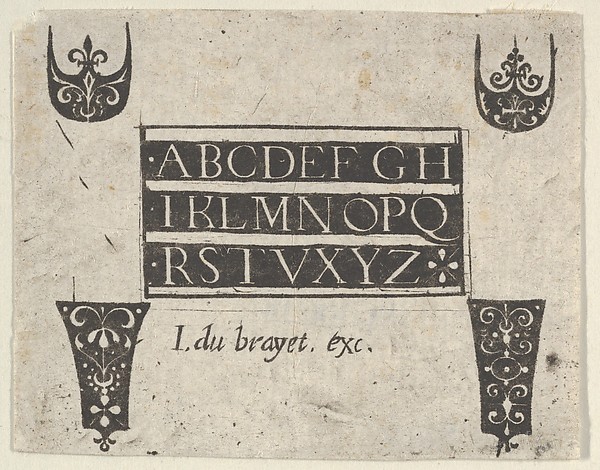
A pattern sheet for needleworkers and goldsmiths at once, offering a stitched alphabet beside four pendant designs. Sheets like this one are where the alphabet left the book and entered the workshop.

early 17th century

Blackwork Design with Alphabet and Four Jewelry Design Motifs

A pattern sheet for needleworkers and goldsmiths at once, offering a stitched alphabet beside four pendant designs. Sheets like this one are where the alphabet left the book and entered the workshop.

× px

Small archival scan: best for reference and screen use, not large prints.

Open in Studio
Source & credits
Creator / date
Jean du Brayet (French) · early 17th century
Source credit
Rogers Fund, 1919. The Metropolitan Museum of Art.
Original file
Dimensions unavailable · JPG
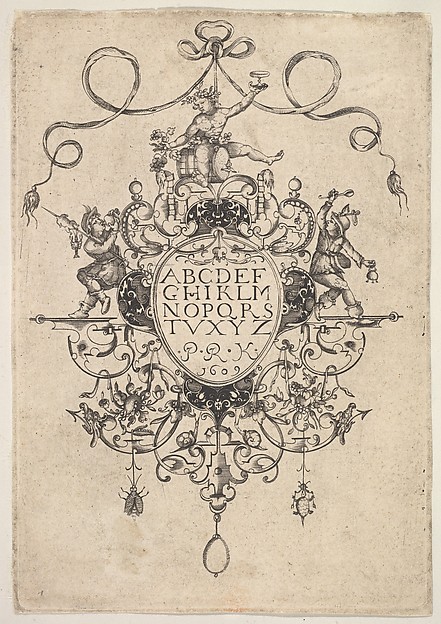
A jewel designed to hold letters: the plate sets an alphabet into a hanging pendant so a wearer could choose a monogram. Print, ornament and personal mark converge on one small object.

1609

Design for a Pendant with the Alphabet

A jewel designed to hold letters: the plate sets an alphabet into a hanging pendant so a wearer could choose a monogram. Print, ornament and personal mark converge on one small object.

× px

Small archival scan: best for reference and screen use, not large prints.

Open in Studio
Source & credits
Creator / date
Master P.R.K (Dutch) · 1609
Source credit
Harris Brisbane Dick Fund, 1942. The Metropolitan Museum of Art.
Original file
Dimensions unavailable · JPG
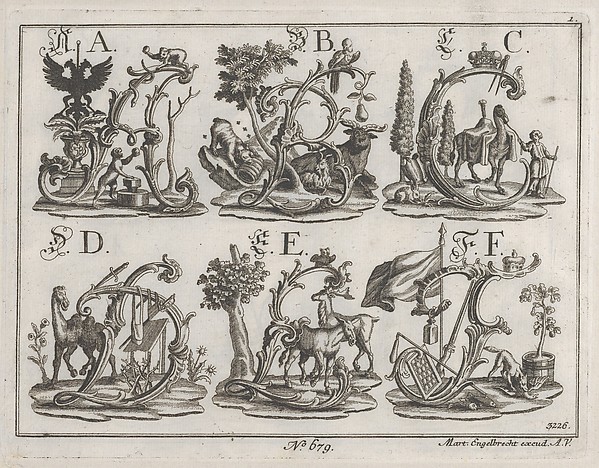
An engraver’s copy plate of decorated capitals, made to be traced and reused by painters, sign writers and craftsmen. Studying these plates is still the fastest way to understand how ornament sits inside a letter.

18th century

Decorated Roman alphabet

An engraver’s copy plate of decorated capitals, made to be traced and reused by painters, sign writers and craftsmen. Studying these plates is still the fastest way to understand how ornament sits inside a letter.

× px

Small archival scan: best for reference and screen use, not large prints.

Open in Studio
Source & credits
Creator / date
Martin Engelbrecht (German) · 18th century
Source credit
Purchase, Mrs. John D. Gordon Gift, in memory of William M. Ivins Jr., 1963. The Metropolitan Museum of Art.
Original file
Dimensions unavailable · JPG
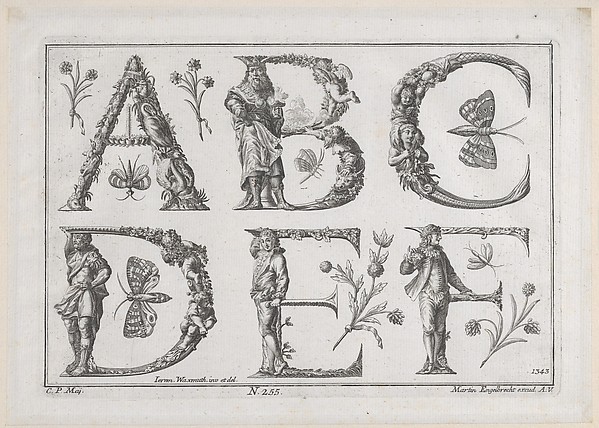
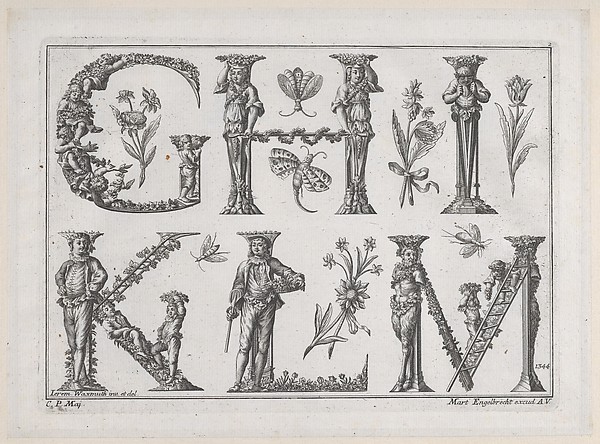
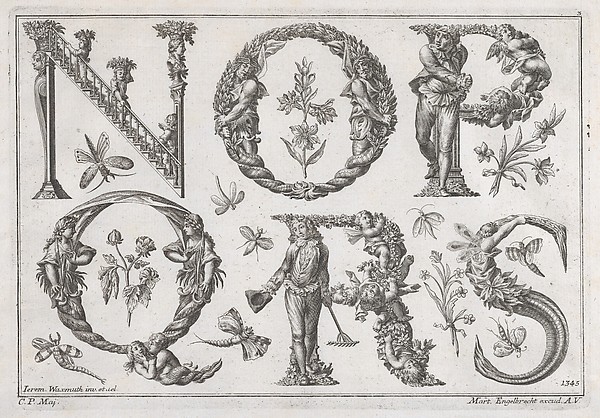
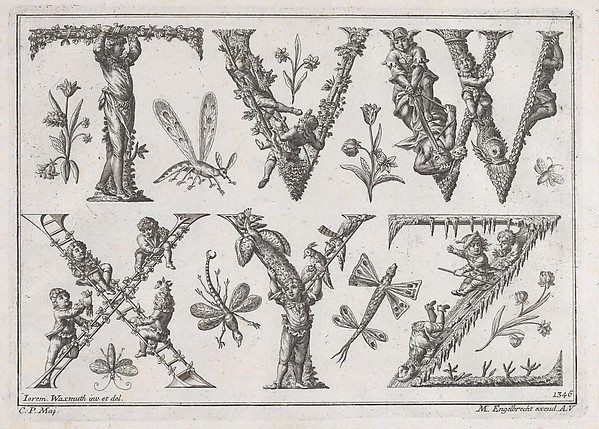
Wachsmuth’s capitals turn each letter into a small scene, figural ornament growing out of the stem and the bowl. Printed as a set for decorative painters, the plates circulated widely enough to shape eighteenth-century shop signs.

18th century

Decorated Roman alphabet

Wachsmuth’s capitals turn each letter into a small scene, figural ornament growing out of the stem and the bowl. Printed as a set for decorative painters, the plates circulated widely enough to shape eighteenth-century shop signs.

× px

Small archival scan: best for reference and screen use, not large prints.

Open in Studio
Source & credits
Creator / date
Jeremias Wachsmuth (German) · 18th century
Source credit
Purchase, Mrs. John D. Gordon Gift, in memory of William M. Ivins Jr., 1963. The Metropolitan Museum of Art.
Original file
Dimensions unavailable · JPG
A second sheet from the same series, with the ornament resolved differently across the alphabet. Read as a sequence, the plates show a designer working out one idea against twenty-six different shapes.

18th century

Decorated Roman alphabet

A second sheet from the same series, with the ornament resolved differently across the alphabet. Read as a sequence, the plates show a designer working out one idea against twenty-six different shapes.

× px

Small archival scan: best for reference and screen use, not large prints.

Open in Studio
Source & credits
Creator / date
Jeremias Wachsmuth (German) · 18th century
Source credit
Purchase, Mrs. John D. Gordon Gift, in memory of William M. Ivins Jr., 1963. The Metropolitan Museum of Art.
Original file
Dimensions unavailable · JPG
Another sheet of Wachsmuth capitals, engraved for workshop use rather than for reading. The letters are drawn as objects: heavy, symmetrical and legible at the distance of a shop front.

18th century

Decorated Roman alphabet

Another sheet of Wachsmuth capitals, engraved for workshop use rather than for reading. The letters are drawn as objects: heavy, symmetrical and legible at the distance of a shop front.

× px

Small archival scan: best for reference and screen use, not large prints.

Open in Studio
Source & credits
Creator / date
Jeremias Wachsmuth (German) · 18th century
Source credit
Purchase, Mrs. John D. Gordon Gift, in memory of William M. Ivins Jr., 1963. The Metropolitan Museum of Art.
Original file
Dimensions unavailable · JPG
The clearest of the group at plate scale, with the ornament kept subordinate to the letter. Useful as a reference for anyone building a display face from historical parts.

18th century

Decorated Roman alphabet

The clearest of the group at plate scale, with the ornament kept subordinate to the letter. Useful as a reference for anyone building a display face from historical parts.

× px

Small archival scan: best for reference and screen use, not large prints.

Open in Studio
Source & credits
Creator / date
Jeremias Wachsmuth (German) · 18th century
Source credit
Purchase, Mrs. John D. Gordon Gift, in memory of William M. Ivins Jr., 1963. The Metropolitan Museum of Art.
Original file
Dimensions unavailable · JPG
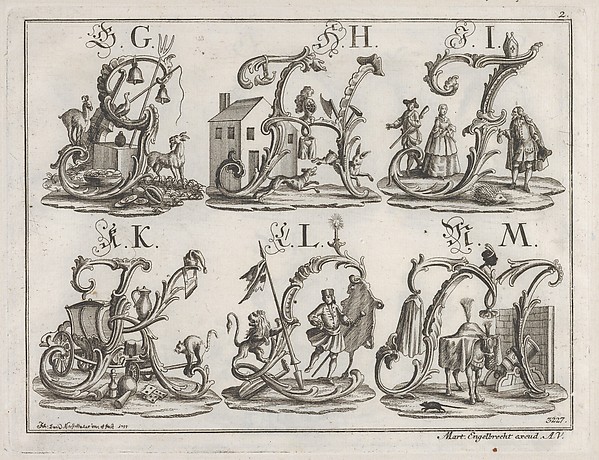
Nessenthaler’s alphabet of 1755 pushes the ornament further, with rocaille and shellwork wrapping the strokes. Dated plates like this one anchor the series in a specific moment of German decorative printing.

1755

Decorated Roman alphabet

Nessenthaler’s alphabet of 1755 pushes the ornament further, with rocaille and shellwork wrapping the strokes. Dated plates like this one anchor the series in a specific moment of German decorative printing.

× px

Small archival scan: best for reference and screen use, not large prints.

Open in Studio
Source & credits
Creator / date
Johann David Nessenthaler (German) · 1755
Source credit
Purchase, Mrs. John D. Gordon Gift, in memory of William M. Ivins Jr., 1963. The Metropolitan Museum of Art.
Original file
Dimensions unavailable · JPG
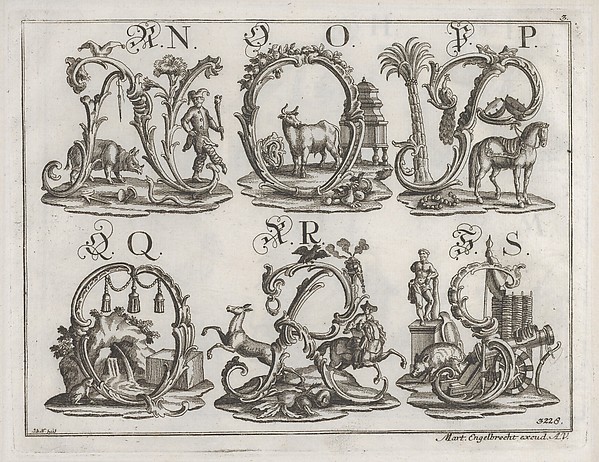
A companion sheet from Nessenthaler’s set, where the same vocabulary of shells and scrolls is adapted to a different run of letters. The comparison between sheets is the point: ornament bends, the skeleton stays.

18th century

Decorated Roman alphabet

A companion sheet from Nessenthaler’s set, where the same vocabulary of shells and scrolls is adapted to a different run of letters. The comparison between sheets is the point: ornament bends, the skeleton stays.

× px

Small archival scan: best for reference and screen use, not large prints.

Open in Studio
Source & credits
Creator / date
Johann David Nessenthaler (German) · 18th century
Source credit
Purchase, Mrs. John D. Gordon Gift, in memory of William M. Ivins Jr., 1963. The Metropolitan Museum of Art.
Original file
Dimensions unavailable · JPG
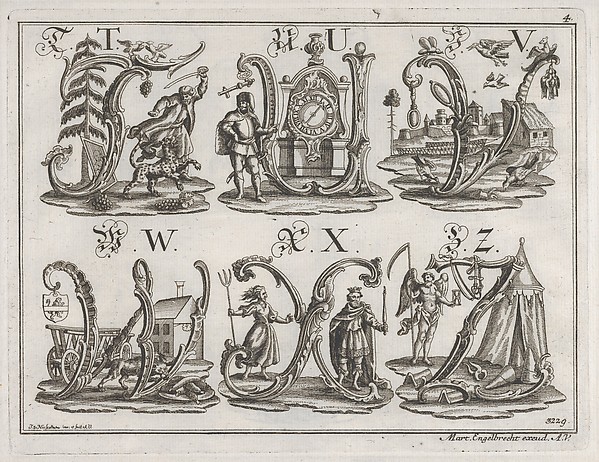
The last of the Nessenthaler plates in this group, closing the alphabet with the same density it opened with. Clean engravings, even impression, and a full set of capitals to lift detail from.

18th century

Decorated Roman alphabet

The last of the Nessenthaler plates in this group, closing the alphabet with the same density it opened with. Clean engravings, even impression, and a full set of capitals to lift detail from.

× px

Small archival scan: best for reference and screen use, not large prints.

Open in Studio
Source & credits
Creator / date
Johann David Nessenthaler (German) · 18th century
Source credit
Purchase, Mrs. John D. Gordon Gift, in memory of William M. Ivins Jr., 1963. The Metropolitan Museum of Art.
Original file
Dimensions unavailable · JPG