← Open CollectionsPublic-domain source library
Album: Persian and Mughal Painting
Mughal and Persian painters worked on paper made for albums, where a single page could hold a portrait, a poem, a border of animals and a colophon naming the scribe. Paper was itself a luxury, sized and burnished until the surface took gouache and gold without bleeding. These seventeen pages, made between the twelfth and eighteenth centuries in Tabriz, Herat, Shiraz, Allahabad and the Mughal courts, are arranged the way an album would be: courtiers and emperors beside animals, a Qur’an page beside a book of poems, each surrounded by a border that is a picture in its own right.
Original means the unmodified digital file supplied by the linked archive, not an upscaled or reconstructed image. Sign in for free downloads. Studio uses a working preview up to 2048 px.
CC0 · Public domain · c. 1585; border added probably 1700s
A royal ram with a gold chain
A ram kept in the imperial menagerie, groomed and collared with a gold chain, painted at the Mughal court around 1585. Animal portraits of this kind belong to the same project as the court’s human portraits: a naturalism that treated the observed world as worth recording in detail.
3400 × 2919 px · Unmodified source file
Open in StudioSource & licensing
- Creator / date
- India, Mughal, maker unknown · c. 1585; border added probably 1700s
- Source credit
- The Cleveland Museum of Art, 2013.298. Open Access.
- Usage notes
- Released by the Cleveland Museum of Art under CC0 1.0. Credit to the museum is encouraged; CC0 does not imply endorsement.
- Original file
- 3400 × 2919 px · JPG · 0.0 MB
- Source checked
- 2026-11-04 · editorial approval separate
CC0 · Public domain · c. 1575; border added probably 1700s
A Mughal courtier
Among the earliest surviving individual portraits from the Mughal atelier, made about 1575. The sitter is unidentified and uninscribed, since studies like this were made as likenesses rather than as records of office.
2550 × 3400 px · Unmodified source file
Open in StudioSource & licensing
- Creator / date
- Mughal India, court of Akbar (reigned 1556–1605), maker unknown · c. 1575; border added probably 1700s
- Source credit
- The Cleveland Museum of Art, 2013.294. Open Access.
- Usage notes
- Released by the Cleveland Museum of Art under CC0 1.0. Credit to the museum is encouraged; CC0 does not imply endorsement.
- Original file
- 2550 × 3400 px · JPG · 0.0 MB
- Source checked
- 2026-11-04 · editorial approval separate
CC0 · Public domain · c. 1627
Nur Jahan holding a portrait of Emperor Jahangir
Nur Jahan, favourite wife of the emperor Jahangir, holds a formal portrait of her husband, who appears aged and grey. Painted around 1627, the image makes the empress the holder of the imperial likeness.
2000 × 3400 px · Unmodified source file
Open in StudioSource & licensing
- Creator / date
- Bishandas (Indian) · c. 1627
- Source credit
- The Cleveland Museum of Art, 2013.325. Open Access.
- Usage notes
- Released by the Cleveland Museum of Art under CC0 1.0. Credit to the museum is encouraged; CC0 does not imply endorsement.
- Original file
- 2000 × 3400 px · JPG · 0.0 MB
- Source checked
- 2026-11-04 · editorial approval separate
CC0 · Public domain · c. 1602–3; borders added c. 1700s
Akbar supervising the capture of wild elephants at Malwa in 1564, painting 90 from an Akbar-nama (Book of Akbar) of Abu’l Fazl (Indian 1551–1602)
Akbar supervises the capture of wild elephants at Malwa in 1564, from a biography of the emperor made shortly before his death. A remembered event becomes a crowded composition built out of a single flowing line of animals and riders.
3400 × 2658 px · Unmodified source file
Open in StudioSource & licensing
- Creator / date
- Farukh Chela (Indian); Govardhan (Indian, active c.1596–1645); Dhanraj (Indian) · c. 1602–3; borders added c. 1700s
- Source credit
- The Cleveland Museum of Art, 2013.309. Open Access.
- Usage notes
- Released by the Cleveland Museum of Art under CC0 1.0. Credit to the museum is encouraged; CC0 does not imply endorsement.
- Original file
- 3400 × 2658 px · JPG · 0.0 MB
- Source checked
- 2026-11-04 · editorial approval separate
CC0 · Public domain · c. 1558–60; borders added probably 1700s
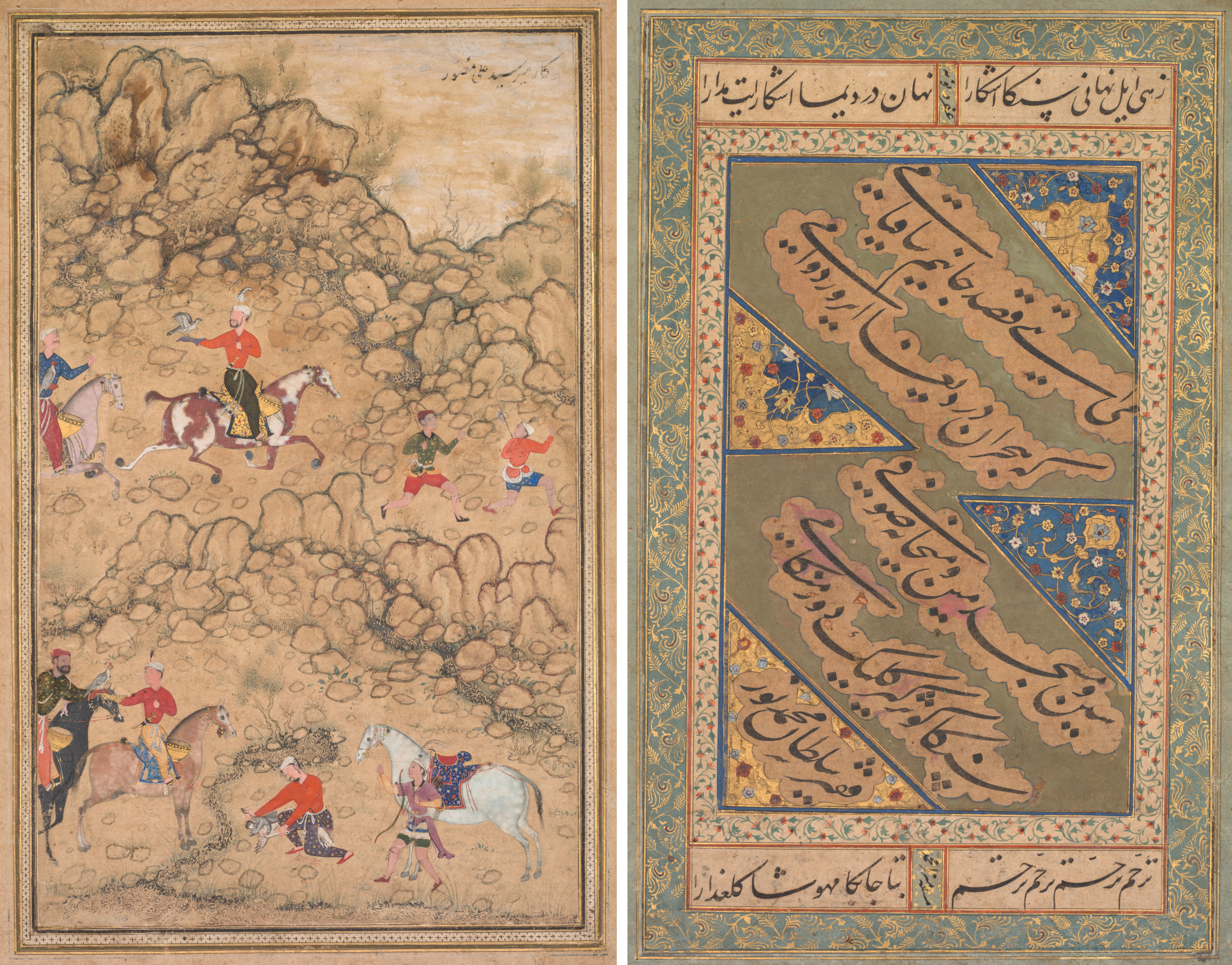
Hunting with falcons in a landscape; verso: Calligraphy of Chaghatai Turkish poems in praise of wine, Sultan Muhammad Nur (Persian, c. 1472–1536) and Mirza Muhammad (probably Persian, active c. 1520s)
The Mughals hunted on horseback with falcons: the party rode out, flushed the prey, and released the bird once its hood was removed. The landscape behind is drawn as a series of coloured terraces, each with its own flowers.
3400 × 2663 px · Unmodified source file
Open in StudioSource & licensing
- Creator / date
- Abd al-Samad (Persian, c. 1510–1600) · c. 1558–60; borders added probably 1700s
- Source credit
- The Cleveland Museum of Art, 2013.292. Open Access.
- Usage notes
- Released by the Cleveland Museum of Art under CC0 1.0. Credit to the museum is encouraged; CC0 does not imply endorsement.
- Original file
- 3400 × 2663 px · JPG · 0.0 MB
- Source checked
- 2026-11-04 · editorial approval separate
CC0 · Public domain · probably 1619
Portrait of Raja Jagat Singh of Nurpur (reigned 1618–46)
Raja Jagat Singh of Nurpur, a prince from the Himalayan foothills raised at Jahangir’s court, painted probably in 1619. The profile fixes his rank through dress and posture rather than through any action.
2324 × 3400 px · Unmodified source file
Open in StudioSource & licensing
- Creator / date
- Bichitr (Indian, active c. 1615–50) · probably 1619
- Source credit
- The Cleveland Museum of Art, 2013.324. Open Access.
- Usage notes
- Released by the Cleveland Museum of Art under CC0 1.0. Credit to the museum is encouraged; CC0 does not imply endorsement.
- Original file
- 2324 × 3400 px · JPG · 0.0 MB
- Source checked
- 2026-11-04 · editorial approval separate
CC0 · Public domain · c. 1630
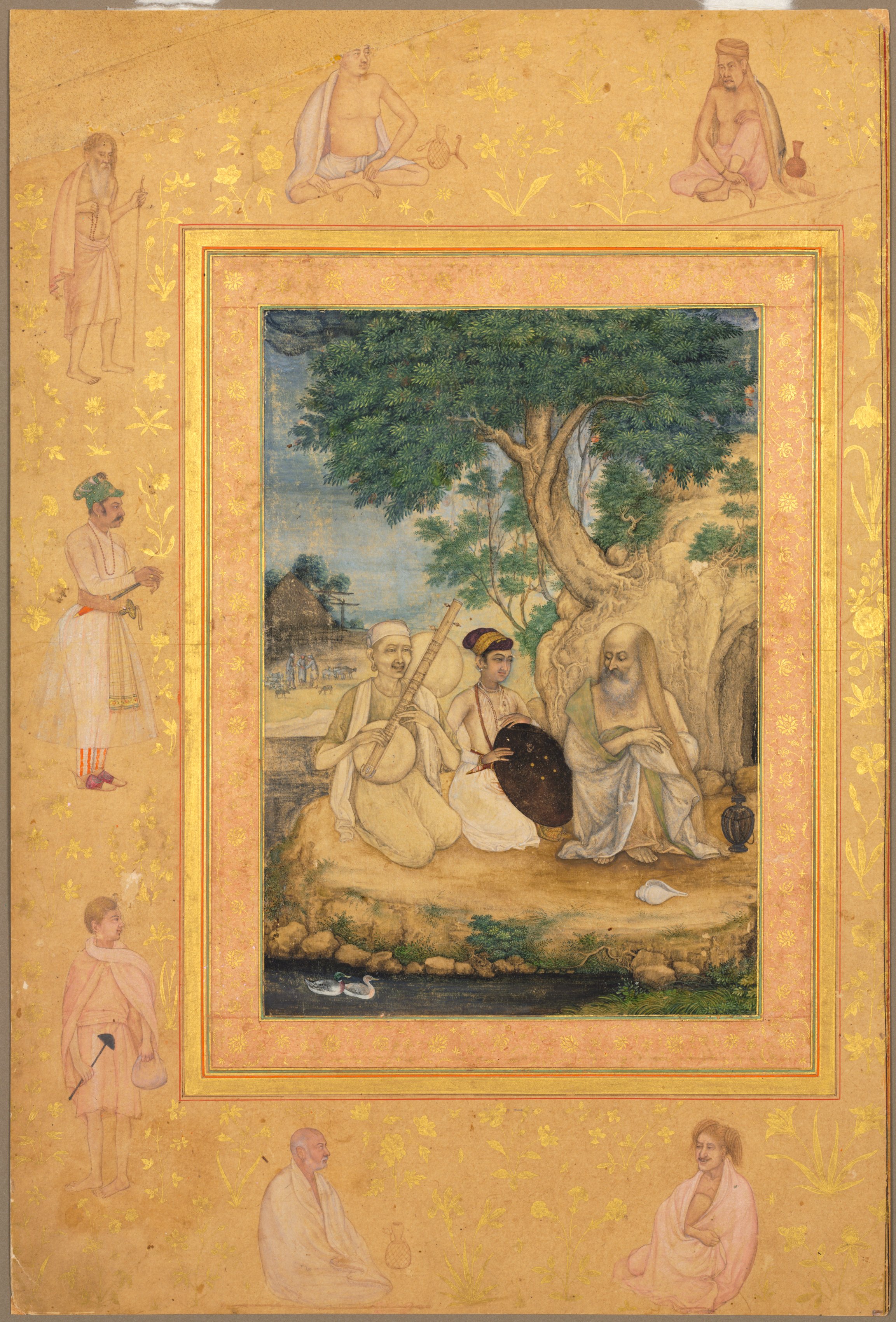
Prince and ascetics, from the Late Shah Jahan Album
From the Late Shah Jahan Album, in which older finished paintings were mounted alongside new ones. A prince sits with ascetics in a garden, a subject that lets the painter set courtly dress against the bare bodies of renunciates.
2305 × 3400 px · Unmodified source file
Open in StudioSource & licensing
- Creator / date
- Govardhan (Indian, active c.1596–1645) · c. 1630
- Source credit
- The Cleveland Museum of Art, 1971.79. Open Access.
- Usage notes
- Released by the Cleveland Museum of Art under CC0 1.0. Credit to the museum is encouraged; CC0 does not imply endorsement.
- Original file
- 2305 × 3400 px · JPG · 0.0 MB
- Source checked
- 2026-11-04 · editorial approval separate
CC0 · Public domain · c. 1600
Portrait of Suraj Singh Rathor, Raja of Marwar and Maternal Uncle of Shah Jahan: A Page from the Prince Khurram Album
Suraj Singh Rathor, raja of Marwar and maternal uncle of Shah Jahan, painted about 1600. The likeness is true to life and the clothing detailed enough to read as a record of what a Rajput nobleman wore at the Mughal court.
1597 × 3400 px · Unmodified source file
Open in StudioSource & licensing
- Creator / date
- Bishandas (Indian, active c. 1610–30) · c. 1600
- Source credit
- The Cleveland Museum of Art, 2013.313. Open Access.
- Usage notes
- Released by the Cleveland Museum of Art under CC0 1.0. Credit to the museum is encouraged; CC0 does not imply endorsement.
- Original file
- 1597 × 3400 px · JPG · 0.0 MB
- Source checked
- 2026-11-04 · editorial approval separate
CC0 · Public domain · c. 1590
Mughal ruler Humayun defeating the Afghans before reconquering India, folio from an Akbar-nama (Book of Akbar) of Abu’l Fazl (Indian, 1551–1602)
Humayun reconquers northern India from the Afghans in 1555 with Iranian military help, painted about 1590 for an Akbar-period history. The fighting spreads across a plain that rises into coloured hills.
2247 × 3400 px · Unmodified source file
Open in StudioSource & licensing
- Creator / date
- Mughal India, court of Akbar (reigned 1556–1605), maker unknown · c. 1590
- Source credit
- The Cleveland Museum of Art, 1971.77. Open Access.
- Usage notes
- Released by the Cleveland Museum of Art under CC0 1.0. Credit to the museum is encouraged; CC0 does not imply endorsement.
- Original file
- 2247 × 3400 px · JPG · 0.0 MB
- Source checked
- 2026-11-04 · editorial approval separate
CC0 · Public domain · c. 1595; borders added probably 1800s
A pair of Brahminy ducks
A pair of Brahminy ducks, also called ruddy shelducks, painted about 1595 with the orange plumage noted accurately. Studies of this kind were kept in albums as records of the natural world.
2112 × 3400 px · Unmodified source file
Open in StudioSource & licensing
- Creator / date
- India, Mughal, 16th century, maker unknown · c. 1595; borders added probably 1800s
- Source credit
- The Cleveland Museum of Art, 2013.299. Open Access.
- Usage notes
- Released by the Cleveland Museum of Art under CC0 1.0. Credit to the museum is encouraged; CC0 does not imply endorsement.
- Original file
- 2112 × 3400 px · JPG · 0.0 MB
- Source checked
- 2026-11-04 · editorial approval separate
CC0 · Public domain · 1764
Posthumous portrait of the Mughal emperor Muhammad Shah (reigned 1719–1748) holding a falcon (recto); Calligraphy (verso)
A posthumous portrait of Muhammad Shah, who reigned from 1719 to 1748 and was known as Rangila, the Colourful, painted in 1764. A black background sets off the figure while the halo and carpet do the work of rank.
3400 × 2303 px · Unmodified source file
Open in StudioSource & licensing
- Creator / date
- Muhammad Rizavi Hindi (Indian, active mid-1700s); Mahmud ibn Ishaq al-Shahabi (Persian, active mid- to late 1500s) · 1764
- Source credit
- The Cleveland Museum of Art, 2013.347. Open Access.
- Usage notes
- Released by the Cleveland Museum of Art under CC0 1.0. Credit to the museum is encouraged; CC0 does not imply endorsement.
- Original file
- 3400 × 2303 px · JPG · 0.0 MB
- Source checked
- 2026-11-04 · editorial approval separate
CC0 · Public domain · 1602–4
Angels bring food to Jesus in the wilderness (folio 55 recto), from a Mirror of Holiness (Mir’at al-quds) of Father Jerome Xavier
From a Mirror of Holiness made for Prince Salim at Allahabad in 1602–04: five angels bring Jesus bread, melons, leeks and fruit to end his forty-day fast. A Christian text illustrated by Mughal painters in the idiom of their Persian manuscripts.
1920 × 3400 px · Unmodified source file
Open in StudioSource & licensing
- Creator / date
- Muhammad Sharif (Indian, active c. 1600) · 1602–4
- Source credit
- The Cleveland Museum of Art, 2005.145.55.a. Open Access.
- Usage notes
- Released by the Cleveland Museum of Art under CC0 1.0. Credit to the museum is encouraged; CC0 does not imply endorsement.
- Original file
- 1920 × 3400 px · JPG · 0.0 MB
- Source checked
- 2026-11-04 · editorial approval separate
CC0 · Public domain · 1522–37
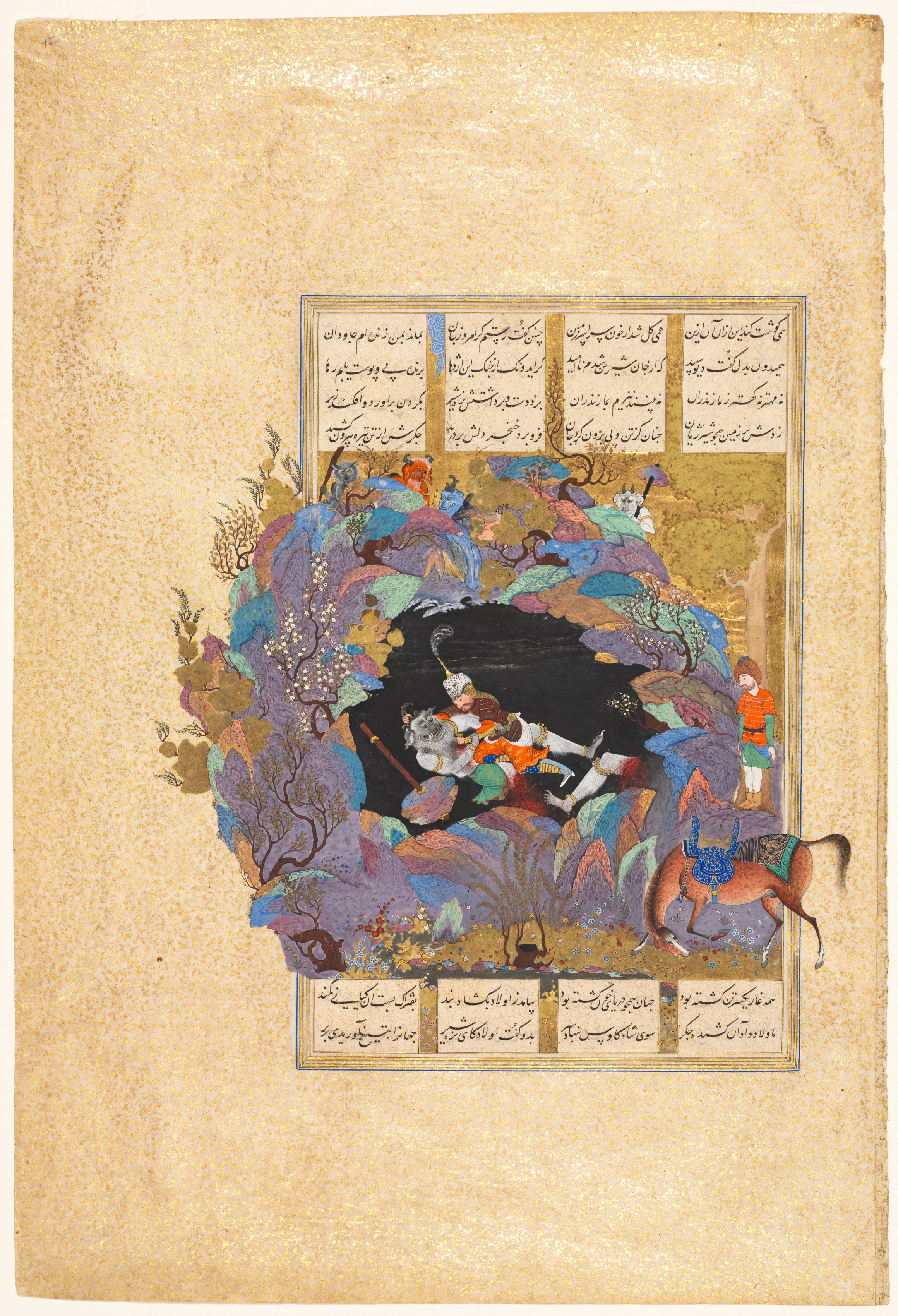
Rustam's seventh course: He kills the White Div, folio 124 from a Shah-nama (Book of Kings) of Firdausi (Persian, about 934–1020)
Rustam kills the White Div to take the demon’s liver blood needed to cure his king’s blindness, folio 124 of a Shah-nama made at Tabriz between 1522 and 1537. The combat fills the page, Rustam’s weight thrown against the demon.
2320 × 3400 px · Unmodified source file
Open in StudioSource & licensing
- Creator / date
- Abd al-Vahhab (Persian, active about 1516); Mir Musavvir (Iranian, c. 1510–1555) · 1522–37
- Source credit
- The Cleveland Museum of Art, 1988.96.a. Open Access.
- Usage notes
- Released by the Cleveland Museum of Art under CC0 1.0. Credit to the museum is encouraged; CC0 does not imply endorsement.
- Original file
- 2320 × 3400 px · JPG · 0.0 MB
- Source checked
- 2026-11-04 · editorial approval separate
CC0 · Public domain · 1444
Royal Reception in a Landscape, left folio from the double frontispiece of a Shahnama (Book of Kings) of Firdausi (Persian, about 940–1019 or 1025)
One half of a double-page frontispiece from a Shahnama copied at Shiraz in 1444: a feast set in a green landscape of blossoming bushes under a gold sky with wisps of blue and white cloud.
2351 × 3400 px · Unmodified source file
Open in StudioSource & licensing
- Creator / date
- Iran, Shiraz, Timurid period (1370-1501), maker unknown · 1444
- Source credit
- The Cleveland Museum of Art, 1956.10. Open Access.
- Usage notes
- Released by the Cleveland Museum of Art under CC0 1.0. Credit to the museum is encouraged; CC0 does not imply endorsement.
- Original file
- 2351 × 3400 px · JPG · 0.0 MB
- Source checked
- 2026-11-04 · editorial approval separate
CC0 · Public domain · 1100s
Folio from a Qur'an
A Qur’an folio in East Persian ornamental Kufic, the script written in black, red and gold and framed by gold and blue medallions. Pages of this kind were designed to be legible across a room as well as read closely.
3400 × 2568 px · Unmodified source file
Open in StudioSource & licensing
- Creator / date
- Iran, Seljuq period (1037–1194), maker unknown · 1100s
- Source credit
- The Cleveland Museum of Art, 1933.488. Open Access.
- Usage notes
- Released by the Cleveland Museum of Art under CC0 1.0. Credit to the museum is encouraged; CC0 does not imply endorsement.
- Original file
- 3400 × 2568 px · JPG · 0.0 MB
- Source checked
- 2026-11-04 · editorial approval separate
CC0 · Public domain · c. 1475–1500; border: c. 1550
Illuminated Folio from a Gulistan (Rose Garden) of Sa'di (c. 1213–1291)
An illuminated folio from Sa’di’s Gulistan, the Rose Garden: the poetical text is framed by a border in which a lion and deer coexist peacefully in a forest, an image that may refer to the rule of a righteous king.
2174 × 3400 px · Unmodified source file
Open in StudioSource & licensing
- Creator / date
- Sultan Muhammad (Iranian); Sultan 'Ali al-Mashadi (Iranian, 1430–1520) · c. 1475–1500; border: c. 1550
- Source credit
- The Cleveland Museum of Art, 2006.148. Open Access.
- Usage notes
- Released by the Cleveland Museum of Art under CC0 1.0. Credit to the museum is encouraged; CC0 does not imply endorsement.
- Original file
- 2174 × 3400 px · JPG · 0.0 MB
- Source checked
- 2026-11-04 · editorial approval separate
CC0 · Public domain · c. 1485
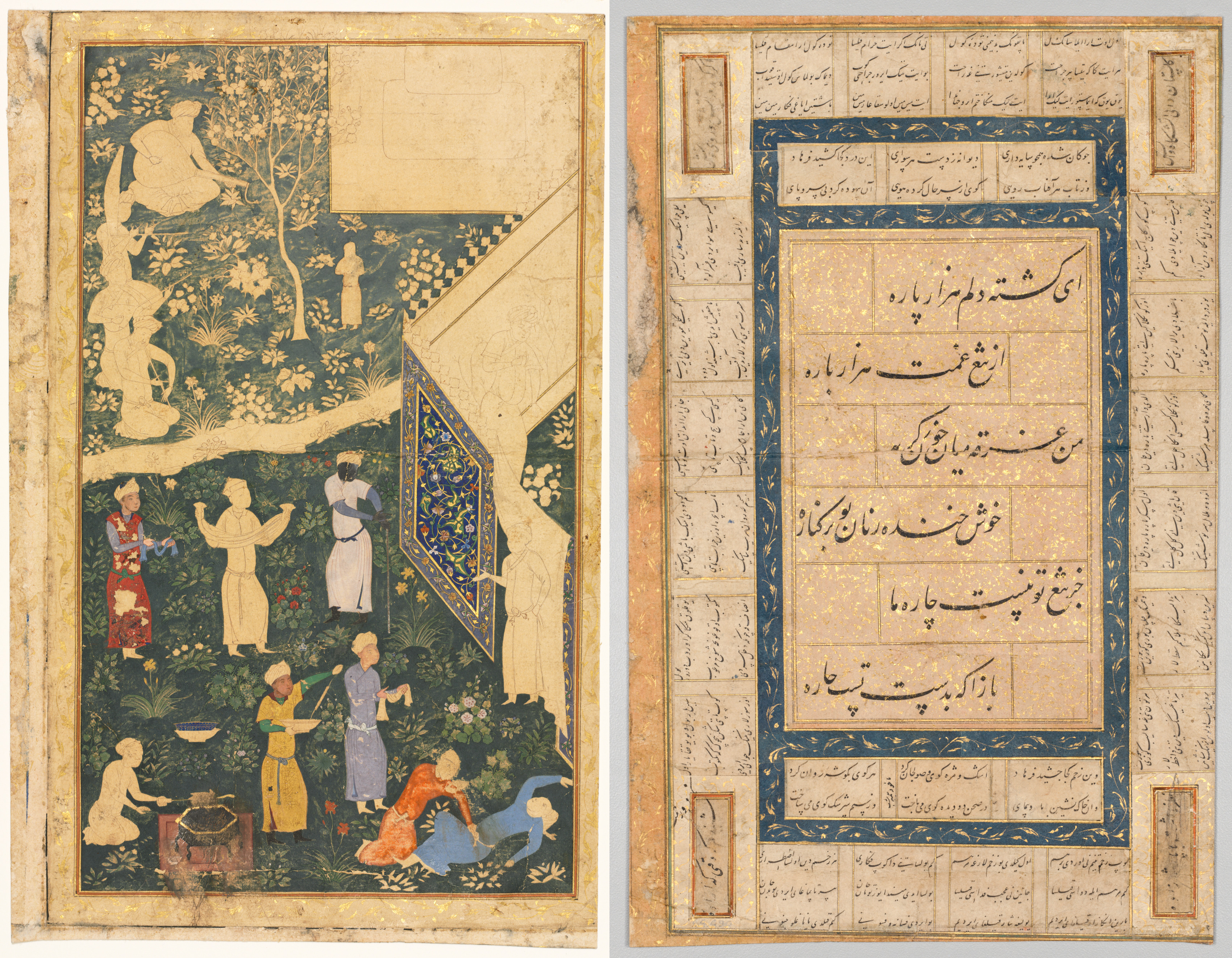
Left side of a double-page album folio: Outside a Royal Encampment (recto) and Calligraphy, Persian Verses (verso)
The left half of a Timurid album page made about 1485: a royal encampment outside, with musicians at the upper left, a cook working over a brazier, and a servant in attendance.
3400 × 2644 px · Unmodified source file
Open in StudioSource & licensing
- Creator / date
- Bihzad (Iranian, active 1470–1506) · c. 1485
- Source credit
- The Cleveland Museum of Art, 1944.490. Open Access.
- Usage notes
- Released by the Cleveland Museum of Art under CC0 1.0. Credit to the museum is encouraged; CC0 does not imply endorsement.
- Original file
- 3400 × 2644 px · JPG · 0.0 MB
- Source checked
- 2026-11-04 · editorial approval separate
Public-domain status is reported by the linked source and may vary by jurisdiction. Check the source record for your intended use. No exclusive rights or Visual Bounty marketplace license are offered for these images.